
With inflation set to stay high for years, investors should brace their portfolios for continuing supply and demand shocks. Australian annual inflation reached 7.3% in the September 2022 quarter. An interest rate rise could cool demand, but it could do little to restore disrupted energy supplies or bring workers back into the labour force.
By Max Riaz, an investment manager and director at Banyantree Investment Group, with responsibilities across equity and multi-asset strategies.
First published in Money Magazine, December 2022/January 2023.

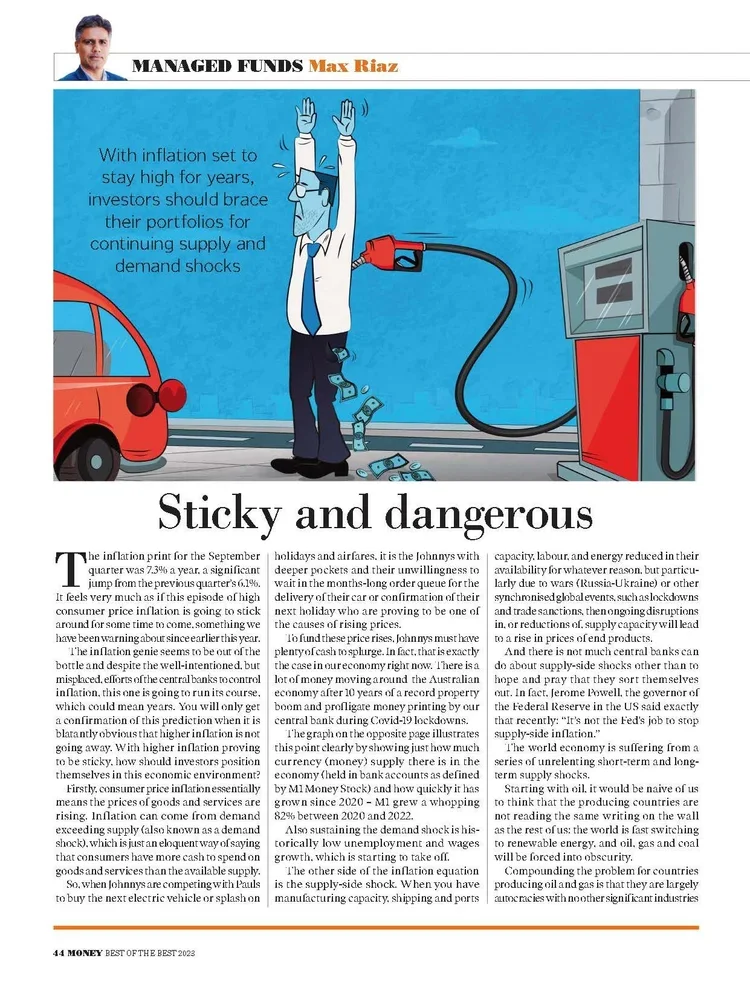
With inflation set to stay high for years, investors should brace their portfolios for continuing supply and demand shocks
The inflation print for the September quarter was 7.3% a year, a significant jump from the previous quarter’s 6.1%. It feels very much as if this episode of high consumer price inflation is going to stick around for some time to come, something we have been warning about since earlier this year.
The inflation genie seems to be out of the bottle and despite the well-intentioned, but misplaced, efforts of the central banks to control inflation, this one is going to run its course, which could mean years. You will only get a confirmation of this prediction when it is blatantly obvious that higher inflation is not going away. With higher inflation proving to be sticky, how should investors position themselves in this economic environment?
Firstly, consumer price inflation essentially means the prices of goods and services are rising. Inflation can come from demand exceeding supply (also known as a demand shock), which is just an elegant way of saying that consumers have more cash to spend on goods and services than the available supply.
So, when Johnnys are competing with Pauls to buy the next electric vehicle or splash on holidays and airfares, it is the Johnnys with deeper pockets and their unwillingness to wait in the months-long order queue for the delivery of their car or confirmation of their next holiday who are proving to be one of the causes of rising prices.
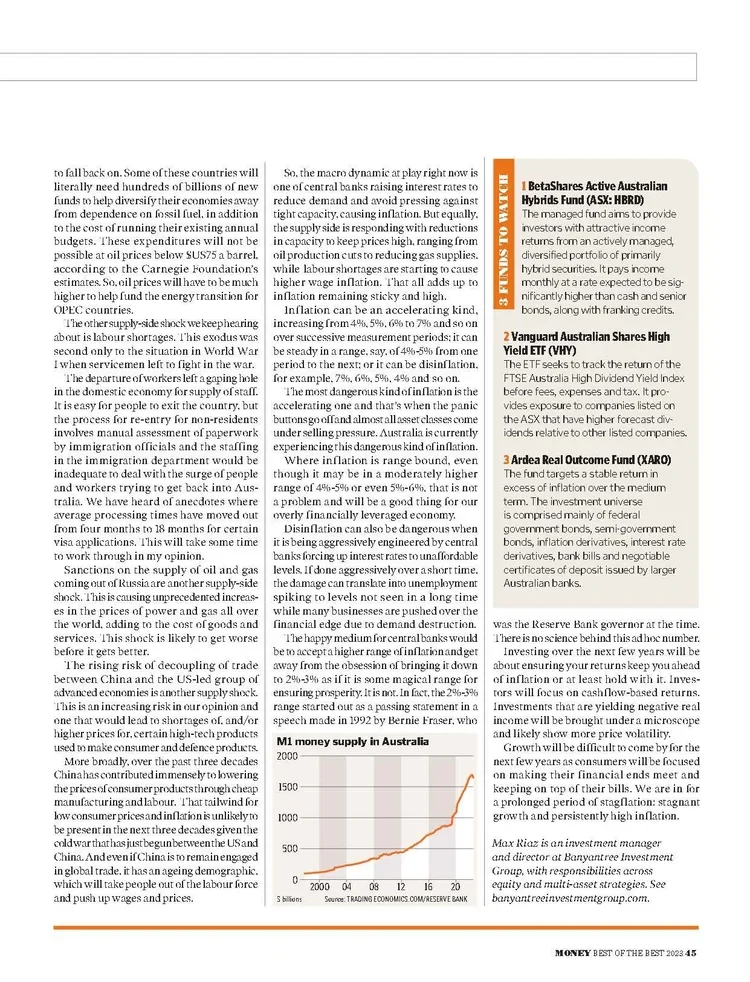
To fund these price rises, Johnnys must have plenty of cash to splurge. In fact, that is exactly the case in our economy right now. There is a lot of money moving around the Australian economy after 10 years of a record property boom and profligate money printing by our central bank during Covid-19 lockdowns. The graph on the opposite page illustrates this point clearly by showing just how much currency (money) supply there is in the economy (held in bank accounts as defined by M1 Money Stock) and how quickly it has grown since 2020 – M1 grew a whopping 82% between 2020 and 2022.
Also sustaining the demand shock is historically low unemployment and wages growth, which is starting to take off.
The other side of the inflation equation is the supply-side shock. When you have manufacturing capacity, shipping and ports capacity, labour, and energy reduced in their availability for whatever reason, but particularly due to wars (Russia-Ukraine) or other synchronised global events, such as lockdowns and trade sanctions, then ongoing disruptions in, or reductions of, supply capacity will lead to a rise in prices of end products.
And there is not much central banks can do about supply-side shocks other than to hope and pray that they sort themselves out. In fact, Jerome Powell, the governor of the Federal Reserve in the US said exactly that recently: “It’s not the Fed’s job to stop supply-side inflation.”
The world economy is suffering from a series of unrelenting short-term and long-term supply shocks.
Starting with oil, it would be naïve of us to think that the producing countries are not reading the same writing on the wall as the rest of us: the world is fast switching to renewable energy, and oil, gas and coal will be forced into obscurity.
Compounding the problem for countries producing oil and gas is that they are largely autocracies with no other significant industries to fall back on. Some of these countries will literally need hundreds of billions of new funds to help diversify their economies away from dependence on fossil fuel, in addition to the cost of running their existing annual budgets. These expenditures will not be possible at oil prices below $US75 a barrel, according to the Carnegie Foundation’s estimates. So, oil prices will have to be much higher to help fund the energy transition for OPEC countries.
The other supply-side shock we keep hearing about is labour shortages. This exodus was second only to the situation in World War I when servicemen left to fight in the war.
The departure of workers left a gaping hole in the domestic economy for supply of staff. It is easy for people to exit the country, but the process for re-entry for non-residents involves manual assessment of paperwork by immigration officials and the staffing in the immigration department would be inadequate to deal with the surge of people and workers trying to get back into Australia. We have heard of anecdotes where average processing times have moved out from four months to 18 months for certain visa applications. This will take some time to work through in my opinion.
Sanctions on the supply of oil and gas coming out of Russia are another supply-side shock. This is causing unprecedented increases in the prices of power and gas all over the world, adding to the cost of goods and services. This shock is likely to get worse before it gets better.
The rising risk of decoupling of trade between China and the US-led group of advanced economies is another supply shock. This is an increasing risk in our opinion and one that would lead to shortages of, and/or higher prices for, certain high-tech products used to make consumer and defence products.
More broadly, over the past three decades China has contributed immensely to lowering the prices of consumer products through cheap manufacturing and labour. That tailwind for low consumer prices and inflation is unlikely to be present in the next three decades given the cold war that has just begun between the US and China. And even if China is to remain engaged in global trade, it has an ageing demographic, which will take people out of the labour force and push up wages and prices.
So, the macro dynamic at play right now is one of central banks raising interest rates to reduce demand and avoid pressing against tight capacity, causing inflation. But equally, the supply side is responding with reductions in capacity to keep prices high, ranging from oil production cuts to reducing gas supplies, while labour shortages are starting to cause higher wage inflation. That all adds up to inflation remaining sticky and high.
Inflation can be an accelerating kind, increasing from 4%, 5%, 6% to 7% and so on over successive measurement periods; it can be steady in a range, say, of 4%-5% from one period to the next; or it can be disinflation, for example, 7%, 6%, 5%, 4% and so on.
The most dangerous kind of inflation is the accelerating one and that’s when the panic buttons go off and almost all asset classes come under selling pressure. Australia is currently experiencing this dangerous kind of inflation.
Where inflation is range bound, even though it may be in a moderately higher range of 4%-5% or even 5%-6%, that is not a problem and will be a good thing for our overly financially leveraged economy.
Disinflation can also be dangerous when it is being aggressively engineered by central banks forcing up interest rates to unaffordable levels. If done aggressively over a short time, the damage can translate into unemployment spiking to levels not seen in a long time while many businesses are pushed over the financial edge due to demand destruction.
The happy medium for central banks would be to accept a higher range of inflation and get away from the obsession of bringing it down to 2%-3% as if it is some magical range for ensuring prosperity. It is not. In fact, the 2%-3% range started out as a passing statement in a speech made in 1992 by Bernie Fraser, who was the Reserve Bank governor at the time. There is no science behind this ad hoc number.
Investing over the next few years will be about ensuring your returns keep you ahead of inflation or at least hold with it. Investors will focus on cashflow-based returns. Investments that are yielding negative real income will be brought under a microscope and likely show more price volatility.
Growth will be difficult to come by for the next few years as consumers will be focused on making their financial ends meet and keeping on top of their bills. We are in for a prolonged period of stagflation: stagnant growth and persistently high inflation.
3 funds to watch
BetaShares Active Australian Hybrids Fund (ASX: HBRD)
The managed fund aims to provide investors with attractive income returns from an actively managed, diversified portfolio of primarily hybrid securities. It pays income monthly at a rate expected to be significantly higher than cash and senior bonds, along with franking credits.
Vanguard Australian Shares High Yield ETF (VHY)
The ETF seeks to track the return of the FTSE Australia High Dividend Yield Index before fees, expenses and tax. It provides exposure to companies listed on the ASX that have higher forecast dividends relative to other listed companies.
Ardea Real Outcome Fund (XARO)
The fund targets a stable return in excess of inflation over the medium term. The investment universe is comprised mainly of federal government bonds, semi-government bonds, inflation derivatives, interest rate derivatives, bank bills and negotiable certificates of deposit issued by larger Australian banks.
