
In March 2026 few oil producers looked better insured against a closed Strait of Hormuz than Saudi Arabia. Its Asian customers were offered one crude, at one port, and less of it. Following those barrels shows which protections pay out when an exit closes, and to whom.
By the team at Banyantree Investment Group
Provenance: Developed from questions first raised in Banyantree's Monthly Investment Letter of 2 March 2026.
On Monday 9 March 2026, Saudi Arabia set a record. Nine days earlier the United States and Israel had begun striking Iran, and tanker traffic through the Strait of Hormuz had all but stopped. That Monday the kingdom's western ports, on the Red Sea, exported oil at a rate of 5.9m barrels a day, by the International Energy Agency's count. In 2025 they had averaged 1.7m.¹
The same day brought other news. Saudi Arabia said it was curbing production of its heavier offshore crudes.¹And traders told Reuters that Saudi Aramco had done something it rarely does: it had put crude up for tender. On offer were 2m barrels of Arab Heavy for loading at Ain Sokhna, on Egypt's Gulf of Suez coast, and 650,000 barrels of Arab Light from Yanbu, on the Red Sea. Three traders said Aramco had also sold 2m barrels of Arab Extra Light to Idemitsu, a Japanese refiner. Two said that oil was already aboard a ship near Taiwan.²
The next day Aramco's chief executive, Amin Nasser, called the war "the biggest crisis the region's oil and gas industry has faced". He also explained how Aramco would keep its customers supplied. The East-West pipeline, which crosses the kingdom to Yanbu, would be running at its full 7m barrels a day within a couple of days. Meanwhile storage that Aramco holds in Asia, the Mediterranean and North-West Europe was meeting most customers' needs.³
On paper few producers were better insured against a closed strait. The pipeline had been built during the Tanker War of the 1980s as a contingency against just such a closure,⁴ and before the war it ran far below capacity.⁵ The kingdom sold several grades of crude and kept stocks abroad. And it had about 1.7m barrels a day of production capacity standing idle in February, the largest figure among OPEC+ producers in the IEA's table.⁶ Idle capacity of that kind is the oil market's cushion. Analysts and investors count on it when supply is lost.
Then the routine broke. Around the tenth of each month Aramco usually tells its Asian customers how much crude they will get the following month. In March the tenth passed with April unsettled. On 11 March, sources told Reuters, buyers were asked for two sets of April loading plans: one for Ras Tanura, the main export terminal on the Gulf, and one for Yanbu, in case the strait stayed shut. The Yanbu plan applied only to Arab Light.⁷ By 23 March one plan was left. Asian term customers would get less oil in April, three sources said, all of it Arab Light, all of it from Yanbu. Aramco said it was using alternative routes. It did not mention the grade.⁸
The kingdom had insured itself four ways: a route around the strait, several grades, stocks abroad and a large cushion of idle capacity. Its customers were offered one crude, at one port, and less of it. While the strait stayed shut, what was all that insurance worth, and to whom?
A way around
A pipeline protects only the oil that can reach it. The UAE showed within a week how much that matters. Its bypass, the Abu Dhabi Crude Oil Pipeline, runs from onshore facilities at Habshan to Fujairah, on the Gulf of Oman beyond the strait. It can carry about 1.8m barrels a day and before the war carried about 1.1m.⁹ In the first ten days of March it averaged 1.8m. It was full, and the offshore fields, which had limited storage and, in the IEA's words, "no connection to the ADCOP pipeline", were being shut in.¹⁰ By mid-March, sources told Reuters, all offshore output was offline and national production was down by more than half.¹¹
Two different things had decided the outcome: connection decided which fields kept an outlet, and the size of the line capped how much oil could leave. Had every offshore field been tied in, the same full pipe would have carried different oil. Such a connection is valuable to the owner of the field it reaches. To the market, while the line is full, it adds nothing.
Saudi Arabia's line had room to spare. Designed for 5m barrels a day, it had been raised to 7m, Aramco reported in 2025, though the IEA noted that sustained flows at that rate were untested. Before the war it carried about 2m.⁵ The record of 9 March was a single day's rate, and it took weeks for sustained flows to approach it. Yanbu's crude exports, about 0.77m barrels a day in January and February, were close to 4m in the week from 16 March. By 28 and 29 March Bloomberg and Argus, each citing unnamed sources, reported the line full. By Argus's account about 5m barrels a day of crude was leaving Yanbu, and a further 0.9m of refined products was leaving the Red Sea coast.¹² Years of carrying far less than it could were what made the line worth having.
The room filled with oil the kingdom was already producing. Saudi crude exports had averaged about 7.1m barrels a day in February.⁸ With the line at full stretch, about 5m could still reach foreign buyers. That left some 2m barrels a day of ordinary exports with no way out.¹³ The pipe had saved most of the export trade without making room for anything more, and even the saved oil had another strait ahead. Crude for Asia leaves Yanbu southwards through the Bab el-Mandeb, and on 28 March the Houthis in Yemen fired missiles at Israel for the first time in the war.¹⁴
Which crude got out
The oil had changed as well as its route. The crudes Saudi Arabia curbed on 9 March were heavier grades from offshore fields. What it sent west was mostly Arab Light, from onshore fields that could reach the line.¹ Argus, citing sources, named four fields closed: Safaniya, which produces Arab Heavy, and Zuluf, Marjan and Abu Safa, which produce Arab Medium. It linked the cuts to the threat of Iranian missile and drone attacks on the Gulf's energy infrastructure.³ Fields in the Gulf were exposed as well as stranded.
Nasser described the rest as a choice. Aramco was "putting mainly Arab Light and some extra light to the western region", he said. It was leaving some medium and heavy fields idle "because we have adequate capacity to meet our requirements". And 12m barrels a day of maximum sustained capacity gave Aramco, in his words, "a lot of optionality in terms of where we concentrate our production".³ That is what idle capacity buys when an exit is narrower than the oil behind it. It does not put more oil through the pipe. It lets the producer choose which oil fills it.
So three filters stood behind the single crude at Yanbu: which fields were safe and connected, which of their oil Aramco chose to send, and which of that it offered these buyers. Nasser's priority included Extra Light, and the April offer did not. The reports do not say how much was constraint and how much decision.
For a refiner the filters mattered as much as the volume. Unipec, the trading arm of China's Sinopec, chartered twelve supertankers to load about 24m barrels at Yanbu in March, Reuters reported on 19 March. Sinopec was still looking for the heavier grades that many of its refineries are built to run.¹⁵ A complex refinery invests in cokers, crackers and hydrotreaters partly so that it can process heavy, sour crude, which usually sells below light.¹⁶ Fed light crude instead, it keeps running but gives up part of the advantage it paid for. Securing ships and securing suitable crude had become separate tasks.
The barrels that got out also set the price for the rest. Saudi crude sold to Asia is priced against the average of Dubai and Oman quotes.¹⁷ A seller into the Dubai benchmark may deliver any of five Middle Eastern crudes, and on 2 March Platts, which publishes it, barred those that had to cross the strait. Two were left: Oman's, and Abu Dhabi's Murban loaded at Fujairah.¹⁸ On 16 March cash Dubai reached a record US$153.25 a barrel, a premium of US$56 over swaps against 90 cents in February, and traders complained of thin trading in grades that did not represent the benchmark.¹⁹ The barrels with a way out were setting the price for everyone who bought against it.
The gains of a shortage could therefore divide very unevenly, and the questions to put to a company differ on each side. Of a producer: how much of its oil reaches a working outlet? Of a refiner: can it get the crude it was built to run, and which barrels set the price it pays? A refiner could be kept supplied, pay a record price and still lose part of the margin its equipment was built to earn. Two investors with the same view of the oil price could reach opposite conclusions about the companies exposed to it.
Behind the same door
Elsewhere in the Gulf, oil with no way out stopped at the wellhead. Kuwait has no route around Hormuz and, the IEA estimated, had about fourteen days of storage when the war began. It began cutting output on 6 March. The next day Kuwait Petroleum Corporation declared force majeure, citing threats to shipping, attacks on Kuwait and an almost total absence of vessels. It called the cut precautionary and said it would restore production when conditions allowed.²⁰ Kuwait could choose when to stop. When to start again waited on ships, and the ships were not Kuwait's to call. Iraq, with a few days of storage, lost its southern exports on 28 February.²¹ By 12 March the IEA reckoned that at least 8m barrels a day of Gulf crude production was being curtailed as tanks filled.²² A closed exit travels backwards, from the strait to the tanks to the wells.
That is where the cushion sat. Of the 3.9m barrels a day of spare capacity in the IEA's table for OPEC+, about 3m belonged to the four producers whose exports the closure had cut.⁶ Behind a closed exit, idle capacity adds to deliveries only if a route has room beyond the oil already using it and the oil diverted onto it. Short of that, it changes whose oil leaves, not how much.²³ Kuwait's share had no route, and Iraq's no working route from the south. The UAE's could only change which crude filled a full pipe. Saudi Arabia's 1.7m, the largest, stood behind some 2m barrels a day of its own stranded exports. It bought the choice Nasser described, not a larger flow. The arithmetic was visible before the war began.
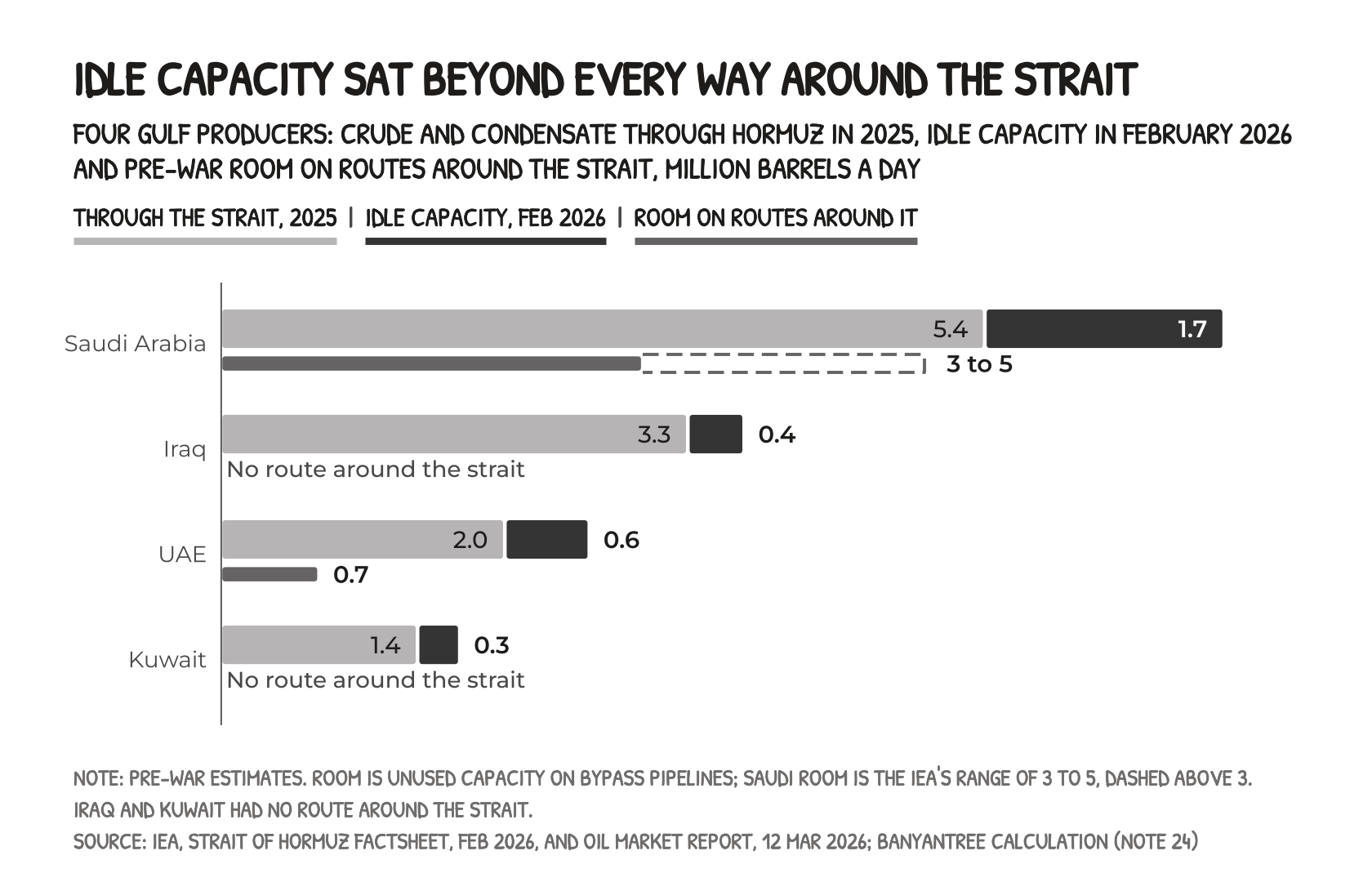
Figure 1. Idle capacity sat beyond every way around the strait. For each producer the oil that normally crossed Hormuz exceeded the pre-war room on routes around it, even at the top of the IEA's range for Saudi Arabia. Idle capacity could reach buyers only in place of oil that already needed the route. These are pre-war estimates; March flows differed.²⁴
A cushion of idle wells is built for a different accident. In September 2019 attacks on Abqaiq and Khurais cut Aramco's lighter crudes. It kept customers supplied partly from stocks abroad and by switching deliveries to Arabian Medium and Arabian Heavy, as its annual report recalled on 10 March.²⁵ The ports were working, so other grades could stand in. When a closure takes the exit and leaves the wells, idle capacity waits behind the same door as the oil it was meant to replace. The IEA had warned in February that a prolonged disruption could make the vast majority of the world's spare capacity unavailable.⁵ Credit investors call the structure wrong-way risk: protection written by a counterparty whose ability to pay falls in the very event it insures. The question to ask of any buffer, in oil or outside it, is whether the event that calls on it also puts it out of reach.
The cushion on paper
The cushion's published size behaves strangely in such a month. Spare capacity is capacity less output. A barrel shut in behind a closed strait lowers output and, unless someone also lowers capacity, raises spare capacity by a barrel: the more oil a closure strands, the larger the cushion appears. The US Energy Information Administration had drawn its line in December 2025. It takes disruptions, which it attributes to events beyond a producer's control "such as wars", off capacity first. Spare is what remains held back by agreement. Voluntary cutbacks are not disruptions, it explained, "because they can be reversed at any time".²⁶ Kuwait's could not be.
The EIA's outlooks show the rule at work. In February it expected OPEC's Middle Eastern members, Iran among them, to hold about 3.7m barrels a day of spare capacity through 2026. Its March outlook, finished on 9 March, cut its forecast of their output in the second quarter by about 2.2m barrels a day. Had it left capacity alone, the cushion would have swollen to about 5.8m. Instead it cut capacity by more than output, and the cushion shrank to 3.0m. The shrinkage outlasted the shut-ins. Output was forecast back on February's path by the end of 2026, yet the cushion stayed about 0.7m lower, nearly a fifth, in every quarter to the end of 2027.²⁷ The EIA did not say why, or which members would bear it. Either way, it expected the Gulf to leave the war with a smaller cushion than it took in, held by the same producers behind the same strait.
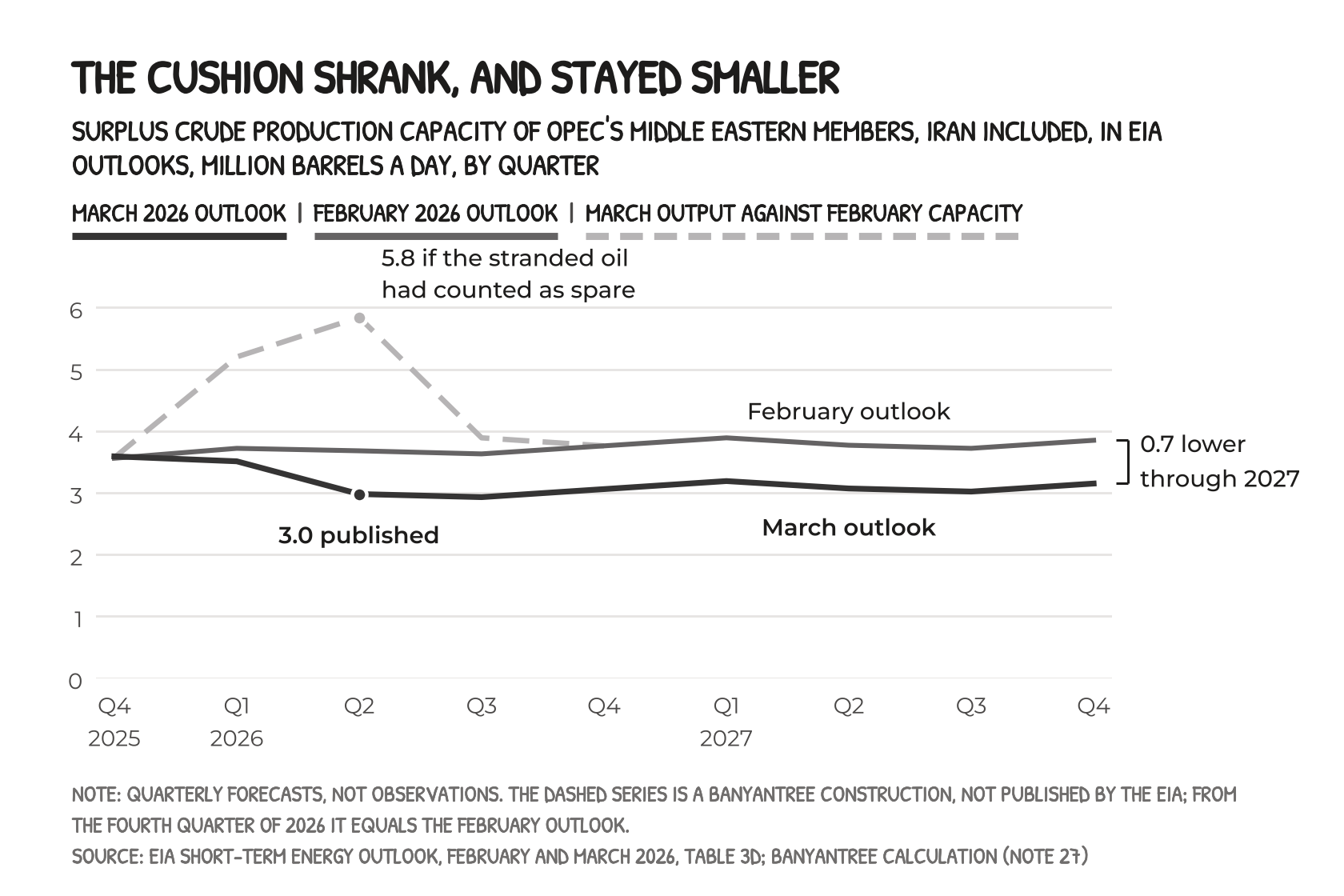
Figure 2. The cushion shrank, and stayed smaller. Spare capacity of OPEC's Middle Eastern members, Iran included, in the EIA's February and March 2026 outlooks. The dashed line sets March's forecast of output against February's capacity. The cushion stays about 0.7m barrels a day below February's path through 2027. All three series are forecasts, not observations.²⁷
The same tables show what to watch on the way back. Between the second and third quarters of 2026 the March outlook has capacity and output each rising by about 1.9m barrels a day, and the cushion barely moving. A flat spare-capacity figure can sit beside returning supply. In a month like March the figure records two things, the idle wells and its publisher's judgement about oil that cannot be shipped, and it means little until it is read beside the capacity figure beneath it.
Oil that had already left
The protection that worked at once was oil already beyond the strait. On 11 March the IEA's member governments agreed to make 400m barrels of emergency stocks available, Asia's share at once.²⁸ Aramco's stocks abroad were covering most of its customers' needs. They were adequate, Nasser said, "provided [the war] does not persist in the long term".³ A cargo from a tank and a cargo from a working route look the same on arrival. The route replaces what it ships. The tank does not. A supplier drawing on stocks can keep a customer whole while spending the protection it will need for the next delay, and an unbroken record of deliveries would not show the difference.
Nor is oil in a tank equally available to all who might want it. Under an arrangement dating from 2010, Japan's energy-security agency, JOGMEC, rents thirteen tanks at a terminal on Okinawa, room for about 8.2m barrels. It lends them free of charge to Aramco, which uses them as a hub for sales in Asia. The condition, renewed for three years in November 2025, is that in an emergency Aramco supplies the oil to Japan with priority.²⁹ Japan has similar arrangements with the national oil companies of Abu Dhabi and Kuwait.³⁰
On 26 March Japan began releasing oil from its national reserves and from the joint stocks, of which its wholesalers were to buy about five days' worth from the producers' companies.³¹ The next day the industry minister, Ryosei Akazawa, was asked how Japan would answer Southeast Asian countries seeking help. Oil from the national reserves, he said, would in principle go to Japan's own refiners. For the joint stocks, "the case may be different", and decisions would be made case by case.³² Japan had paid in advance for first call on oil that sat on its side of the strait. Whether anyone else would share it was, by its minister's account, for Tokyo to weigh. Aramco's other customers had Nasser's word that storage abroad would cover them. Japan had a contract. That is the difference between a supplier's assurance and a buyer's right.
Read again, the news of 9 March already showed the order. The record shipments from the Red Sea were the route at work. The heavier offshore crude being curbed was oil the route would not take. And the tender sorted Aramco's barrels in the order a closed strait sorts them. The Extra Light sold to Idemitsu was already at sea, and the Arab Heavy was offered at Ain Sokhna, beyond Hormuz on any route. The Arab Light came from Yanbu, at the end of the one line around the strait. None of it called on idle capacity.
By the end of the month the April offer had explained itself. One port, because the kingdom's only way around the strait ran to Yanbu. One crude, because Aramco filled a full line with light oil and chose what to offer. Less of it, because the line was already carrying oil the kingdom had exported before the war. While a strait stays shut, the barrels that go first are those already beyond it. Next come those from fields with a working way around it, chosen by grade. Only then, if a route has room left, comes the idle capacity in the tables. Of the kingdom's four kinds of insurance, the one that paid out at once was the oil that had already left.
General information only. Not personal advice. Past performance is not indicative of future performance. Examples are illustrative. Banyantree may hold securities or funds discussed in this essay in client portfolios. This material is intended for wholesale and professional investors.
Notes
1. International Energy Agency (IEA), Oil Market Report, 12 March 2026, dated PDF. P. 3: tanker movements through the strait had come to a near halt. P. 18: "On 9 March, Saudi hit a record daily export from its western ports of 5.9 mb/d", against average exports of 1.7 mb/d in 2025; the report does not say whether the figure covers crude only or all oil. It is a single day's rate and is not comparable with the weekly crude loadings or the pipeline capacities in notes 5 and 12; Argus (note 4) later put Yanbu's crude exports at about 5 million barrels a day and Red Sea product exports at a further 900,000. Same page: Saudi Arabia announced on 9 March that it was curbing production of its heavier offshore grades and transitioning more production to "lighter onshore grades that can be sent by pipeline to western ports"; Aramco was routing flows of mostly Arab Light through the East-West pipeline to Yanbu. Reuters, "OPEC+ agrees modest oil output boost", report of 1 March 2026 (Business Recorder edition, 2 March 2026), opening and shipping paragraphs: the US-Israeli war on Iran; shipments through Hormuz had halted since Saturday 28 February, after shipowners received an Iranian warning that the area was closed. Banyantree calculation: 28 February to 9 March 2026 is nine days. Whether particular medium or heavy fields lacked any connection to the East-West line is not established by these reports.
2. Reuters, Siyi Liu, "Saudi Aramco offers oil in rare tenders as Iran war disrupts exports, traders say", 9 March 2026 (Zawya edition; also published as "Saudi Aramco offers millions of crude barrels in rare tenders", Baird Maritime edition): according to traders, offers of 2 million barrels of Arab Heavy, free on board and destined for Asia, for loading at Ain Sokhna, Egypt, between 10 and 30 March, and 650,000 barrels of Arab Light on a cost-and-freight basis from Yanbu; three traders said Aramco had sold 2 million barrels of Arab Extra Light to Idemitsu Kosan, Japan's second-largest refiner, and two of them said the cargo was already on a vessel near Taiwan. The Zawya edition reports that both companies declined to comment. Neither edition says where the Arab Heavy was stored or how it reached Egypt, or when the tenders were issued; Ain Sokhna lies on Egypt's Gulf of Suez coast, beyond Hormuz on any route. The Idemitsu vessel, its loading date and its route were not reported, and nothing links the cargo to the storage arrangements in notes 29 and 30.
3. Remarks by Amin Nasser on Aramco's results call, 10 March 2026, in two trade-press reports. S&P Global Commodity Insights, "Aramco's East-West pipeline to hit full capacity in 'next couple of days': CEO", 10 March 2026 (spglobal.com; Hellenic Shipping News edition, 12 March): the war was "the biggest crisis the region's oil and gas industry has faced"; the 7 million barrel a day line would reach full capacity in the next couple of days; most customer requirements were being met from Aramco's storage in Asia, the Mediterranean and North-West Europe; "We have 12 million b/d of maximum sustained capacity. That gives us a lot of optionality in terms of where we concentrate our production"; the company had adequate inventories to maintain flows "provided [the war] does not persist in the long term" (brackets in the original). Argus, Nader Itayim, "Aramco says prolonged Hormuz halt would be catastrophic", 10 March 2026: "We are putting mainly Arab Light and some extra light to the western region. Certain areas where we have medium and heavy we are not utilising for the time being because we have adequate capacity to meet our requirements"; according to sources, Aramco had closed the Safaniya, Marjan, Zuluf and Abu Safa fields, an estimated reduction of 2 million to 2.5 million barrels a day; Safaniya produces Arab Heavy, and Zuluf, Marjan and Abu Safa produce Arab Medium; Argus links the cuts to security threats from Iranian missile and drone attacks on Gulf energy infrastructure; Nasser did not confirm the figures or identify the fields. The remarks have not been checked against a recording of the call.
4. Argus, Bachar Halabi, "Saudi East-West pipeline maxed out on Hormuz closure", 29 March 2026: the line was developed during the Tanker War of the 1980s as a contingency against a closure of Hormuz; sources said that over recent days it had moved around 7 million barrels a day, about 2 million of it to domestic Red Sea facilities, and that crude exports via Yanbu had reached around 5 million barrels a day, with a further 900,000 barrels a day of refined products shipped from the Red Sea; Saudi Arabia exported around 7.1 million barrels a day of crude in February; Houthi forces launched missiles at Israel on 28 March. These are attributed recent operating rates, not a certified sustainable capacity.
5. IEA, Strait of Hormuz Factsheet, February 2026 (CC BY 4.0; flow data are IEA analysis based on Kpler). P. 2: 2025 crude and condensate through the strait by origin, million barrels a day: Saudi Arabia 5.43, Iraq 3.32, UAE 2.02, Kuwait 1.40, within a total of 14.95. P. 4: an estimated 3.5 to 5.5 million barrels a day of available capacity on alternative routes through Saudi Arabia and the UAE, with the logistics of rerouting large flows not robustly tested; no alternative route listed for Kuwait or Iraq; East-West pipeline design capacity 5 million barrels a day, an increase to 7 million reported by Aramco in March 2025, sustained flows not tested at that level, about 2 million in use. P. 2, "Oil", and p. 4, "Potential market impact": a prolonged disruption could render unavailable the vast majority of the world's spare production capacity. Banyantree calculation: room on the East-West line before the war, 5 − 2 = 3 to 7 − 2 = 5 million barrels a day. The factsheet's day of publication is not printed.
6. IEA, Oil Market Report, 12 March 2026, dated PDF, p. 22, OPEC+ crude oil production table (excluding condensates), February supply, sustainable capacity and effective spare capacity against February, million barrels a day: Saudi Arabia 10.40, 12.1, 1.7; UAE 3.64, 4.3, 0.6; Iraq 4.50, 4.9, 0.4; Kuwait 2.54, 2.9, 0.3; total OPEC+ 43.07, 48.0, 3.9. Saudi Arabia's 1.7 is the largest entry. Footnote 2: capacity levels "can be reached within 90 days and sustained for an extended period". Banyantree calculation: 1.7 + 0.6 + 0.4 + 0.3 = 3.0, or 77% of 3.9. The IEA's online version of the table shows the same four country values to two decimal places (1.71, 0.64, 0.36, 0.34); this essay uses the dated PDF throughout.
7. Reuters, Siyi Liu and Nidhi Verma, 11 March 2026, in two versions. Earlier version, "Aramco asks buyers for dual loading nominations amid Hormuz crisis, sources say" (Deccan Herald and Zawya editions; Baird Maritime edition as "Aramco seeks dual port loading plans for April crude cargoes"): according to sources, Aramco asked buyers in Asia for April loading plans for both Ras Tanura and Yanbu; the Yanbu option applied only to purchases of Arab Light; the nomination deadline had been extended to Friday, 13 March; Asian allocations are typically released around the tenth of each month and are watched by traders as a gauge of demand. Updated version, "Saudi Aramco seeks dual Gulf, Red Sea buyer plans amid Iran crisis, sources say" (MarketScreener edition): buyers were asked to decide by Friday how much crude they wanted to load at Yanbu in April in case the Strait of Hormuz remained blocked; Aramco declined to comment. These are source-based reports; no reason for the Arab Light restriction was reported.
8. Reuters, Florence Tan and Siyi Liu, "Saudi Aramco cuts oil supply to Asia for second month in April", 23 March 2026, updated version of 24 March citing three sources (Profit edition), opening, company-response and Kpler paragraphs: reduced April volumes for Asian term customers, supplied only with Arab Light from Yanbu; Aramco said it was using alternative routes through Yanbu and had adjusted loading schedules, without addressing the grade. The same report put Saudi crude exports at 7.108 million barrels a day in February, citing Kpler data. April deliveries were prospective at the cutoff.
9. ADNOC, press release on the Abu Dhabi Crude Oil Pipeline bond issue, 6 November 2017: the line runs about 406 kilometres to the Fujairah export terminal and was designed to carry 1.5 million barrels a day, and 1.8 million using drag-reducing agents. IEA, Strait of Hormuz Factsheet (note 5), p. 4: the line runs from onshore facilities at Habshan; reported current capacity close to 1.8 million barrels a day; about 1.1 million barrels a day of UAE crude exported through it; room for up to 0.7 million more.
10. IEA, Oil Market Report, 12 March 2026: p. 17, the UAE announced on 7 March that it was cutting output at its offshore fields, which exported over 1.8 million barrels a day of crude in 2025; p. 23, offshore production cut "due to limited storage capacity and no connection to the ADCOP pipeline", with ADCOP flows averaging 1.8 million barrels a day from 1 to 10 March. The statements about connection assume the line's sustainable capacity stays near 1.8 million barrels a day; they are not an engineering forecast for a redesigned network, and they do not estimate what any connection would cost or earn.
11. Reuters, "UAE crude output falls by more than half as Hormuz closure forces shut-ins", 16 March 2026 (MarketScreener and BOE Report editions): sources said all offshore production was offline and two sources said national output was down by more than half. These are source-based reports, not official production data.
12. Reuters, Ahmad Ghaddar, Jonathan Saul and Nerijus Adomaitis, "Saudi boosts Yanbu crude oil exports as it works around Hormuz halt", 24 March 2026, citing Kpler, LSEG and Clarksons data: Yanbu crude exports near 4 million barrels a day in the week starting 16 March, against an average of about 770,000 in January and February; Aramco's statement of 10 March that it could pump up to 7 million barrels a day to Yanbu, around 5 million of which could be available for export. Bloomberg, "Saudi Pipeline to Bypass Hormuz Hits 7 Million Barrel Goal", 28 March 2026 (Al Arabiya edition), citing one person familiar with the matter: the line was pumping at its full capacity of 7 million barrels a day, about 2 million of it to Saudi refineries. Argus, 29 March (note 4). Both reports rest on unnamed sources; weekly tanker-tracking estimates measure loadings, not a sustainable maximum.
13. Banyantree calculation: Saudi crude exports of 7.108 million barrels a day in February (note 8; Argus, note 4, gives about 7.1) less the about 5 million that could be exported through Yanbu with the line at 7 million (notes 4 and 12) leaves about 2.1 million barrels a day. The comparison sets a monthly national average against a stated export rate; it ignores any Saudi crude that still crossed the strait, changes in Red Sea refinery runs and sales from storage abroad, and it is not a measure of March exports.
14. Associated Press, "A Houthi missile attack on Israel stokes fears of renewed Red Sea shipping strikes", 28 March 2026 (Washington Times and WTOP editions): the Houthis fired missiles at Israel, their first attack since the war began, while Saudi Arabia was sending millions of barrels of crude a day through the Bab el-Mandeb. bne IntelliNews, "Houthi strike puts Red Sea shipping on alert as Hormuz remains shut", 29 March 2026, relaying UKMTO reporting: no new incident reports involving merchant ships in the southern Red Sea or Gulf of Aden. Neither report establishes any closure of the Bab el-Mandeb.
15. Reuters, Chen Aizhu, "China's Unipec to load 24 million barrels of Saudi oil from Yanbu in March, shipping data shows", 19 March 2026, opening paragraphs: twelve very large crude carriers chartered to load about 24 million barrels at Yanbu in March; nearly all Yanbu exports were Arab Light; Sinopec was still seeking heavier grades for refineries configured to process them. Scheduled loadings, not confirmed deliveries.
16. US Energy Information Administration (EIA), Corrina Ricker, Jeffrey Barron and Mason Hamilton, "Changing quality mix is affecting crude oil price differentials and refining decisions", Today in Energy, 21 September 2017: density and sulphur as the main quality measures; the additional processing units, such as cokers, crackers and hydrotreaters, needed to run heavy, sour crude; light crude typically priced above heavy. The general mechanism only; no margin effect is estimated for any named refinery.
17. Dow Jones Newswires, Anthony Harrup, "Saudi Arabia raises oil prices for April", 5 March 2026 (MarketScreener edition): Aramco set the official selling price for April loadings of Arab Light to Asia at US$2.50 a barrel over Oman/Dubai, up from parity in March, and raised prices for other grades sold to Asia by US$2.00 a barrel. The report is cited for the pricing basis; the differential is applied to the Oman/Dubai average over the loading month, which lay after the cutoff, and no April invoice price is implied.
18. Platts (S&P Global), subscriber note, "Platts suspends nominations of crude oil grades loading in Persian Gulf for Platts Dubai crude benchmark", 2 March 2026: sellers may not nominate Dubai, Upper Zakum, Al-Shaheen, or Murban cargoes loading from Jebel Dhanna upon convergence of Dubai partials in the Market on Close process, until further notice. Platts subscriber note, 26 August 2025, on the Murban quality premium: Dubai assessments reflect willingness to accept a cargo of Dubai or the alternative delivery of Upper Zakum, Oman, Al-Shaheen or Murban. Platts subscriber note, 20 March 2026: the negative Murban quality adjustment suspended from 20 March to maximise deliverable crude "at a time when only Murban and Oman can be declared". Reuters, "Mideast crude premiums spike on Iran war, Platts Dubai change", 6 March 2026 (MarketScreener edition): the exclusions left only Murban from Fujairah and Oman deliverable, which one trader said cut deliverable crude by about 70%. Bloomberg, "Mideast War Spurs Tweak to Oil Benchmark With Hormuz Shut Off", 20 March 2026 (Energy Connects edition): Oman's cargoes load at Mina Al Fahal.
19. Reuters, Florence Tan, Siyi Liu and Nidhi Verma, "Middle East oil benchmarks hit record highs as war cuts supply", 16 March 2026 (Business Recorder and Dawn editions; updated in later editions): cash Dubai at a record US$153.25 a barrel on 16 March for May-loading cargoes, a premium of US$56.01 to Dubai swaps against a February average of 90 cents; one trader called it "unnatural and unfair pricing because of thin trading", and another said the remaining grades, Oman and Murban, were not representative of the benchmark used to price Middle Eastern and some Russian barrels; S&P Global defended its assessment. A later edition (Profit, 18 March) reports US$157.66 and a premium of US$60.82 on 17 March. Banyantree's statement that buyers paid against these quotes is general: Middle Eastern term crude for Asia is priced against the Oman/Dubai average (note 17), and no individual contract is examined.
20. IEA, Oil Market Report, 12 March 2026: p. 17, Kuwait started reducing production on 6 March to slow the filling of its storage tanks; p. 22, Kuwait had no option to bypass Hormuz and, at the start of the war, about 14 days of storage at pre-conflict production rates. Reuters, Yousef Saba and Trixie Yap, "Kuwait declares force majeure, cuts crude oil output due to Middle East conflict", 7 March 2026: Kuwait Petroleum Corporation declared force majeure in a trade notice, citing Iranian threats to passage through the strait, attacks on Kuwait and an almost total absence of vessels. WAM, 7 March 2026, relaying KPC's statement through the Kuwait News Agency: the cuts were precautionary and production would be restored when conditions allowed. The storage estimate rests on a production-rate assumption; it does not date when Kuwait's tanks filled.
21. IEA, Oil Market Report, 12 March 2026, pp. 21 to 24, Iraq paragraphs: only a few days of crude storage; crude supply forecast to fall by 3 million barrels a day in March; the Strategic Pipeline, which could move 850,000 barrels a day north from the southern fields, needs repair. Rudaw, "Iraq to boost Kirkuk oil exports to 250,000 barrels per day via Kurdistan pipeline", 25 March 2026, citing the North Oil Company: southern shipments through Basra halted on 28 February; about 200,000 barrels a day of northern crude were moving to Ceyhan, about the line's recent pre-war volume.
22. IEA, Oil Market Report, 12 March 2026, p. 3: Gulf crude production "currently being curtailed by at least 8 mb/d", with few ships able or willing to load and domestic storage filling up. Attacks also curtailed some output (notes 3, 20 and 21).
23. The condition is Banyantree's statement of the arithmetic of a full route, not a published dispatch rule. On a line at capacity an added barrel can displace another, through choices of grade, contract or storage, but cannot raise throughput. The country conditions rest on notes 20 (Kuwait), 21 (Iraq), 9 and 10 (the UAE's line full) and 13 (Saudi Arabia). The Saudi conclusion follows from the subtraction in note 13; the reports of a full line in notes 4 and 12 are consistent with it but are not needed for it.
24. Figure 1 sets out, for the four producers, 2025 crude and condensate through the strait (note 5), effective spare capacity against February 2026 (note 6) and pre-war room on routes around the strait: Saudi Arabia 3 to 5 (note 5), the UAE 0.7 (note 9), Iraq and Kuwait none listed. Banyantree calculation: in every case the flow exceeds the upper estimate of room (5.43 against 5; 2.02 against 0.7), so the spare capacity drawn beyond the flow lies beyond the room. Summed, the country components give room of 3.7 to 5.7 against the IEA's own estimate of 3.5 to 5.5 for the two routes; against flows of 12.17, between 6.47 and 8.47 million barrels a day of the four producers' ordinary traffic had nowhere to go. Flows include condensate; spare capacity is crude only. These are pre-war estimates; in March the UAE's line ran full and Yanbu's loadings rose (notes 10 and 12). Figure 1's data, source sheet and code accompany the figure files.
25. Saudi Aramco, Annual Report 2025, released with the company's results on 10 March 2026, printed p. 86, "Terrorism and armed conflict": after the attacks on Abqaiq and Khurais in September 2019, Aramco used inventories outside the Kingdom and minimised the effect of reduced Arabian Light and Extra Light production by "swapping crude oil grades of deliveries to Arabian Medium and Arabian Heavy". That export terminals kept working in 2019 is inferred from the swapped deliveries the report describes; the comparison with March 2026 is Banyantree's, and the two disruptions differed in cause and scale.
26. EIA, "EIA updates its definitions and estimates of OPEC crude oil production capacity", Today in Energy, 19 December 2025: effective production capacity is maximum sustainable capacity less any disruptions; "Disruptions are due to events out of an oil producer's control, such as wars, sanctions, strikes", political uprisings, fires, weather-related events or unscheduled equipment outages; "Voluntary production cutbacks are not considered to be disruptions because they can be reversed at any time"; surplus, or spare, capacity is the available capacity held back as part of a coordinated OPEC or OPEC+ agreement, calculated as effective capacity less actual production. The article does not address export or shipping constraints; applying it to Kuwait's cut is Banyantree's reading.
27. EIA, Short-Term Energy Outlook, February 2026 (released 10 February, modelling completed 5 February) and March 2026 (released 10 March, modelling completed 9 March), Table 3d, OPEC Middle East, million barrels a day, fourth quarter of 2025 to fourth quarter of 2027. Crude oil production capacity: February 27.14, 27.04, 26.96, 26.96, 26.96, then 27.11 in each quarter of 2027; March 27.16, 25.35, 24.10, 26.00, 26.26, then 26.41. Surplus capacity: February 3.56, 3.72, 3.68, 3.63, 3.76, 3.89, 3.77, 3.72, 3.85; March 3.59, 3.51, 2.98, 2.93, 3.06, 3.19, 3.07, 3.02, 3.15. The March outlook (printed p. 5) states that physical damage to oil infrastructure was limited as of 9 March. Banyantree calculation: expected output is capacity less surplus. February's surplus averages 3.70 over the four quarters of 2026. Second quarter of 2026, March against February: output 21.12 against 23.28 (−2.16), capacity 24.10 against 26.96 (−2.86), surplus 2.98 against 3.68 (−0.70); March output against February capacity, 26.96 − 21.12 = 5.84. From the fourth quarter of 2026 expected output is the same in both outlooks, and capacity and surplus are each 0.70 lower in every quarter to the end of 2027; the surplus is 0.70 lower in every quarter from the second quarter of 2026, 18% to 19% of February's figure. Within the March outlook, second to third quarter of 2026: capacity +1.90, output +1.95, surplus −0.05. Figure 2 plots the surplus capacity from both outlooks with a third series, March's expected output set against February's capacity (3.57, 5.20, 5.84, 3.89 and 3.76 for the fourth quarter of 2025 to the fourth quarter of 2026, and thereafter equal to February's surplus); the third series is a Banyantree construction that the EIA did not publish. Figure 2's data, source sheet and code accompany the figure files. The group comprises Iran, Iraq, Kuwait, Saudi Arabia and the UAE; neither outlook prints 2026 forecasts by country, so the changes cannot be assigned among them. These are forecasts compared across two outlooks, not revisions of observed data. Reading the capacity cut as the deduction of stranded output is Banyantree's inference from the definitions in note 26; the outlooks do not explain the further 0.7. "Wrong-way risk" in the body is the credit-market term for exposure to a counterparty that grows as the counterparty weakens; its use here is Banyantree's analogy.
28. IEA, "IEA Member countries to carry out largest ever oil stock release amid market disruptions from Middle East conflict", 11 March 2026: members agreed to make 400 million barrels available. IEA, "Update on IEA collective action decision of 11 March 2026", 15 March 2026: Asia Oceania stocks available immediately, those of Europe and the Americas from the end of March. Availability is not delivery.
29. Argus, "Japan extends crude storage deal with Saudi Arabia", 20 November 2025 (The Energy Year edition, 21 November): JOGMEC renewed the contract on 12 November, announced on 19 November; it leases 13 storage tanks in Okinawa prefecture to Aramco at no charge on condition that Aramco supply the stored oil to Japan with priority in an emergency, and Aramco may use them as a supply hub for Asian markets; JOGMEC pays fees to use the tanks, owned by Eneos and Cosmo Oil, with a total capacity of 8.2 million barrels; the arrangement was first signed in 2010 and has been renewed every three years. JOGMEC statement of 19 November 2025 (Argaam edition): 13 national crude oil storage tanks at the CTS facility in Okinawa; about 8.2 million barrels for three years; preferential access for Japan in an emergency. The figure is capacity, not measured inventory.
30. Ministry of Economy, Trade and Industry (METI), budget sheets for the subsidy for joint crude oil stockpiling with oil-producing countries, FY2021, FY2023 and FY2024: the subsidy is paid through JOGMEC to cover the cost of producers' national oil companies using crude tanks in Japan, on condition of priority supply to Japan in an oil crisis (Banyantree translation). IEA, "Japan Oil Security Policy", country page: the agreements allow producers to use Japanese tanks for their own commercial activities; the first were with Saudi Aramco and ADNOC, and a third was reached with Kuwait Petroleum Corporation in December 2020. Reuters, reported by Energy World, 7 December 2020 (Tank Terminals edition): a METI official said supply from the Kuwaiti arrangement could also be used in other Asian countries, mainly in ASEAN, in an emergency.
31. METI, press conference by Minister Akazawa, 24 March 2026 (provisional translation): Japanese oil wholesalers would sign sales contracts with companies in oil-producing countries for "approximately five days' worth of crude oil", with release to begin within March. Press conference, 27 March 2026: "yesterday, on Thursday, March 26, we started to release oil from the national reserves and also from the oil reserved under the joint crude oil stockpiling project with oil-producing countries". The statements do not identify the producers or terminals involved; no release from Okinawa or by Aramco is established.
32. METI, press conference by Minister Akazawa, 27 March 2026 (provisional translation), answer to a question about Southeast Asian countries, including Vietnam, requesting help in securing oil: released national reserves "will surely be sold to domestic oil refining companies in principle"; for oil reserved under the joint stockpiling project, "the case may be different"; "we will make decisions case by case in an appropriate manner, while carefully monitoring what is going on"; no specific plans at present.
