
Before it’s too late, investors should brace their portfolios for a slowdown. In August 2023, higher interest rates were already reaching household budgets while company earnings still looked resilient. That gap mattered to anyone deciding how much to hold in growth assets and how much in high-quality bonds.
By Max Riaz, an investment manager and director at Banyantree Investment Group, with responsibilities across equity and multi-asset strategies.
First published in Money Magazine, August 2023, pp. 74–75.

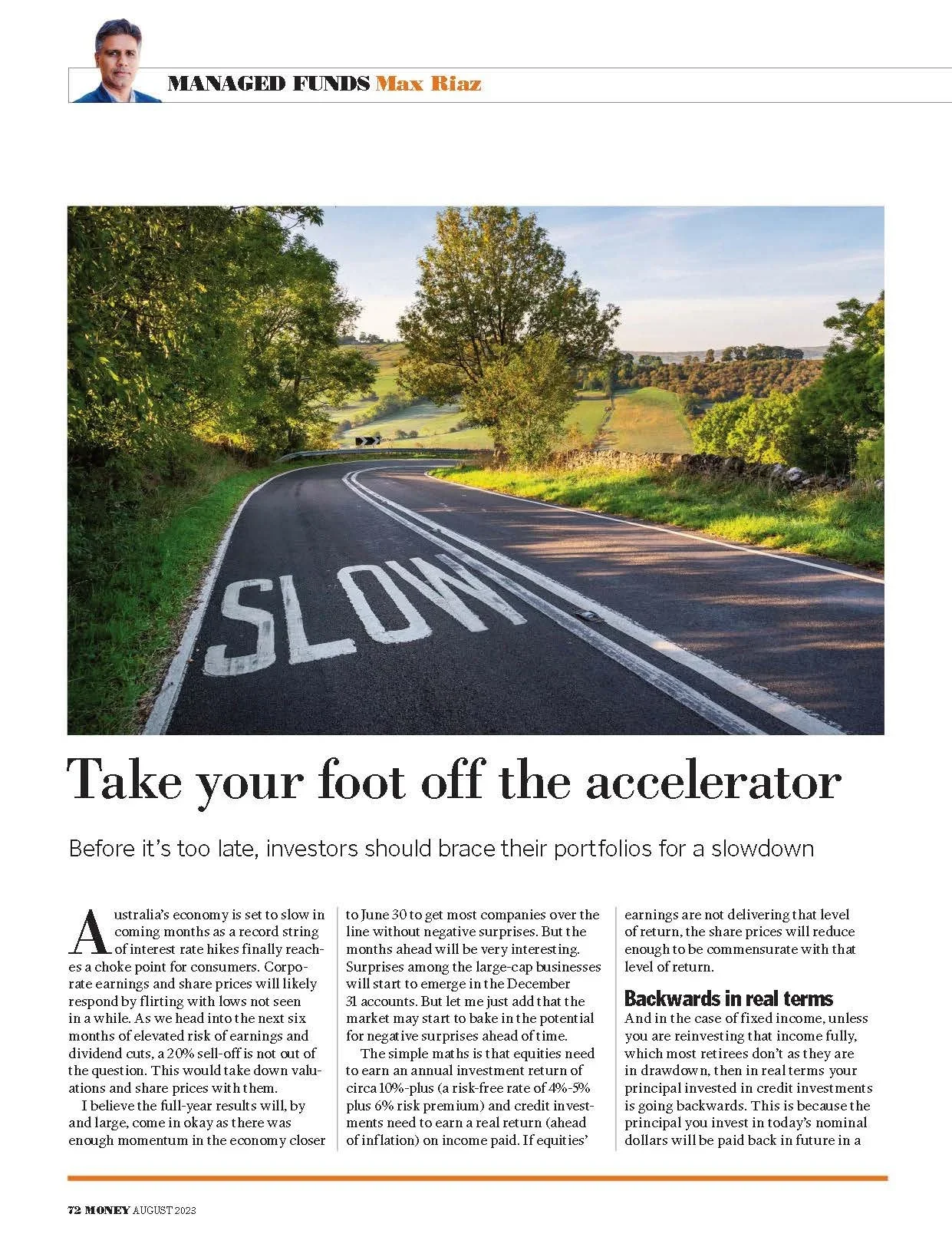
Before it’s too late, investors should brace their portfolios for a slowdown
Australia’s economy is set to slow in coming months as a record string of interest rate hikes finally reaches a choke point for consumers. Corporate earnings and share prices will likely respond by flirting with lows not seen in a while. As we head into the next six months of elevated risk of earnings and dividend cuts, a 20% sell-off is not out of the question. This would take down valuations and share prices with them.
I believe the full-year results will, by and large, come in okay as there was enough momentum in the economy closer to June 30 to get most companies over the line without negative surprises. But the months ahead will be very interesting, Surprises among the large-cap businesses will start to emerge in the December 31 accounts. But let me just add that the market may start to bake in the potential for negative surprises ahead of time. The simple maths is that equities need to earn an annual investment return of circa 10%-plus (a risk-free rate of 4%-5% plus 6% risk premium) and credit investments need to earn a real return (ahead of inflation) on income paid. If equities’ earnings are not delivering that level of return, the share prices will reduce enough to be commensurate with that level of return.
Backwards in real terms
And in the case of fixed income, unless you are reinvesting that income fully, which most retirees don’t as they are in drawdown, then in real terms your principal invested in credit investments is going backwards. This is because the principal you invest in today’s nominal dollars will be paid back in future in a depreciated currency due to the impact of inflation.
You can’t completely hedge against rapidly rising inflation. However, you should not be enticed by credit funds offering very low running yields. My sense is that inflation will settle around 4%-6% for a while, so your fixed income should be delivering somewhere within that range. As yours truly has been pointing out for awhile, inflation is proving to be sticky, no thanks to the prolific government spending (federal and states). The wages momentum continues; insurance, rents, energy bills also continue to rise.
For these reasons, plus the Reserve Bank’s chequered record of forecasting, I remain unwilling to align our hard-earned funds to its forecast of 2%-3% inflation any time soon.
The RBA remains firmly of the belief that it can engineer inflation down to 2%-3% by raising rates unrestrained. This is despite calls by some international economists, such as the International Monetary Fund, suggesting central banks may need to, in so many words, become pragmatic and raise the target rate of inflation from 2%-3% to a range more in line with the current realities of supply side pressures.
Remember, the inflation target of 2%-3% is an entirely arbitrary number with no science behind it. The real goal of central banks is to bring stability in prices, so, if prices are rising at 4%-5%pa and importantly have come off from their peak rates of 8%-10%, then that is a good outcome. Then, other fiscal factors, such as investment in innovation and supply side constraints, in due course will lift productivity and reduce the inflation rate down to 2%-3% in the long term.
That would be my advice to the central banks.
How should investors be bracing their investment portfolios for a slowdown? Those with multi-asset portfolios should seize the market’s ambivalence as an opportunity to readjust their portfolios. Specifically, dial back on growth allocations and improve the quality of exposures within each asset class. As I have said to clients in recent weeks,
Dial back growth
Trimming growth (equities) by 10% is warranted given this may be a protracted slowdown going into 2024. Most investment portfolios will have growth allocation divided among Australian equities, international equities, and property and infrastructure.
My preference is to be overweight international relative to Australian equities - China's economy, our main trading partner, is currently a letdown and the domestic picture from rising rates looks subdued. Keep property and infrastructure exposures to a minimum: we have been zero allocation to this last category since 2019.
Tunderstand that many individual investor portfolios will be sitting on negative returns in their property and infrastructure exposures as these assets have borne the brunt of higher interest rates and risks of write-downs. Many investors would likely have exposures in property and infrastructure through passive exchange traded funds holding globally listed businesses.
These assets are trading at well below their book value (20%-30% discount to net tangible assets). So, on that account it’s worth holding these from here on as the majority of the pain of potential asset valuation write-downs may well be in the traded share price.
However, where you have an active manager investing in unlisted infrastructure or property assets, then reconsider their position in the portfolio as their future returns are yet to fully price in the potential asset writedowns.
Dial up income
Use the proceeds of a10% dial-back from growth to fund an overweight position in higher quality defensive (fixed-interest) exposures. Keep lower-quality credit (hybrids and high yield) around 8%-10%, and the rest of the investment in the defensives should be higher ranking debt, term annuities and term deposits.
I consider term deposits as income products and not cash. They are a liability of the bank. Government bonds by and large still don’t work for us, as most managers have very low running yields. By making these adjustments, we are seeking to reduce the impact of the possible volatility ahead. You can’t completely eliminate it, as that’s what investing is all about. You will have improved your quality of exposures (large-cap stocks), reduced exposure to leveraged balance sheets and improved diversification, with greater tilt to income. After these changes, be comfortable with holding the balance of exposures for the next five years and beyond.
3 funds to watch
Kapstream Absolute Return Income Fund
Aims to provide a steady stream of income and capital stability over the medium term, with a global, diversified portfolio of predominantly investment-grade, fixed-income securities,
AB Managed Volatility Equities Fund (Managed Fund) - MVE Class
Aims to achieve returns that exceed the S&P/ASX 300 Accumulation Index after fees over the medium to long term. The MVE Class is designed for equity investors seeking lower volatility than is typical for an equity fund, reduced downside risk in falling equity markets, and the potential for long-term capital growth and some income, including franked Australian dividend income.
Talaria Global Equity Fund
Takes a high-conviction, value-biased approach to construct a portfolio of high-quality, large-cap companies from around the globe. The fund seeks to deliver consistent income generation and capital appreciation.
