
Investors need to adjust their expectations as ageing populations around the world retire. For decades, workers added to their savings and helped keep borrowing costs low. Retirement changes both sides of that equation, just as rivalry between major economies and the cost of the energy transition put further pressure on prices.
By Max Riaz, an investment manager and director at Banyantree Investment Group, with responsibilities across equity and multi-asset strategies.
First published in Money Magazine, November 2023, pp. 76–77.
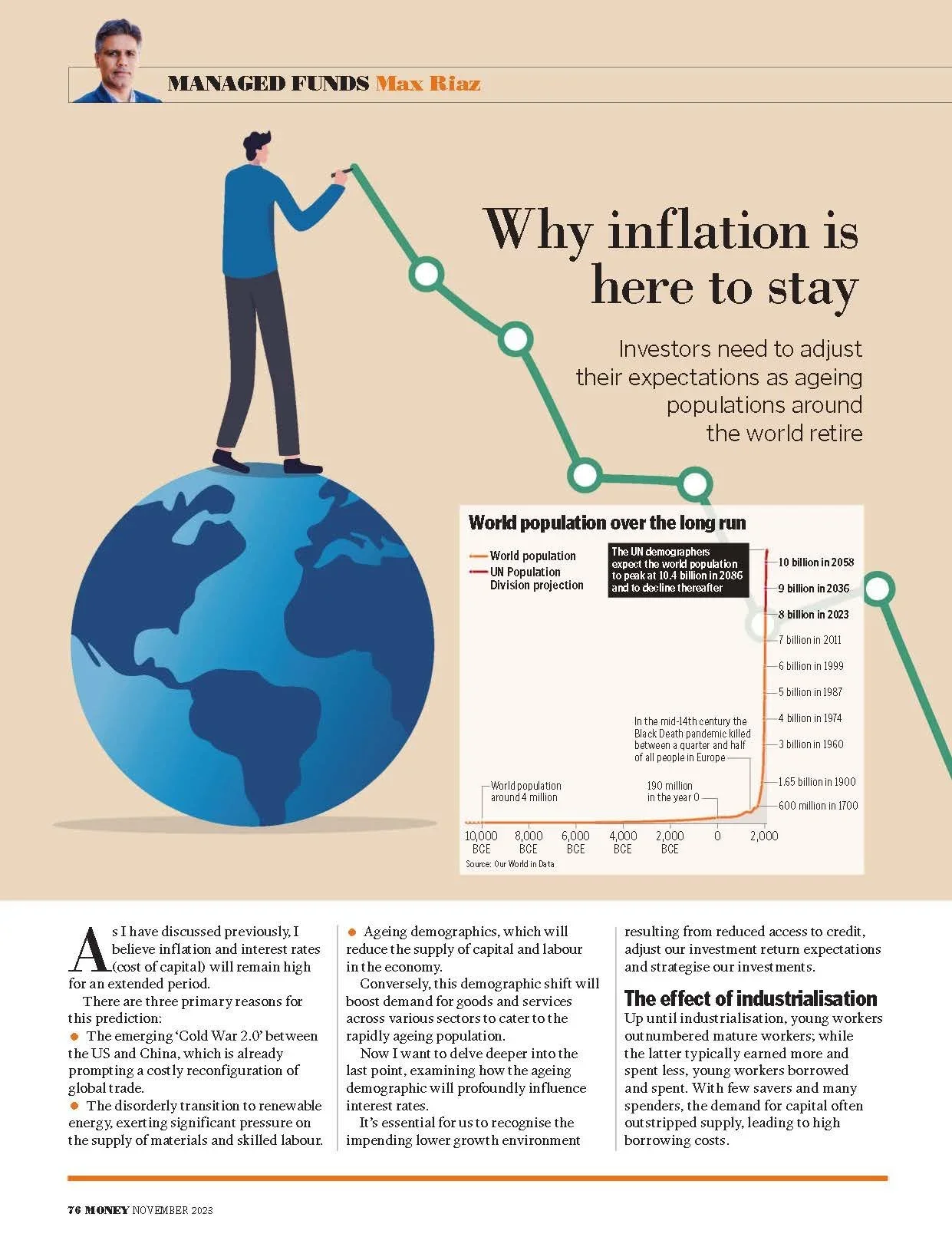
Investors need to adjust their expectations as ageing populations around the world retire
As I have discussed previously, I believe inflation and interest rates (cost of capital) will remain high for an extended period.
There are three primary reasons for this prediction: @ The emerging ‘Cold War 2.0’ between the US and China, which is already prompting a costly reconfiguration of global trade. @ The disorderly transition to renewable energy, exerting significant pressure on the supply of materials and skilled labour.
• Ageing demographics, which will reduce the supply of capital and labour in the economy.
Conversely, this demographic shift will boost demand for goods and services across various sectors to cater to the rapidly ageing population.
Now I want to delve deeper into the last point, examining how the ageing demographic will profoundly influence interest rates.
It’s essential for us to recognise the impending lower growth environment resulting from reduced access to credit, adjust our investment return expectations and strategise our investments.
The effect of industrialisation Up until industrialisation, young workers outnumbered mature workers; while the latter typically earned more and spent less, young workers borrowed and spent. With few savers and many spenders, the demand for capital often outstripped supply, leading to high borrowing costs.
Industrialisation altered the balance between younger and mature workers. Average lifespans began to extend and infant mortality rates decrease. This shift led to explosive population growth in nations as they each embarked on their industrialisation journeys.
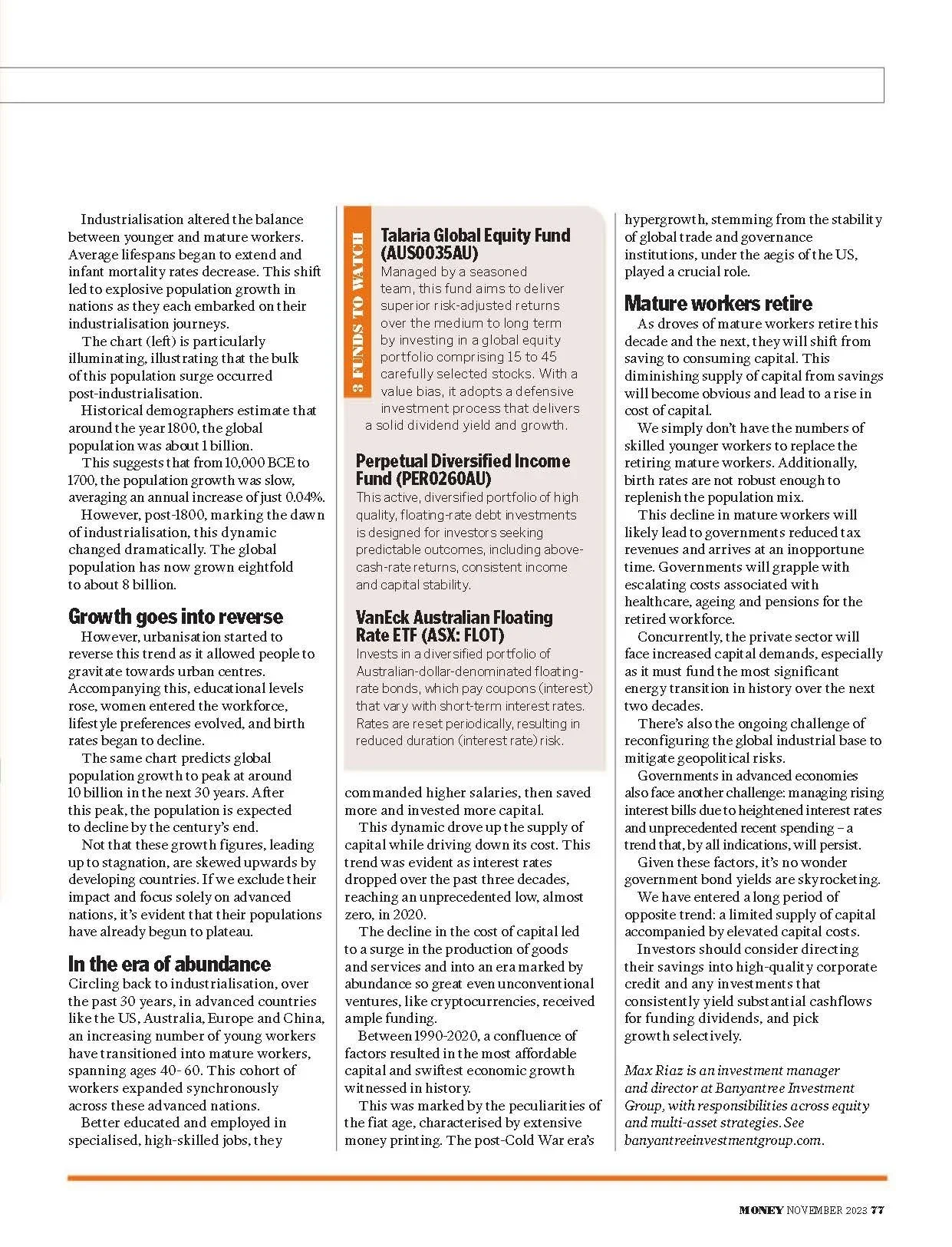
The chart (left) is particularly illuminating, illustrating that the bulk of this population surge occurred post-industrialisation.
Historical demographers estimate that around the year 1800, the global population was about 1 billion.
This suggests that from 10,000 BCE to 1700, the population growth was slow, averaging an annual increase of just 0.04%. However, post-1800, marking the dawn of industrialisation, this dynamic changed dramatically. The global population has now grown eightfold to about 8 billion.
Growth goes into reverse
However, urbanisation started to reverse this trend as it allowed people to gravitate towards urban centres. Accompanying this, educational levels rose, women entered the workforce, lifest yle preferences evolved, and birth rates began to decline.
The same chart predicts global population growth to peak at around 10 billion in the next 30 years. After this peak, the population is expected to decline by the century’s end.
Not that these growth figures, leading up to stagnation, are skewed upwards by developing countries. If we exclude their impact and focus solely on advanced nations, it’s evident that their populations have already begun to plateau.
In the era of abundance
Circling back to industrialisation, over the past 30 years, in advanced countries like the US, Australia, Europe and China, an increasing number of young workers have transitioned into mature workers, spanning ages 40- 60. This cohort of workers expanded synchronously across these advanced nations.
Better educated and employed in specialised, high-skilled jobs, they commanded higher salaries, then saved more and invested more capital.
This dynamic drove up the supply of capital while driving down its cost. This trend was evident as interest rates dropped over the past three decades, reaching an unprecedented low, almost zero, in 2020.
The decline in the cost of capital led to a surge in the production of goods and services and into an era marked by abundance so great even unconventional ventures, like cryptocurrencies, received ample funding.
Between 1990-2020, a confluence of factors resulted in the most affordable capital and swiftest economic growth witnessed in history.
This was marked by the peculiarities of the fiat age, characterised by extensive hypergrowth, stemming from the stability of global trade and governance institutions, under the aegis of the US, played a crucial role.
Mature workers retire
As droves of mature workers retire this decade and the next, they will shift from saving to consuming capital. This diminishing supply of capital from savings will become obvious and lead to arise in cost of capital.
‘We simply don’t have the numbers of skilled younger workers to replace the retiring mature workers. Additionally, birth rates are not robust enough to replenish the population mix.
This decline in mature workers will likely lead to governments reduced tax revenues and arrives at an inopportune time. Governments will grapple with escalating costs associated with healthcare, ageing and pensions for the retired workforce.
Concurrently, the private sector will face increased capital demands, especially as it must fund the most significant energy transition in history over the next two decades.
There’s also the ongoing challenge of reconfiguring the global industrial base to mitigate geopolitical risks.
Governments in advanced economies also face another challenge: managing rising interest bills due to heightened interest rates and unprecedented recent spending - a trend that, by all indications, will persist. Given these factors, it’s no wonder government bond yields are skyrocketing. We have entered along period of opposite trend: a limited supply of capital accompanied by elevated capital costs. Investors should consider directing their savings into high-quality corporate credit and any investments that consistently yield substantial cashflows for funding dividends, and pick growth selectively.
3 funds to watch
Talaria Global Equity Fund (AUS0035AU)
Managed by a seasoned team, this fund aims to deliver superior risk-adjusted returns over the medium to long term by investing in a global equity portfolio comprising 15 to 45 carefully selected stocks. With a value bias, it adopts a defensive investment process that delivers a solid dividend yield and growth
Perpetual Diversified Income Fund (PER0260AU)
This active, diversified portfolio of high quality, floating-rate debt investments is designed for investors seeking predictable outcomes, including above-cash-rate returns, consistent income and capital stability.
VanEck Australian Floating Rate ETF (ASX: FLOT)
Invests in a diversified por tfolio of Australian-dollar-denominated floating-rate bonds, which pay coupons (interest) that vary with short-term interest rates. Rates are reset periodically, resulting in reduced duration (interest rate) risk.
