
The Risk-First Portfolio
Why We Size to Downside Before Return
By the team at Banyantree Investment Group
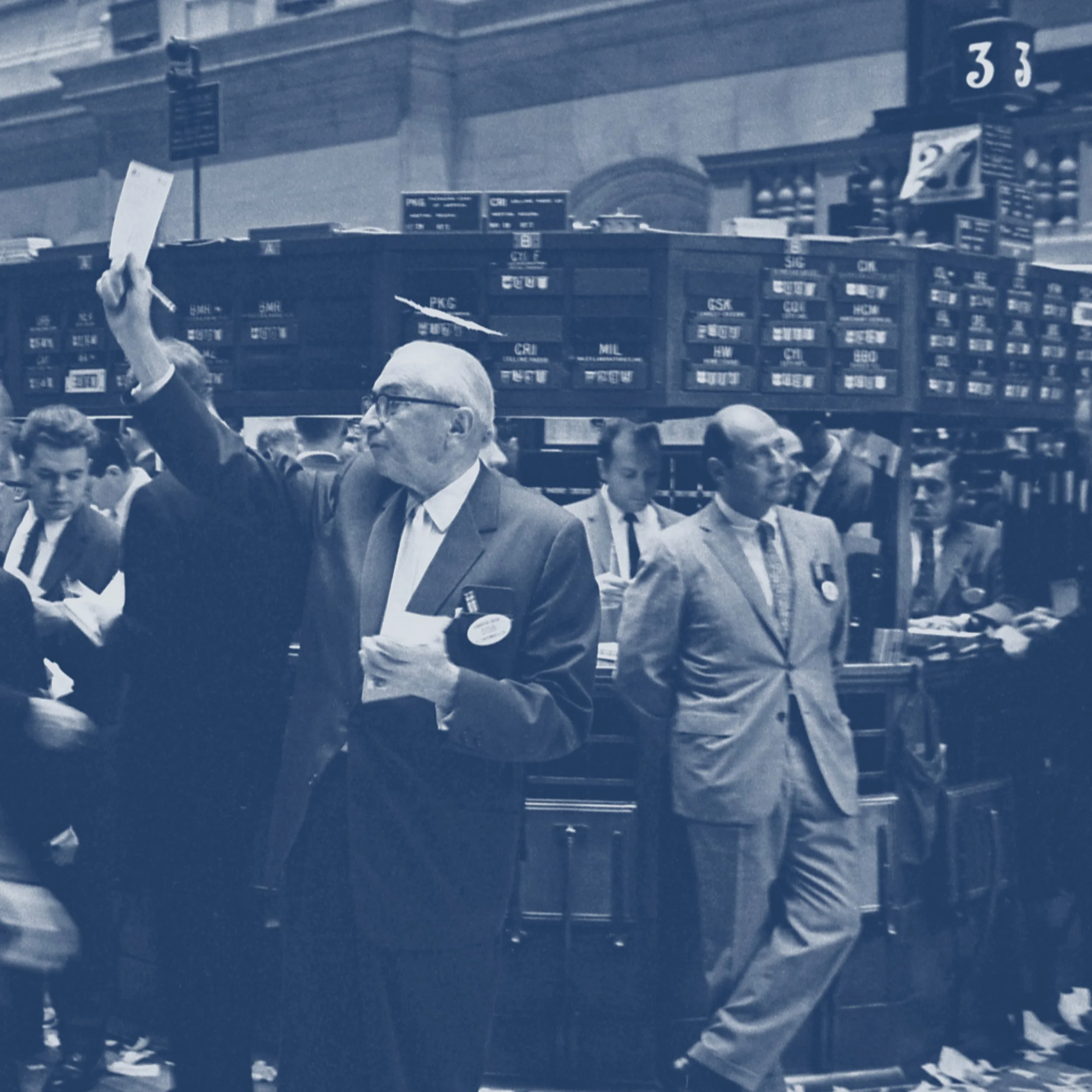
Floor of the New York Stock Exchange, 1963. Library of Congress. Cropped and colour-treated.
At around seven o’clock on the evening of Thursday, 25 March 2021, Bill Hwang picked up the phone and did something he had spent a career avoiding. He asked for help.
Hwang was not a man who negotiated from weakness. A protégé of Julian Robertson at Tiger Management, he had built Archegos Capital Management into a family office controlling positions worth more than thirty billion dollars — a figure that, had it been widely known, would have placed him among the largest holders of equities on earth. He had done it quietly, using total return swaps that allowed him to command enormous economic exposure to stocks without technically owning them and without triggering the disclosure rules that applied to conventional shareholders. The method was legal. The scale was breathtaking. In several companies, Archegos controlled more than half the tradeable float, and the market had no idea.
The positions were not exotic. ViacomCBS. Discovery. Baidu. GSX Techedu. Real businesses with identifiable models and, in several cases, genuinely defensible investment theses. Hwang was not a gambler reaching for lottery tickets. He was a concentrated investor who had been right, repeatedly, for years — and who had used that track record to extract more and more leverage from the prime brokers competing for his business.
But earlier that week, ViacomCBS had announced a secondary stock offering. The share price dropped. Then it dropped further. And now the banks on the other end of Hwang’s swaps — Goldman Sachs, Morgan Stanley, Credit Suisse, Nomura, and others — were doing arithmetic of their own. They wanted more collateral. Hwang wanted time. The Thursday evening call was his attempt to hold the coalition together, to persuade the banks to act in concert rather than in self-interest, to give the positions room to recover before anyone rushed for the exit.
Think about what he was asking. He needed a handful of competing investment banks, each with its own risk committee and its own profit-and-loss statement, to trust one another enough to sit still while billions of dollars in collateral requirements went unmet. It was the kind of coordination that works only when everyone believes the alternative is worse. And by Thursday night, not everyone did.
The call ended without agreement. By Friday morning, Goldman Sachs had begun liquidating. Morgan Stanley followed. Block trades totalling roughly fifteen billion dollars hit the market before most investors had finished their coffee. The stocks cratered, which triggered further margin calls at the slower banks, which triggered further selling. By Monday, Archegos was gone — not wounded, not restructured, but erased. Hwang’s personal fortune, estimated days earlier at twenty billion dollars, had effectively ceased to exist. Credit Suisse, which had hesitated while its American counterparts moved, eventually wrote off 5.5 billion dollars. The loss contributed to a crisis that would end with the bank’s forced sale to UBS two years later.
The post-mortems focused on leverage and disclosure, and those were real issues. But the deeper failure was older and more common than any regulatory loophole. It was a failure of sizing. Hwang had built positions so large relative to his capital that the thesis didn’t need to be wrong. It merely needed to be late.
He had built a portfolio that could not survive being wrong.
───
There is a piece of arithmetic sitting inside that collapse, and inside many of investing’s most unpleasant surprises. Hwang’s concentrated positions didn’t need to fall far in percentage terms to become lethal — what mattered was the relationship between the drawdown, the leverage, and the point at which the banks could force a sale. A twenty per cent decline in a stock you own outright is painful. The same decline on a position levered five to one doesn’t just hurt five times as much. It can extinguish the entire stake and leave you owing money on the remainder.
The general principle is the asymmetry of losses, and it applies with or without leverage. A portfolio that falls ten per cent needs an eleven per cent gain to recover. At twenty per cent down, you need twenty-five per cent back. At fifty per cent — a level the S&P 500 has approached or breached several times since 1950 — you need one hundred per cent just to return to where you started.
Exhibit 1: The Asymmetry of Drawdown Recovery
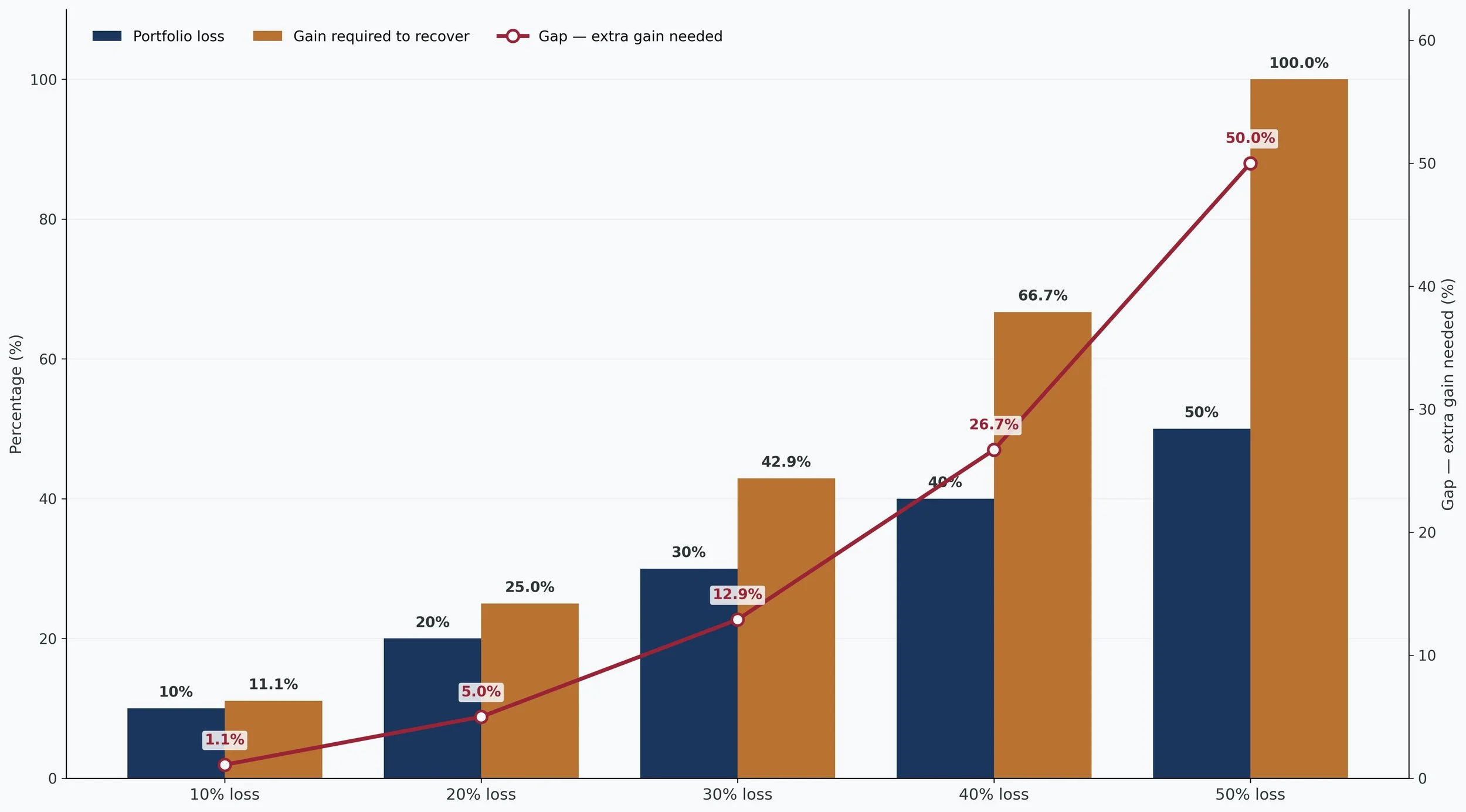
Simple arithmetic: recovery = loss ÷ (1 – loss). The gap widens nonlinearly.
The maths is simple. What the maths does to time, behaviour, and governance is not.
A drawdown is not merely a number on a quarterly statement. It alters the conditions under which every subsequent decision gets made. Committees shorten their horizons. Mandates get rewritten. Clients who swore they were long-term investors discover, under the specific pressure of watching real money disappear, that their actual tolerance for pain is considerably lower than the version they described in calmer rooms in easier times. And selling — which looked like one option among many when markets were orderly — reveals itself as the only tool left, exercised at prices nobody would have accepted a month earlier, into liquidity that has evaporated precisely when it was needed most.
This is how most portfolios fail. Not because the underlying ideas were foolish, but because the ideas were sized as if drawdowns were optional and liquidity was guaranteed.
───
The industry’s default method is what might be called return-first portfolio construction. You identify an investment with an attractive expected return. You take a meaningful position — large enough to ‘make it matter’. Then you check the risk metrics afterward, the way a driver checks the mirrors after merging. It sounds sensible because, most of the time, it is. The trouble is that ‘most of the time’ is not the period that determines outcomes.
Spend enough time in investment committee meetings and you will hear the same sentence, phrased with minor variations, in every one: ‘This position is different. The thesis is strong. The management team is excellent. The valuation is undemanding.’ All of which may be true. None of which tells you how the position will behave when the market stops caring about your thesis. The tendency to forecast based on the specifics of the case in front of you — while ignoring the base rate of how similar cases have turned out — is one of the most durable errors in human reasoning. It survives intelligence, experience, and credentials. It thrives in committee rooms because committees reward confidence in the specific and punish attention to the general.
The base rate is blunt. Drawdowns happen. Correlations rise in stress. Liquidity disappears when you need it most. Return-first sizing plans for the specific case. Risk-first sizing plans for the base rate.
───
A risk-first portfolio inverts the operation. Instead of starting with expected return and working backward to risk, you start with a question that most portfolios never explicitly answer: how much can this portfolio lose, without forced selling, mandate breach, or strategy abandonment?
Call it a loss budget. The label matters less than the act of stating it. What you are really doing is converting ‘tolerance for pain’ from a vague sentiment that different committee members interpret differently into a design constraint that can be measured, reviewed, and held steady across market cycles. Pain tolerance, discussed in the abstract, is whatever the most optimistic person in the room wants it to be. Written down as a number and stress-tested against history, it becomes architecture.
Once you have a loss budget, position sizing becomes arithmetic rather than enthusiasm. The rule is plain enough to write on an index card:
Downside sets size; expected return sets order.
For any position, you define a plausible stress scenario — not the worst case imaginable, but a realistic adverse outcome you can articulate in plain language. What happens if the thesis is wrong in a normal way? What happens if it’s wrong in a bad way, or the market de-rates the entire sector, or both? Then you ask: how much of this loss can the portfolio absorb without triggering the kind of decision-forcing event — a margin call, a mandate breach, a panicked board meeting — that turns temporary pain into permanent impairment?
The maximum position size flows directly from that constraint. If your loss budget allows a single position to cost the portfolio no more than two per cent in a stress scenario, and your stress downside for the position is forty per cent, then the arithmetic gives you a starting size of five per cent. Not because five per cent ‘feels right’, but because five per cent is the answer to a question you actually asked.
Then you adjust for the things that show up late in cycles and early in crises: liquidity that may not exist when you need it, and correlation with other positions that may spike precisely when you hoped they would diversify.
Only after size is set does expected return enter the conversation. Not to determine how much you own, but to determine the priority among ideas competing for limited risk budget. Downside sets size. Expected return sets order. The sequence matters.
───
Here is how this works in practice.
A portfolio team is evaluating a European payments company — a genuine compounder with dominant market share, subscription-like revenue, and a management team that has executed well for a decade. The stock trades at thirty-eight times earnings, expensive by historical standards but defensible given the growth profile. The bull case offers fifteen per cent annualised returns over five years. It is exactly the kind of position that return-first thinking wants to make large, because the business is so obviously good.
The stress case is different. Multiple compression to twenty-two times earnings, plus a modest earnings cut in a recession, implies a forty per cent drawdown. The company would still be a fine business at the bottom. The question is whether the portfolio can still be a fine portfolio at the bottom.
Return-first thinking asks: how much do we need to own to make this position matter? Risk-first thinking asks: how much can we own without this breaking the portfolio?
Assume a loss budget of twelve per cent for the total portfolio, and a rule that no single holding should contribute more than two per cent of portfolio-level stress loss.
Starting size: two per cent divided by forty per cent equals five per cent. But this is a crowded name, heavily owned by similar funds running similar strategies. In a broad de-rating, the team would not be the only seller — it might not even be the first. Apply a liquidity adjustment: reduce by fifteen per cent. And the position correlates heavily with existing quality-growth holdings that would fall together in the same scenario. Apply an overlap adjustment: reduce by another ten per cent.
Exhibit 2: Worked Example — Position Sizing (Hypothetical)
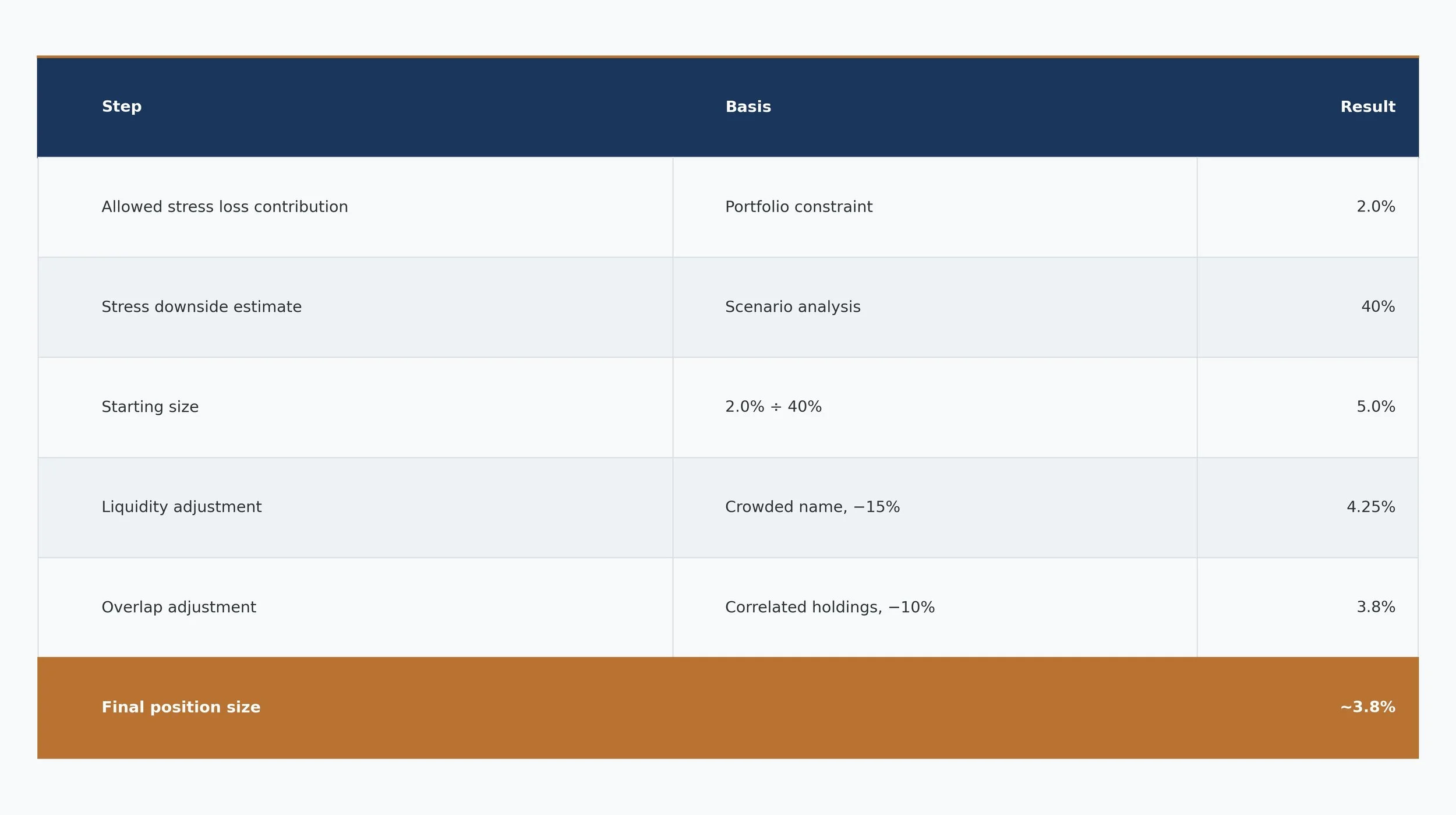
Worked example of risk-first position sizing. Hypothetical example for illustrative purposes only.
The return-first instinct protests. At eight per cent of the portfolio, this beautiful compounder would really move the needle. But at eight per cent, the same forty per cent stress scenario costs the portfolio 3.2 per cent from a single name — before accounting for the correlated quality-growth holdings falling alongside it. String three or four such positions together and a portfolio of individually excellent ideas becomes collectively unsurvivable. That is how a portfolio becomes a collection of good theses that cannot survive contact with a bad market.
───
This is sometimes misread as an argument against conviction. It is not. It is an argument for what might be called earned concentration.
Concentration is earned; diversification is used where conviction is not.
The distinction matters because conviction, in practice, is one of the most abused words in professional investing. It gets used to describe a feeling — the warmth of a well-rehearsed thesis, the comfort of a management team that returns your calls, the private satisfaction of having been early — when it should describe a position that has survived a genuine constraint. Concentration is earned only when three conditions hold: the downside is bounded in a way you can explain to someone who disagrees with you, the exit is feasible under stress, and the position does not simply duplicate risks the portfolio already carries. If those conditions are not met, concentration is not confidence. It is an accident waiting for a catalyst.
There is a tell that appears in portfolio reviews, and once you notice it you will see it everywhere. When a position has done well, the commentary focuses on the thesis: management execution, margin expansion, market share gains. The analyst built the model. The portfolio manager backed the idea. Everyone takes credit for the return. When the same position is down thirty per cent, the commentary shifts quietly from thesis to sizing: ‘It’s only three per cent of the portfolio.’ The thesis was the reason for owning it. The size becomes the excuse for still owning it.
This sleight of hand is seductive because it works in both directions simultaneously. On the way up, a large position proves you had conviction. On the way down, a position that has become small through losses proves you were diversified. The narrative reshapes itself around the outcome, and nobody in the room has to confront the possibility that the sizing was never the product of a deliberate decision at all — that it was simply whatever number felt right when the trade was put on, subsequently ratified by whichever direction the market happened to move.
The mirror image is equally revealing. Ask a portfolio manager about a position they sized to five per cent that subsequently fell thirty per cent: ‘It’s only 3.5 per cent now.’ But the loss to the portfolio — the thing that actually determines compounding — has already happened. The smaller weight is not evidence of discipline. It is the wreckage of its absence. Sizing discipline means the loss was tolerable before it occurred, not merely survivable after.
Risk-first sizing eliminates this sleight of hand by forcing the conversation to happen in the right tense. The size is set before the outcome is known, which means it has to be defensible regardless of which direction the outcome runs. You cannot take credit for conviction on the way up and credit for diversification on the way down if the sizing decision is written down, stress-tested, and recorded before the position moves at all.
───
Now for the part that belongs in the body of this essay, not in the small print.
Risk-first portfolios will lag in strong, narrow bull markets. There is no version of this framework that avoids that cost. When the market rewards concentration, leverage, or crowding into the same handful of winners — and it does, reliably, for stretches that can last years — a portfolio sized to survive stress will not keep pace with portfolios sized to maximise exposure. In the years when everything goes right, the disciplined portfolio looks timid. The leveraged portfolio looks visionary. The manager who sized to risk will spend conference calls explaining a process. The manager who sized to return will spend them accepting congratulations.
This is not an abstract cost. It is a felt one. It means watching a competitor who bought twice as much of the same stock report twice the return, knowing that you understood the same thesis just as well and arrived at the same conclusion, and that the only difference was that they were willing to bear a risk you were not. It means sitting in review meetings where the question is not ‘was your process sound?’ but ‘why didn’t you own more?’ It means, in the specific silence that follows that question, having to defend a philosophy that has not yet been tested by the market conditions it was designed for.
The honest answer is that being right in a way that looks wrong is one of the hardest things in professional investing, and no framework eliminates that difficulty. The claim is not that risk-first always wins. The claim is narrower and, we think, more durable: it preserves the ability to compound by avoiding the drawdowns that force you out of the game. The most important position in a portfolio is the one you can actually hold. The most valuable returns are the ones you are still around to collect. And the difference between a portfolio that survives a full cycle and one that doesn’t is rarely the quality of the ideas. It is the relationship between the size of the positions and the investor’s true capacity to endure.
───
What would change this view?
Two developments would genuinely require revisiting the framework. The first is structural: if cheap, liquid options-based protection became a reliable substitute for cash-funded downside reserves — so that the loss budget could be maintained without the drag of holding uninvested capital — the mechanics of the framework would remain, but its cost would fall significantly, and the case for accepting that cost would need to be remade. The second is institutional: if evaluation horizons for active managers structurally lengthened — through longer performance measurement periods, outcome-based fee arrangements, or governance structures that explicitly permitted multi-year divergence — the career penalty for looking different during a bull market would diminish. Risk-first sizing would become easier to sustain, and the pre-commitment apparatus described here would be less necessary. Neither development appears close. Until one does, the framework stands.
───
Sizing is the least glamorous part of portfolio construction. It does not trend on financial media. It does not win performance awards in rising markets. It will never be the reason someone walks out of a conference excited about an investment idea. What it does is something quieter and, measured across a complete market cycle, something more consequential: it keeps the portfolio yours when the market tries to take it away from you.
Downside sets size; expected return sets order.
The right size always looks excessive before the market tests it and obvious afterwards. That is not a failure of judgement. It is what discipline costs, and what it is worth.
General information only. Not personal advice. Past performance is not indicative of future performance. Examples are illustrative and hypothetical. This material is intended for wholesale and professional investors.
