
In March 2026 Australia counted a month of diesel and announced the release of up to 762m litres of fuel. Almost all of that month was a legal floor, and the release lowered the floor rather than adding fuel. Five weeks of Tuesday counts show how far the industry went into the new room, and what a release of this kind hands over.
By the team at Banyantree Investment Group
Provenance: Developed from questions first raised in Banyantree's Monthly Investment Letter of 25 March 2026.
Transwest Fuels, the largest fuel distributor in New England, in northern New South Wales, took delivery of a small load on Tuesday 10 March 2026 and was warned that there might be nothing more until the following week. The Tamworth company, which employs about 100 people, supplied the region's farmers, and it said it had been cut off from supply out of the major terminals. "We have no access to any fuel from tomorrow," Sam Clifton of Transwest told the local paper. "Zero. None out of Brisbane, none out of Newcastle. Zero."¹
The American and Israeli strikes on Iran were ten days old, and tanker movements through the Strait of Hormuz had come close to a halt. That afternoon in Canberra, Melissa McIntosh, the opposition member for Lindsay in Sydney's outer west, put a constituent's problem to the Minister for Climate Change and Energy, Chris Bowen. Aaron, of Penrith City Plumbing Services, had a fleet of three trucks and had taken one of them off the road "due to fuel shortages". Could the Minister assure him there were no fuel shortages in Western Sydney? Bowen told the House that supplies were secure and that there was no need for panic buying. The country had, he said, "2.97 billion litres of diesel in our minimum stock obligations", and 1.56bn litres of petrol "in reserve", "not called upon". "Let me say to the House: I won't hesitate to release those reserves if necessary."²
Later in the afternoon, in a debate on the government's handling of fuel supplies, Scott Buchholz, the member for Wright in south-east Queensland, described what the buyers in his electorate were hearing: "when my spot buyers go to buy from the terminals, they're told: 'There is no fuel for you today.'" He wanted the government to "release the contracted fuel to the spot market".²
It was a Tuesday, and on Tuesdays every importer and refiner of fuel above a modest size must hold the minimum stock the law sets for it, and that March each had to report the count by Friday. The count for 10 March, published days later, put the country's diesel at 30 days of normal use and 2% above the quantity the law required.³ Of roughly 2.8bn litres, about 2.74bn had to be there. Above that floor stood about 55m litres, a little over half a day of the country's diesel.
Set against the same floor, the Minister's 2.97bn litres would have left about 230m litres above it, roughly two and a half days rather than half of one. The House was not told what date his figure described, though it is close to what the industry had held on average in the last months of 2025, before the war.⁴
Three days later Bowen did what he had said he would not hesitate to do. The minimum that suppliers had to hold of petrol and diesel would be cut by up to a fifth, which the government described as releasing up to 762m litres "from Australia's domestic reserves", and Australia counted the change as its share of an emergency release of oil stocks by the members of the International Energy Agency.⁵ No tanker sailed and no tank was opened for the release to take effect. It moved a line the law drew through fuel already in the country. What, then, had been released?
The floor inside the month
The days figure is a division. The government adds up the fuel that counts under the minimum stockholding obligation and divides it by a day's normal national use. The count is broad: fuel in a supplier's terminals, in pipelines it owns and controls, aboard tankers anywhere inside Australia's exclusive economic zone, which runs 200 nautical miles out to sea, and crude oil at the two remaining refineries, counted at the fuel it is expected to yield. Fuel already sold into a farmer's or a contractor's tank does not count, though not a drop of it has been burnt.⁶ Each supplier's requirement is set against its own trade. An importer owes 32 days of the diesel it brings in and a refiner 20 days of what it makes; summed across the industry and set against national use, the requirement came to 29 or 30 days.⁷ The weekly headline counted that requirement together with everything above it.
The floor's height was a decision. When the rules were written in 2022, the petrol requirement was set at the average of 2018 and 2019, before the pandemic, and the scheme's designers expected suppliers' business-as-usual petrol stocks to be enough to meet it. Diesel's was set 40% above its pre-pandemic level, which took an importer from 20 days to 28, and four more days were added to allow for the fuel on tankers inside the zone that counts towards it. Fuel companies, the designers noted, "generally operate on a 'just-in-time' basis".⁸ By design, then, petrol had room above its floor and diesel much less.
Because the headline contains its own floor, the informative number in the department's figures was the one printed beside it. If stock stands a margin m above its requirement, the share of the headline above the floor is m divided by one plus m. Petrol's 52% put about a third of its 37 days, almost 13 days, above the floor. Diesel's 2% put about 2% of its 30 days there: 98% of the diesel in terminals, pipelines and tankers offshore that Tuesday was fuel the law required the industry to keep.⁴
That does not mean only half a day of diesel could be sold. Suppliers sell from all their stock every day and refill it as ships arrive, and the rules let a supplier hold less than its minimum between Tuesdays so long as it is back on the day.⁹ The margin limits how far the industry's total can fall, net of arrivals, from one count to the next. With some bulk customers buying four times their usual volume, half a day was very little room.¹⁰ The room is also held company by company. A supplier may count stock another entity holds for it under a written arrangement, and the trade press reports a market in compliance tickets, each worth a litre, so one supplier's spare can help another meet its floor on a Tuesday.⁹ It does not put diesel in the second supplier's customers' tanks.
Bank supervisors know the problem through a fable Charles Goodhart retold in 2007. A weary traveller reaches a railway station late at night and is delighted to find a taxi there. The driver cannot take him, because "local bylaws require that there must always be one taxi standing ready at the station". "Required liquidity is not true, usable liquidity," Goodhart wrote, and he said the same of a bank's required minimum capital.¹¹ A bank's liquidity and capital ratios are reported with their minimums inside them. So, it turned out, was Australia's month of diesel. On 10 March the rank held a month of it, and the bylaw held 98%.
First in line
With buying running ahead of the ships and half a day of room above the floor, somebody was going to go short. On 11 March the Australian Institute of Petroleum, whose four core members supply about 85% of the country's fuel, said who. Its members "have had to prioritise supply to their regular customers and cease spot sales", which it called "a normal response to high demand", and they typically lacked the stock to supply businesses that could not get fuel from their regular suppliers.¹⁰ A month later the Minister described the same order. Customers were drawing down all of their bulk contract allocations, leaving less on the spot market, and "The companies are legally obliged to meet their contracts to people who have contracted diesel in particular in advance."¹²
That order mattered most in the countryside, because the spot market is how much of the countryside is supplied. "The majority of fuel in regional communities is supplied by independent retailers," the president of the National Farmers' Federation said in March, and the president of NSW Farmers added that farm tanks are normally refilled by bulk suppliers, many of them small independent distributors.¹³ The Minister called the spot market the one "which predominates in regional Australia".¹² Transwest was one of those distributors. By the local paper's account in April, it had operated largely without formal supply contracts, "on handshakes", and it said it had received more than a million litres less than usual in March; its managing director said its capacity to serve regional New South Wales and Queensland had fallen by 30%. Industry sources told the same paper that most bulk suppliers in New England were securing their normal allocations.¹⁴ One company's account against unnamed sources settles nothing on its own. It is, though, what the institute's order of service would look like from the back of the queue.
The competition regulator heard the same complaint at a meeting on 17 March, where concerns were raised that off-contract buyers in the wholesale market were "struggling to obtain supply", disproportionately in some regional areas. It opened an investigation into allegations about the four majors' conduct in supplying diesel to regional independents and, by 10 April, had formed no view.¹⁵
The regulator's own reading of the shortages, on 20 March, was that they "have tended to be localised and caused by increases in demand, rather than overall reduced supply".¹⁵ Petrol shows how much of that holds. It stood 45% or more above its floor at every count, and its stations still ran out: 193 of them on figures the Minister gave in early April, against 410 without diesel.¹⁶ And at least one major was sending independents more, not less: Ampol's supplies to independent distributors in regional New South Wales in March to date were 40% higher than a year earlier, the Minister told the House on 26 March.¹⁷ A rush of buying, and the hours a tanker truck takes to reach a country town, can empty a bowser however much stock stands above the floor. What the floor and the contracts decided was how quickly a rush used up what could be sold, and whose tanks ran dry first.
For a business that runs on diesel, a miner, a hauler or a grain grower, the exposure that month lay in facts no national figure contains: whether its fuel came under contract or by custom, whether its supplier imported for itself or bought at someone else's terminal, and how many days of diesel it kept in its own tanks.
A switch and a dial
On 11 March the International Energy Agency asked its members to make 400m barrels of emergency stocks available. Two days later Bowen announced Australia's part. The government would release "up to 20 per cent of the baseline Minimum Stockholding Obligation for petrol and diesel", up to 762m litres, to "allow fuel companies to hold less in storage and get more into pumps", and the relaxation would count towards the agency's collective action as the equivalent of up to 5m barrels.⁵
The scheme had been built with a different kind of release in mind. The explanatory statement to its 2022 rules listed an agency call for collective action among the occasions for suspending the obligation, and the cost-benefit case behind the rules modelled a disruption in which "the Minister directs a suspension of the MSO" and "allows stocks to be drawn down for a period of time to meet product demand".¹⁸ That was a switch. What Bowen used was a dial, added to the Act on 5 December 2025, just over three months earlier: a power to reduce the obligation by legislative instrument, by no more and for no longer than reasonably necessary, six months at a time.¹⁹Several suppliers, the instrument's explanatory statement records, had asked for a reduction or a suspension.²⁰
The dial turned one supplier at a time. From 17 March a supplier's minimum for petrol or diesel fell by a fifth from the day it lodged a written plan, once the department had confirmed the lower quantity in writing, and for as long as the supplier took all reasonable steps to carry the plan out. The plan had to explain how the supplier would prioritise regional, agricultural and maritime customers facing shortages, how it would supply the distributors that mainly serve those regions and, if it had regularly sold into wholesale spot markets, how it would keep allocating to them. Jet fuel was left out, and the instrument was written to lapse at the end of 30 June.²⁰The government was offering room above the floor in exchange for plans to serve the buyers the queue had left behind. Its announcement drew the line on the other side as well: suppliers were to meet usual demand, and were not expected to supply uncontracted distributors, or customers profiteering, panic buying or stockpiling, with above-normal quantities.⁵
Within days the agency published what each member had committed. Australia's row held one number three times: 4.8m barrels in total, 4.8m from "obligated industry stocks" and 4.8m of oil products, with nothing from public stocks. Of the 426m barrels listed in the whole table, 119m, more than a quarter, sat in the same column, the category the agency described as the lowering of obligations set on industry. The United States' 172m came entirely from public stocks; the United Kingdom, Spain and Italy, like Australia, contributed only by lowering obligations. The agency said the split was not final.²¹
A barrel sold from a government stockpile is a barrel the market did not have. A lowered obligation releases fuel only where the floor binds. Measured against what each fuel held above its floor on 10 March, the petrol part of the release, 213m litres, was less than half of petrol's margin of about 555m, so for suppliers as a whole it added room they were not using. The diesel part, 548m litres, was ten times diesel's margin.²²
The count of 17 March, taken the day the instrument commenced, already showed a lower floor. Diesel stocks were 2.804bn litres, much the same as a week earlier and still 30 days, but the margin above the requirement had risen from 2% to 18%. The requirement the department measured against had therefore fallen by about 370m litres, roughly two-thirds of the full diesel cut, and the room above it had grown from half a day to about four and a half days while the stock barely moved. How much of that fall was the new instrument is not known: the government's own situation reports dated the reduction's effect from 19 March, and the instrument's explanatory statement noted that reductions under an older, company-by-company power "may apply to 3 entities".²³
Tuesday by Tuesday
Room is not fuel sold, and the next four counts show how far into it the industry's stock went. At two of them, 24 and 31 March, the stock stood below the 2.74bn litres the industry had owed before the cut, a position only a lowered minimum could make lawful if the reported stocks were compliant.²⁴ The second was the lowest published, something like 40m to 120m litres, half a day to about a day and a third, below the old floor.²⁵ The stock was back above it by 7 April, and on 14 April stood roughly where it had on 10 March, still below the Minister's 2.97bn.²⁶
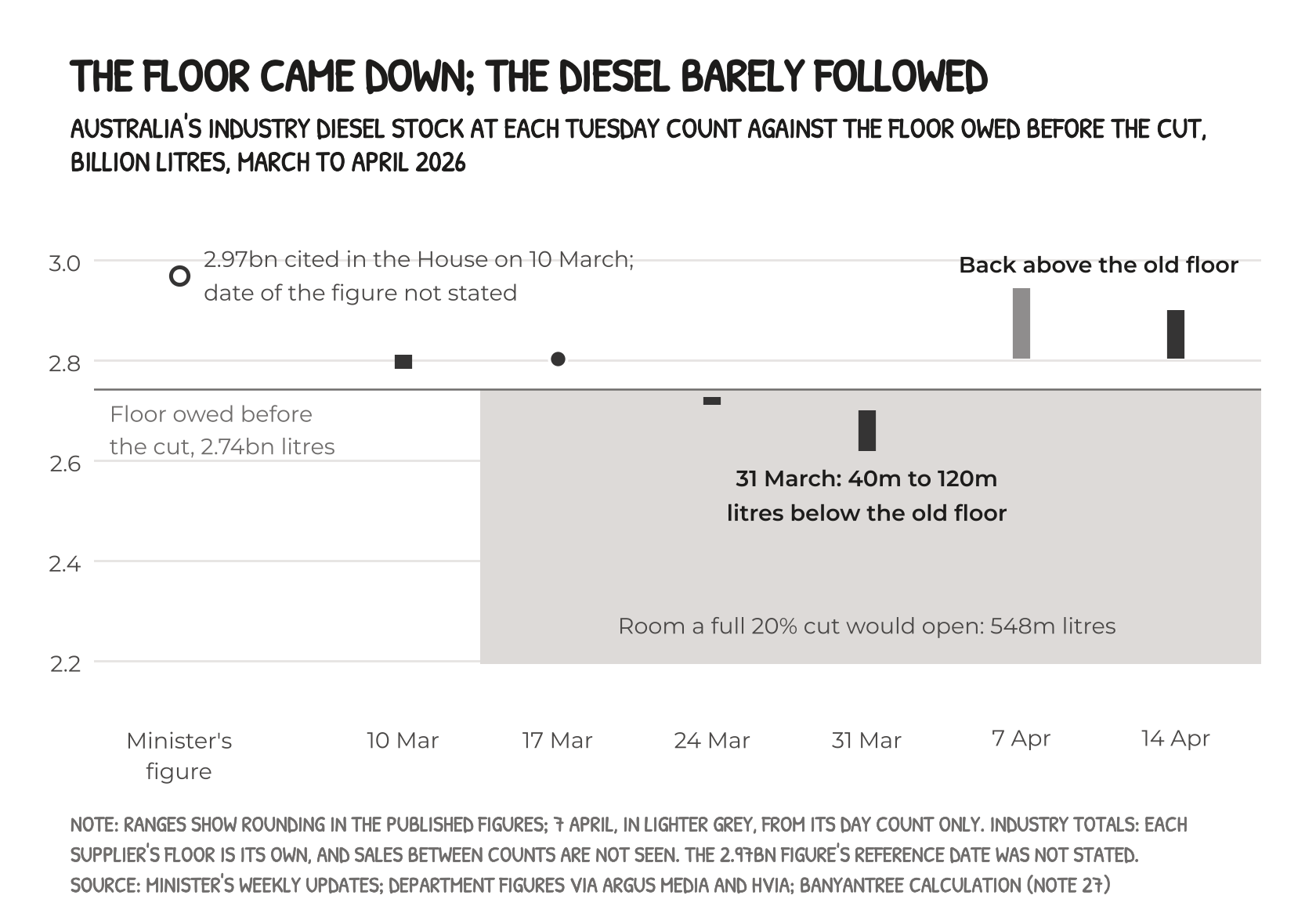
Figure 1. The floor came down; the diesel barely followed. Industry diesel stock at each Tuesday count, against the floor the industry owed before the cut and the room a full 20% cut would open. The stock went below the old floor at two counts, by at most about 120m litres, and was back above it by 7 April. Ranges reflect rounding in the published figures; sales between counts are not seen, and each supplier's floor is its own.²⁷
At no published count did the industry go far into the room it had been given. At its deepest the stock sat at most about a fifth of the diesel cut below the old floor: in barrels, well under a million of the 4.8m Australia had counted towards the agency's release. Against the half day that had stood above the old floor on 10 March, though, the same low was as much as twice that margin, on the other side of the line. Petrol never came near its floor at any count.²⁷
The counts cannot see what happened between them. A supplier expecting a cargo before Tuesday could sell ahead of it, and a lower floor let it sell further ahead with less risk of being caught short on the day. That freedom was real, and a Tuesday figure records none of it. Nor could a supplier keep the room it used. The instrument was written to lapse at the end of 30 June, after which a supplier would again owe its full minimum on the next Tuesday, unless the Minister lowered the floor again, as the Act allowed and as nobody had yet announced. Had the cut lapsed with the stock where it stood on 14 April, roughly a day of diesel would have stood above the old floor.²⁸ What the release handed suppliers was room, on loan until 30 June.
Supplier by supplier
What the government received in exchange was the plans. Of the examples the Minister gave on 28 March of what the release had produced, the two with a volume came to 1.6m litres: an extra 1.2m litres of diesel sent by one supplier to a regional distributor, and "an extra 400 kilolitres to the rural Dubbo region, which is so important and seeding at the moment, to fill bulk tanks".²⁴ They were a sliver of the cut, though the first alone was about the size of the shortfall Transwest reported for the whole of March, and both went to the regional and agricultural buyers the plans had named.
The government added purchase to permission on 16 April. Under new strategic reserve powers, the government announced about 100m litres of additional diesel in two shipments, from Brunei and South Korea. Export Finance Australia had partnered with Viva Energy to buy more than 570,000 barrels of diesel, and agreed commercial terms with Ampol and two independents, Park Fuels and IOR, for more. The cargoes, Bowen said, were "additional to existing contracted supply", were "required to remain in Australia" and "will be directed to the industries and regions which need them the most". The Prime Minister later spoke of 300m litres of additional supply achieved in seven days through Export Finance Australia, working with the private sector. Those were announced volumes, not fuel shown to have arrived.²⁹
The published total adds the suppliers together and cannot show how far any one of them stood above its own floor. That became a question about one company on the evening of Wednesday 15 April, when fire broke out in the alkylation unit at Viva Energy's Geelong refinery, one of the country's two. Viva told the market on 20 April that in the short term it expected the refinery to make diesel and jet fuel at about 80% of capacity and petrol at about 60%, and that "The Company has sufficient fuel stocks to cover this reduced production".³⁰ How far Viva could draw those stocks down depended on where its own floor sat. A refiner owes 20 days of what it makes rather than an importer's 32, less a fifth once a plan is lodged and confirmed, and whether Viva had lodged one is not public. The trade press reported that Viva usually had compliance tickets to spare for other importers, and that lower output at Geelong could leave it fewer to offer.³¹ Viva reports its stock to the department every week, as each supplier does, and the department publishes the sum: a month of diesel, with the floor inside it. The room the release handed over is inside it too, lent supplier by supplier until 30 June, in numbers the public does not see.
General information only. Not personal advice. Past performance is not indicative of future performance. Examples are illustrative. Banyantree may hold securities or funds discussed in this essay in client portfolios. This material is intended for wholesale and professional investors.
Notes
1. RK Crosby, "No fuel, no clue: Government blames panic buying as local suppliers run empty", New England Times, 10 March 2026 (updated 13 March): Transwest, "the largest fuel distributor in the region", says it will have no access to any fuel from tomorrow; Sam Clifton of Transwest Fuels said the company had been "cut off from supply out of major terminals"; "We have no access to any fuel from tomorrow"; "Zero. None out of Brisbane, none out of Newcastle. Zero."; the company received a small amount of fuel on Tuesday 10 March but had been warned there may be nothing more until the following week; the company described as "a critical supplier of fuel to our region's farmers". RK Crosby, "Tamworth distributor Transwest secures late invite to NSW fuel roundtable", New England Times, 16 March 2026: "Tamworth-based independent fuel distributor Transwest Fuels", which "employs about 100 people and is the largest fuel distributor in the New England". These are the newspaper's descriptions and the company's statements as reported. International Energy Agency (IEA), Oil Market Report, 12 March 2026, pp. 1 and 3: strikes by the United States and Israel on Iran from 28 February and a near halt in tanker movements through the Strait of Hormuz. Banyantree calculation: 28 February to 10 March is ten days.
2. House of Representatives, 10 March 2026, as reproduced by OpenAustralia from the official Hansard. Questions without notice, 3.02 pm, Mrs McIntosh (Lindsay): businesses in her electorate "are being impacted by fuel shortages"; "Aaron of Penrith City Plumbing Services has a fleet of three trucks but has had to take one of those trucks off the road due to fuel shortages. Can the minister assure Aaron there are no fuel shortages in Western Sydney?" Answer, 3.03 pm, the Minister for Climate Change and Energy: "our fuel supplies are secure and there is no need for panic buying"; "we have 2.97 billion litres of diesel in our minimum stock obligations, and we have 1.56 billion litres of petrol in reserve", "not called upon"; "Let me say to the House: I won't hesitate to release those reserves if necessary." Matter of public importance on the government's management of fuel supplies, from 3.14 pm; Mr Buchholz (Wright), from 3.54 pm: "when my spot buyers go to buy from the terminals, they're told: 'There is no fuel for you today.'"; "release the contracted fuel to the spot market".
3. Argus Media, Tom Woodlock, "Australia moves to weekly fuel stock reporting", 16 March 2026: as of 10 March, 30, 37 and 29 days of gasoil, gasoline and jet fuel "at the normal rate of consumption", "2pc, 52pc and 23pc above the required volumes under the MSO at the time"; suppliers "are required to report stocks held on Tuesday by Friday and prove compliance with the MSO"; the article reports that the department would temporarily publish the figures weekly rather than quarterly, and does not say when the Friday deadline began. Department of the Prime Minister and Cabinet, Fuel Supply Taskforce daily situation report of 20 March 2026 (FOI/2026/153), p. 1: stockholdings as at 10 March of 37 days of petrol, 29 of jet fuel and 30 of diesel. Fuel Security (Minimum Stockholding Obligation) Rules 2022 (F2022L01450), s 15 (obligation days each Tuesday from 1 July 2024) and s 17 (thresholds of 200 megalitres a year for gasoline and 250 megalitres each for diesel and kerosene). The weekly figures here and in notes 23 to 26 are the department's, as carried by the Minister's statements, the situation reports, Argus Media and Heavy Vehicle Industry Australia rather than by the department's own releases. The department's measure counts the stock described in note 6 and divides it by normal daily consumption.
4. Banyantree calculation. Pre-cut requirements of 2,742 megalitres of diesel and 1,067 of petrol: HWL Ebsworth Lawyers, J. Heatley and J. Zhan, "Fuel security: legal implications of the MSO framework under current global energy supply disruption", 10 April 2026, table of required volumes, consistent with the instrument's explanatory statement (note 20), which gives the cut as "up to 213 million litres of gasoline and up to 548 million litres of diesel", 20% of each. 10 March: for a margin m above the requirement, the share of the headline above the floor is m ÷ (1 + m). Diesel 0.02 ÷ 1.02 = 2.0% of 30 days, 0.59 day (0.44 to 0.73 if the 2% is rounded from 1.5% to 2.5%), so 98% of the stock was required; in litres 2% × 2,742m = 55m (41m to 69m), and the stock 2,797m (2,783m to 2,811m). Petrol 0.52 ÷ 1.52 = 34% of 37 days, 12.7 days, about 555m litres above its requirement. These assume the requirement in force on 10 March equalled the baseline. The Minister's figure (note 2): 2,970m − 2,742m = 228m litres (223m to 233m on rounding), 2.4 to 2.5 days at 91.9m to 93.5m litres a day of normal use (note 26). The reference date of the 2.97bn figure was not stated. It equals 32.3 days at Argus's normal rate of consumption, which matches the industry's average diesel holding of 32 days from September to December 2025 (Argus Media, "Australian fuel stocks exceed levels before US-Iran war", 20 April 2026); the petrol figure in the same answer, 1.56bn litres, is 35.9 days at Argus's normal petrol use of 273,000 barrels a day (43.4m litres; note 3), matching the 36 days of petrol the Minister on 18 April put at the start of the conflict (note 26). If the 2.97bn described the stock before the war, its fall to the 10 March stock was 173m litres (154m to 192m), about three-quarters (76%) of that margin, used in the first ten days of the war; the inference is conditional on the figure's date.
5. Minister for Climate Change and Energy, "More fuel for regional Australians", media release, 13 March 2026 (as reproduced on the ALP website): "releasing up to 20 per cent of the baseline Minimum Stockholding Obligation for petrol and diesel"; "allow the release of up to 762 million litres of petrol and diesel from Australia's domestic reserves"; "allow fuel companies to hold less in storage and get more into pumps"; "Relaxing the MSO will also serve as a contribution to the International Energy Agency's global collective action"; "This temporary reduction in the MSO could be equivalent to up to 5 million barrels". Companies would be allowed to relax their obligations only if taking steps to prioritise supply to regional customers and to "allocate reasonable additional supply to bulk customers such as independent regional distributors", and if providing "volumes needed to help meet usual demand, not tobe expected to provide uncontracted distributors or customers seeking to profiteer from global price spikes, panic purchasing or stockpiling with above normal quantities of fuel" (spelling as reproduced; the qualifier "with above normal quantities of fuel" governs the whole list). Explanatory statement to the instrument (note 20), Background: "On 11 March 2026, the IEA requested a voluntary collective action of 400 million barrels of emergency oil stocks". Banyantree calculation: 20% × (1,067m + 2,742m) = 761.8m litres = 4.79m barrels at 158.987 litres a barrel.
6. Fuel Security (Minimum Stockholding Obligation) Rules 2022 (note 3), s 7 (stock in a pipeline under the entity's ownership and control), s 9 (stock on a vessel within the outer limits of Australia's exclusive economic zone, or travelling directly to an Australian port after entering the zone and temporarily leaving it en route), ss 13 and 14 (crude oil and unfinished product counted at expected refinery yields); ss 11 and 12 (stock held by another entity, counted for an entity under a written arrangement giving it a contractual right to take possession of the stock, or under a written "section 24 arrangement", s 4, allocating the stock to it for a specified period). Stock that has passed to customers is not held by or for an obligated entity and is not counted; that it has not been burnt is the definition, not a measurement. Argus Media, 20 April 2026 (note 4): weekly volumes "include those in country storage and cargoes located within Australia's exclusive economic zone".
7. Department of Climate Change, Energy, the Environment and Water and ACIL Allen, Regulation Impact Statement Addendum: Minimum Stockholding Obligation, 8 November 2022 (Office of Impact Analysis), p. 9, Table 1: diesel consumption cover days for importers of 20 to 30 June 2024 and 32 from 1 July 2024; refiners 20. Argus Media, "Australia to cut mandated gasoil, gasoline stock levels", 13 March 2026, dates the full 32-day importer requirement from 1 July 2025; the rules allowed transitional reductions before then (Rules s 23). Banyantree calculation: 2,742m litres (note 4) is 29.3 days at 93.5m litres a day and 29.8 days at 91.9m (note 26).
8. Explanatory statement to the Fuel Security (Minimum Stockholding Obligation) Rules 2022, p. 1: "Gasoline and kerosene MSOs have been set at the average of the 2018 and 2019 calendar years (pre-COVID-19) levels, and the diesel MSO has been increased by 40% on pre-COVID-19 levels from mid-2024". Regulation Impact Statement Addendum (note 7): p. 8, "an additional 12 CCDs for diesel comprising 8 CCDs as a 40 per cent uplift in stocks" plus "4 CCDs accounting for stocks held in the EEZ"; p. 9, "due to a largely demand driven importing model, fuel companies generally operate on a 'just-in-time' basis and do not hold sufficient stocks to cover moderate to severe disruption events"; p. 18, "$0 in cost to gasoline as their business-as-usual stocks of gasoline are likely to be sufficient to meet their MSO". Banyantree calculation: 20 days × 1.4 = 28, plus 4 = 32.
9. Explanatory statement to the Rules (note 8), p. 11, on s 15: "While it will be possible for regulated entities to hold less than the required quantity of stock at other times", the required quantity must be held on the obligation day; p. 31, on the intermediary market for stock held on an entity's behalf: "This secondary market is important". Rules ss 11 and 12 (note 6). Argus Media, 20 April 2026 (note 4): "An S-21 ticket is a ticket for one litre of gasoil, jet fuel or gasoline"; "Suppliers subject to the MSO can paper trade S-21 tickets with other importers to ensure compliance". How actively tickets traded in March 2026 is not known.
10. Australian Institute of Petroleum, "AIP statement on fuel supply in Australia", 11 March 2026: "In some cases, suppliers have seen bulk fuel customers buying four times their usual volume of fuel."; "In these circumstances, AIP members have had to prioritise supply to their regular customers and cease spot sales."; "This is a normal response to high demand and is not a sign that longer term supply has been disrupted"; "Given the tight supply situation today, members typically do not have sufficient inventory to supply businesses" that cannot obtain fuel from their regular suppliers; its core members, Ampol, bp, Mobil Oil Australia and Viva Energy, "supply about 85 per cent of Australia's liquid fuels".
11. C.A.E. Goodhart, Liquidity Risk Management, London School of Economics Financial Markets Group, Special Paper 175, October 2007, pp. 3 and 4: "The most salient metaphor and fable in prudential regulation is of the weary traveller who arrives at the railway station late at night, and, to his delight, sees a taxi there who could take him to his distant destination. He hails the taxi, but the taxi driver replies that he cannot take him, since local bylaws require that there must always be one taxi standing ready at the station." "Required liquidity is not true, usable liquidity. Nor might I add, is required minimum capital fully usable capital from the point of view of a bank." The application to fuel stocks is Banyantree's.
12. Emma Alsop, "Diesel for NSW farms prioritised, Gulf ceasefire welcomed", Sheep Central, 8 April 2026, reporting the Minister: customers were drawing down 100pc of their bulk contract allocations, leaving less fuel available on the spot market, "which predominates in regional Australia hasn't been working as well"; "The companies are legally obliged to meet their contracts to people who have contracted diesel in particular in advance."
13. Beef Central, "Farming groups sound the alarm on fuel squeeze", 12 March 2026: Hamish McIntyre, president of the National Farmers' Federation, "The majority of fuel in regional communities is supplied by independent retailers. If those operators can't access supply, farmers can't access fuel."; Xavier Martin, president of NSW Farmers, on farm tanks: "Normally they're refilled by bulk suppliers, many of them smaller independent distributors in rural and regional areas." Neither statement gives a measured share of regional diesel delivered in bulk.
14. RK Crosby, "Extra diesel not getting to New England as fuel tensions persist", New England Times, 12 April 2026 (updated 15 April): "The company has previously acknowledged it operated largely without formal supply contracts", followed by the line "We've done business with these oil companies and our suppliers on handshakes", whose speaker the article does not name; "Transwest has claimed it received over one million litres less than its usual volume in March"; Ben Clifton, managing director: "our capacity to serve regional New South Wales and Queensland has dropped by 30%"; "industry sources say most bulk suppliers in the New England" "are securing their normal allocations"; other local bulk suppliers contacted denied any issues or declined to comment. These are the company's and the newspaper's accounts; the comparison is not a controlled test.
15. Australian Competition and Consumer Commission (ACCC), Weekly fuel price monitoring report, 20 March 2026: p. 2, "Petrol and diesel shortages have tended to be localised and caused by increases in demand, rather than overall reduced supply", with concerns about diesel availability in regional and rural Australia; p. 4, among the themes of its meeting of 17 March with industry and motoring organisations, concerns that "off-contract (spot market) buyers of fuel in the wholesale market are struggling to obtain supply", "disproportionately impacting supply reaching some regional areas", and the enforcement investigation announced on 19 March into allegations of anticompetitive conduct by each of the major fuel suppliers. ACCC, "ACCC investigating diesel supply conduct in regional and rural Australia", media release, 19 March 2026: the investigation concerns Ampol, BP Australia, Mobil Oil Australia and Viva Energy Australia, after reports about diesel availability to independent wholesalers and distributors serving regional and rural Australia. ACCC, Weekly fuel price monitoring report, 10 April 2026, p. 12: the investigation "is at an early stage, ongoing, and the ACCC is yet to form a view". Allegations are not findings.
16. International Business Times Australia, "More Than 600 Service Stations Run Out of Fuel as Aussies Are Urged Again Not to Panic Buy", 3 April 2026, reporting the Minister's figures via Sky News: "410 service stations across Australia have run out of diesel"; "193 service stations, on the other hand, have run out of petrol". A station short of both fuels may appear in both counts. Petrol's margin above its requirement exceeded 45% at every count from 10 March to 14 April (note 27).
17. House of Representatives, 26 March 2026, as reproduced by OpenAustralia, Questions without notice, 2.14 pm, the Minister for Climate Change and Energy: suppliers, "not unreasonably and, in fact, lawfully and legally", making sure they supplied petrol to "people who had orders in advance", "people on contract"; "People in the spot market have not been able to be supplied at the same rate", contracts being "honoured in the first instance"; Ampol's supplies in March compared with March 2025 were "40 per cent higher to independent suppliers in regional New South Wales", and "up 27 per cent in total". The Ampol figures are the company's, relayed by the Minister on 26 March.
18. Explanatory statement to the Rules (note 8), p. 23, on s 28: the circumstances in which the obligation may be suspended "may include (but not be limited to) where there is an actual or likely national liquid fuel emergency", or "where the International Energy Agency has triggered the collective action provisions of the Agreement". Regulation Impact Statement Addendum (note 7), p. 10: the modelled case in which "the nature of the event is such that the Minister directs a suspension of the MSO under the Act" and "allows stocks to be drawn down for a period of time to meet product demand".
19. Regulatory Reform Omnibus Act 2025 (C2025A00073), Schedule 4, Part 5, Division 1, "Temporary reduction power", commencing the day after Royal Assent on 4 December 2025; item 21 inserts s 16A into the Fuel Security Act 2021: the Minister may, by legislative instrument, reduce the quantity of stocks if satisfied the reduction is necessary to meet obligations under the International Energy Program Agreement or to prevent or alleviate a disruption to supply; the reduction "must not be greater, or apply to more obligation days, than is reasonably necessary"; the period of a reduction must not exceed six months, and further reductions may be made. Item 17 amends s 6 so that the obligation "may also be suspended or reduced". A company's own application to the Secretary for a temporary reduction was already possible under ss 17 and 18 of the Act. Banyantree calculation: 5 December 2025 to 16 March 2026 is 101 days.
20. The instrument on temporary reduction for securing regional supply made by the Minister under s 16A of the Fuel Security Act 2021 (Federal Register of Legislation F2026L00256), registered 16 March 2026: s 2, commencement the day after registration; s 5, for an entity that has given the Secretary a written plan, its minimum quantity of diesel or gasoline on each obligation day from the day the plan is given to the end of 30 June 2026 "is reduced by 20% if" the Secretary has given written notice of the reduced quantity and the entity "is taking all reasonable steps to carry out the plan"; s 6(1), the plan must set out how the entity will work with the Commonwealth, States and Territories to prioritise supply to regional, agricultural or maritime consumers who face or are likely to face shortages, allocate supply to distributing entities that mainly supply such regional areas and, "if the entity has been regularly supplying the MSO product to wholesale spot markets", "take reasonable steps to allocate supplies of the MSO product to those markets"; kerosene is not covered; s 7, repeal at the end of 30 June 2026. Explanatory statement: "Several fuel suppliers requested a temporary reduction or suspension of the MSO to support them to meet regional requirements"; the reduction applies from when the Secretary gives written notice; a reduction already approved by the Secretary under s 18 of the Act "may apply to 3 entities", the greater reduction prevailing. The government's own situation reports (note 3) dated the reduction's effect from 19 March.
21. IEA, "IEA confirms member country contributions to collective action to release oil stocks in response to Middle East disruptions", iea.org, which reports that the Governing Board "met yesterday" (the energy-pedia reproduction of 22 March 2026 dates the meeting to 18 March), table of contributions in million barrels: Australia 4.8 total, none from public stocks, 4.8 obligated industry stocks, 4.8 oil products; total IEA 426, of which public stocks 280, obligated industry stocks 119 and production increases 28; United States 172.2, all public stocks; United Kingdom 14.0, Spain 11.6 and Italy 10.0, all obligated industry stocks. Volumes coming from public stocks "or the lowering of obligations set on industry, remain subject to change"; "Breakdown by public/obligated industry stocks and by crude/products are not final and are subject to change"; the collective action was "by far the largest ever". Banyantree calculation: 119 ÷ 426 = 28%, as listed; Korea and France had not yet been split.
22. Banyantree calculation from notes 4 and 5, each cut against its own fuel's margin above the baseline requirement on 10 March: the petrol cut of 213m litres against the petrol margin of 555m litres, 38%; the diesel cut of 548m litres against the diesel margin of 55m, 10.0 times. The diesel cut is 72% of the 761.8m-litre total. The petrol statement concerns the industry total; an individual supplier could have stood closer to its own petrol floor.
23. Heavy Vehicle Industry Australia, "Fuel security update: March 20, 2026", reporting the department's figures for Tuesday 17 March: "diesel stocks sat at 2.804 billion litres as at Tuesday, the equivalent of 30 days' supply", 18% above the "required volume"; petrol 1.644bn litres, 38 days, 78% above; "Seven of the 11 domestic suppliers have now provided plans", from the national fuel supply briefing of 19 March. Banyantree calculation: diesel requirement 2,804m ÷ 1.18 = 2,376m litres, 366m (356m to 376m on rounding of the 18%) below the 2,742m baseline, 67% (65% to 69%) of the 548m-litre diesel cut; room above it 428m litres, 4.6 days, against 0.59 day on 10 March, a ratio of 7.8 (6.1 to 10.6); stock change from 10 March +7m litres at the central estimate. The petrol requirement fell by 67% of the petrol cut. What the department measured the 17 March margin against, including any s 18 reductions (note 20), was not published, and the government's situation reports dated the instrument's reduction from 19 March (note 20); the two-thirds is a share of volume, not a count of suppliers.
24. Minister for Climate Change and Energy, press conference, Sydney, 28 March 2026 (PM Transcripts 47297): "Diesel, 30 days, which is pretty flat at 2.7 billion litres"; "39 days of petrol, 1.6 billion litres"; "since we released the Minimum Stock Obligation, the 20 per cent, a few examples": "one provider has provided an additional 20 per cent to go to farmers and regional communities out of fuel"; "Another provider has provided 1,200 kilolitres extra diesel to a regional distributor"; "and one provider has provided an extra 400 kilolitres to the rural Dubbo region, which is so important and seeding at the moment, to fill bulk tanks". The update does not state its reference date. Argus Media, Tom Woodlock, "Asia fuel crunch pushes Australia to US, Europe", 1 April 2026: "Australia held 17.1mn bl of gasoil" on 24 March. Banyantree calculation: 17.1m barrels (17.05m to 17.15m) × 158.987 = 2,719m litres (2,711m to 2,727m), 15m to 31m below the 2,742m baseline. The examples total 1.6m litres, 0.4% of the 366m-litre reduction implied on 17 March; they are the Minister's selection, not a measure of the cut's use. The first, 1,200 kilolitres or 1.2m litres, is of the order of the "over one million litres" less than usual that Transwest said it received in March (note 14); the transcript does not name the distributor that received it.
25. Minister for Climate Change and Energy, press conference, Parliament House, 7 April 2026 (PM Transcripts 47313): "29 days' worth of diesel, that's 2.6 billion litres", repeating the figures of his Saturday update, as The Nightly reported it on 4 April 2026: "29 days of diesel (2.6 billion litres)" and "just over a month of petrol in supplies (1.7 billion litres)". Argus Media, Grace Dudley, "Australia secures fuel into May, Asia assures supply", 7 April 2026: 29 days of gasoil "as of 31 March". Banyantree calculation: a volume of 2.6bn litres (rounded or truncated) consistent with 29 days (rounded or truncated) at 91.9m or 93.5m litres a day gives 2,619m to 2,700m litres, 42m to 123m below the 2,742m baseline, 0.5 to 1.3 days.
26. Heavy Vehicle Industry Australia, "Fuel Security Update: April 15, 2026": "As at April 7, there were 38 days of petrol supply held under the MSO, 31 days of diesel and 28 days of jet fuel"; no volume was given. Minister for Climate Change and Energy, press conference, Sydney, 18 April 2026 (PM Transcripts 47336): "we have 31 days' worth of supply. That's the same as last week, 2.8 billion litres"; petrol "46 days", "just under 2 billion litres"; "these figures are more than we had on hand at the beginning of the Iran conflict", stated against 36 days of petrol at the start. Argus Media, 20 April 2026 (note 4), dates these figures to 14 April. Banyantree calculation: 2.8bn litres consistent with 31 days gives 2,803m to 2,900m litres, 61m to 158m above the baseline, between 8m below and 117m above the 10 March stock, and 65m to 172m below 2.97bn. Divisors: 578,000 barrels a day of normal gasoil use (Argus, note 3), 91.9m litres, and 2,804m ÷ 30 = 93.5m. The count of 24 March was given as 30 days by the Minister (note 24), while Argus described the 29 days of 31 March as unchanged from the week before (note 25), so day counts are treated as whole days.
27. Banyantree calculation from notes 3 to 5 and 23 to 26. At the deepest count (31 March) the stock was 42m to 123m litres below the old floor: 8% to 22% of the 548m-litre diesel cut, 11% to 34% of the 366m reduction implied on 17 March, and 0.26m to 0.77m barrels against the 4.79m counted towards the IEA action. Against the 55m litres (41m to 69m) that stood above the old floor on 10 March (note 4), the same 42m to 123m below it is 0.8 to 2.2 times that margin at its central value (0.6 to 3.0 across its rounding). On 24 March it was 15m to 31m litres below; on 10 and 17 March and on 7 and 14 April it was above. Petrol stood 45% or more above its baseline requirement of 1,067m litres at every count, and further above any reduced floor: 51% to 52% on 10 March and 54% on 17 March (notes 3 and 23); 45% or more on 24 March, at 1.6bn litres (note 24); 54% or more on 31 March, at 1.7bn (note 25); 52% or more on 7 April, at 38 days and 43.3m to 43.4m litres a day (note 26); and 78% or more on 14 April, at just under 2bn (note 26). Figure 1 plots the diesel stock intervals at each count (7 April from its day count only), the 2,742m-litre baseline, the 2,193.6m-litre floor that a full 20% cut would leave, and the 2.97bn figure of note 2; its data, source sheet and code accompany the figure files. Aggregate figures only; they assume the department's measure was comparable week to week and the reported stocks were compliant, and they say nothing about any one supplier or about sales between counts.
28. Instrument (note 20), s 7; Fuel Security Act 2021, s 16A (note 19), which allows further reductions. No further reduction had been announced by 22 April. Banyantree calculation: the 14 April stock of 2,803m to 2,900m litres stands 61m to 158m above the old floor, 0.7 to 1.7 days at 91.9m litres a day. Against the floor in force on 14 April, which is not published, the room was 4.6 to 5.7 days if only the reductions implied on 17 March applied, or 6.6 to 7.7 days if every supplier's cut had been confirmed, assuming none had lapsed; the cut supplied 70% to 90% of that room.
29. Prime Minister of Australia, "First fuel shipments secured under new Strategic Reserve Powers", media release, 16 April 2026: "approximately 100 million litres of additional diesel", "with two shipments coming from Brunei and South Korea"; Export Finance Australia "has partnered with Viva Energy" to purchase "more than 570,000 barrels of additional diesel" (about 91m litres; the release does not say how this relates to its 100 million litres); "EFA has also agreed to commercial terms with Ampol, Park Fuels, and IOR", to purchase additional fuel "to address regional shortages and critical supply gaps"; the Minister: "These cargoes are additional to existing contracted supply", "are required to remain in Australia" and "will be directed to the industries and regions which need them the most". The release does not say who owns the fuel or how it will be allocated, and does not mention the Geelong refinery. Prime Minister, press conference, Port Botany, transcript released 21 April 2026 (PM Transcripts 47339): "a new additional 200 million litres of diesel"; "this 300 million litres of additional supply we've achieved in the last seven days"; "an additional 300 million litres over the last seven days through Export Finance Australia, and working with the private sector". These are announced volumes; no delivery before 22 April is established.
30. Viva Energy Group, "Geelong Refinery Update", ASX announcement, 20 April 2026: a fire "within the Gasoline complex at Geelong Refinery" "on the evening of Wednesday 15 April 2026", in "the Alkylation Unit"; "In the short-term, Geelong Refinery expects to be producing diesel and jet fuel at approximately 80% of capacity and petrol at approximately 60%"; "The Company has sufficient fuel stocks to cover this reduced production and expects to maintain normal fuel supply"; it expected to lift production to over 90% of capacity in the following weeks, subject to inspection.
31. Argus Media, 20 April 2026 (note 4): "Viva is typically long on S-21 tickets thanks to its lower days of consumption requirements owing to its 120,000 b/d Geelong refinery"; "Lower distillates output at Geelong could mean it has less tickets to offer other importers who could be short of their MSO requirements"; the requirement is "20 days for refiners Viva Energy and Ampol"; "Around one-third of Viva's transport fuel sales are supplied by the Geelong refinery". Refiners' diesel requirement of 20 days: also note 7. Whether Viva lodged a plan under the instrument is not public, and company-level positions are not published; suppliers report their Tuesday stocks to the department each week (note 3).
