
The Reserve Bank of Australia reads underlying inflation through a measure built to throw out the largest price changes. In March 2026 it threw out fuel's, and fuel moved it anyway. When fuel would move it again was being settled less by the price of oil than by an averaging rule and the end date of a tax holiday.
By the team at Banyantree Investment Group
Provenance: Developed from questions first raised in Banyantree's Monthly Investment Letter of 30 April 2026.
At 2.30 in the afternoon of 5 May 2026, the Reserve Bank of Australia announced that its Monetary Policy Board had raised the cash rate to 4.35%. It was the Board's third increase of the year, and the vote was eight to one. The Bank published its quarterly Statement on Monetary Policy with the decision, and at 3.30 the Governor, Michele Bullock, held her media conference in Sydney.¹
Sophia Rodrigues, of Central Bank Intel, asked about oil. Other central banks, she said, all seemed to be looking for signs of second-round effects of higher oil prices. "Now, is the second-round effect because of home grown inflation or is it because of the Middle East conflict?"
"So we might get into semantics about what's first-round and what's second-round and so on," the Governor began. "There's clearly an impact on the Consumer Price Index on inflation from fuel prices. That's number one." Next came fuel, fertilisers and other inputs feeding into the cost bases of businesses, which passed the costs on. "Now, that could be it," she said. Prices would have reached a new, higher level, and if inflation expectations stayed low and stable, inflation would go back to the 2 to 3% the Bank aims for. Central banks, she thought, were watching less for the passing on of costs, which she called second-round, than for whether "that mindset" was "getting set further into inflation expectations". Then she drew the line. "So when we say we look through it, we can look through the initial impact. The indirect impact, if you like, on the costs of other businesses. And then we're looking for it to stop there."
Rodrigues asked her to clarify: by second round, did the Governor mean the indirect effect? "Look, the terms get used interchangeably."²
Where the Bank looks for it to stop is a statistic. Its preferred gauge of underlying inflation, the trimmed mean, ranks the price changes of the 87 expenditure classes in the consumer price index from the largest fall to the largest rise, sets aside the classes that make up the bottom 15% and the top 15% of the basket by weight, and averages the 70% in between. For now the Bank reads the quarterly version, which the Australian Bureau of Statistics (ABS) compiles on the collection schedule the index used before it went monthly in late 2025.³Automotive fuel makes up about 3.3% of the basket. In March its price rose 32.8%, the strongest monthly increase since the series began in 2017.⁴ A rise like that is what the top cut is for.
The Statement published that afternoon recorded, in a footnote, what had happened instead. Before the conflict, the Bank's staff had expected fuel to fall into the March quarter's "lower tail", the bottom 15%. It had landed in the "upper tail". Either way it was cut, but the footnote went on: "When an item's inflation rate moves from the lower tail to the upper tail, it causes higher item-level inflation rates to be included in the trimmed distribution over which the mean is calculated". The Bank put the effect at "around 0.1 percentage points", an eighth of the quarter's 0.8%. It counted that tenth among the direct effects of dearer fuel, the initial impact in the Governor's terms, and set it aside: net of it, underlying inflation had come in slightly lower than expected.⁵
The instrument for looking through the initial impact had been moved by it, without containing any of it. The Board would see the measure again when the June-quarter figures appeared in late July, before its August meeting, and again in late October, days before it met on 2 and 3 November.⁶ When would fuel, an item the measure had just left out, move it next, and could anyone reading the figures tell fuel's tenth from a sign that the effect had not stopped there?
A quarter with weather in it
The arithmetic can be watched at work. In September 2011, in a paper on its seasonal adjustment methods, the ABS published a fully worked trimmed mean for the June quarter of that year. It listed all 90 expenditure classes then in the basket, ranked from the largest seasonally adjusted fall to the largest rise, each with a running total of weight. Classes lying wholly below 15% or above 85% of that total were cut, and a class straddling a cut kept only the part of its weight inside the band. The answer was 0.7%.⁷
It was a quarter with weather in it. Cyclone Yasi had struck North Queensland in early February and cut the region's supply of bananas to around 15% of normal, and by the June quarter the ABS put banana prices at almost five times their level before the cyclone. Fruit stood at the top of the ranking, up 33.8%. At the bottom stood vegetables, down 10.3% as crops damaged by the floods recovered.⁷ ⁸ Rebuilt from the published table, the calculation gives 0.67%, which rounds to the ABS's figure. Had fruit risen by only 0.6%, the quarter's weighted median, the trimmed mean would have been 0.02 point lower. In an untrimmed average, fruit's spike would have added more than 0.4 point; the trim removed 95% of it.⁹ The ABS later wrote that the trimmed mean and weighted median had been "largely unaffected" by the banana shocks.¹⁰ The rebuild puts a number on "largely".
Automotive fuel sat lower down, 20th of 90, with a seasonally adjusted fall of 0.5%. It straddled the bottom cut: 1.71 points of its 4.2% weight lay inside the band and the rest below it.⁷ Move fuel alone into the upper tail of the same table and the trimmed mean rises from 0.67% to 0.81%. It rises by exactly that much whether fuel goes up 2.1%, 10% or the 32.8% of March 2026. Once fuel clears the top cut, about 2% in that quarter, none of its own price change reaches the average.⁹
What changes is the membership of the band. With fuel's weight now at the top rather than the bottom, both cuts move up the ranking. At the bottom, 4.2 points of weight leave the band: fuel's own 1.71 points, and the small falls in eggs, motor vehicle parts and part of motor vehicles that had sat just above it. At the top, 4.2 points of rises between 1.9% and 2.1%, which had sat just beyond the old cut, come in: domestic holiday travel, urban transport fares, bacon and ham, pets, lamb and mutton, and the fees on deposit and loan facilities. A shock to petrol reaches the average as lamb, bacon and holiday travel.⁹
That gives a rule. When a heavy item crosses from one tail to the other, the trimmed mean moves by roughly the item's weight, divided by the 70% of the basket that is kept, times the gap between the price changes pushed out at one end and let in at the other. In 2011 the gap was about 2.3 points, so each point of weight that crossed from the bottom tail to the top added a little over 0.03 point to the quarterly trimmed mean. At fuel's 2026 weight that comes to 0.11, consistent with the Bank's "around 0.1". The gap widens and narrows with the spread of prices from one quarter to the next, so the rule gives a first approximation and no more.⁹
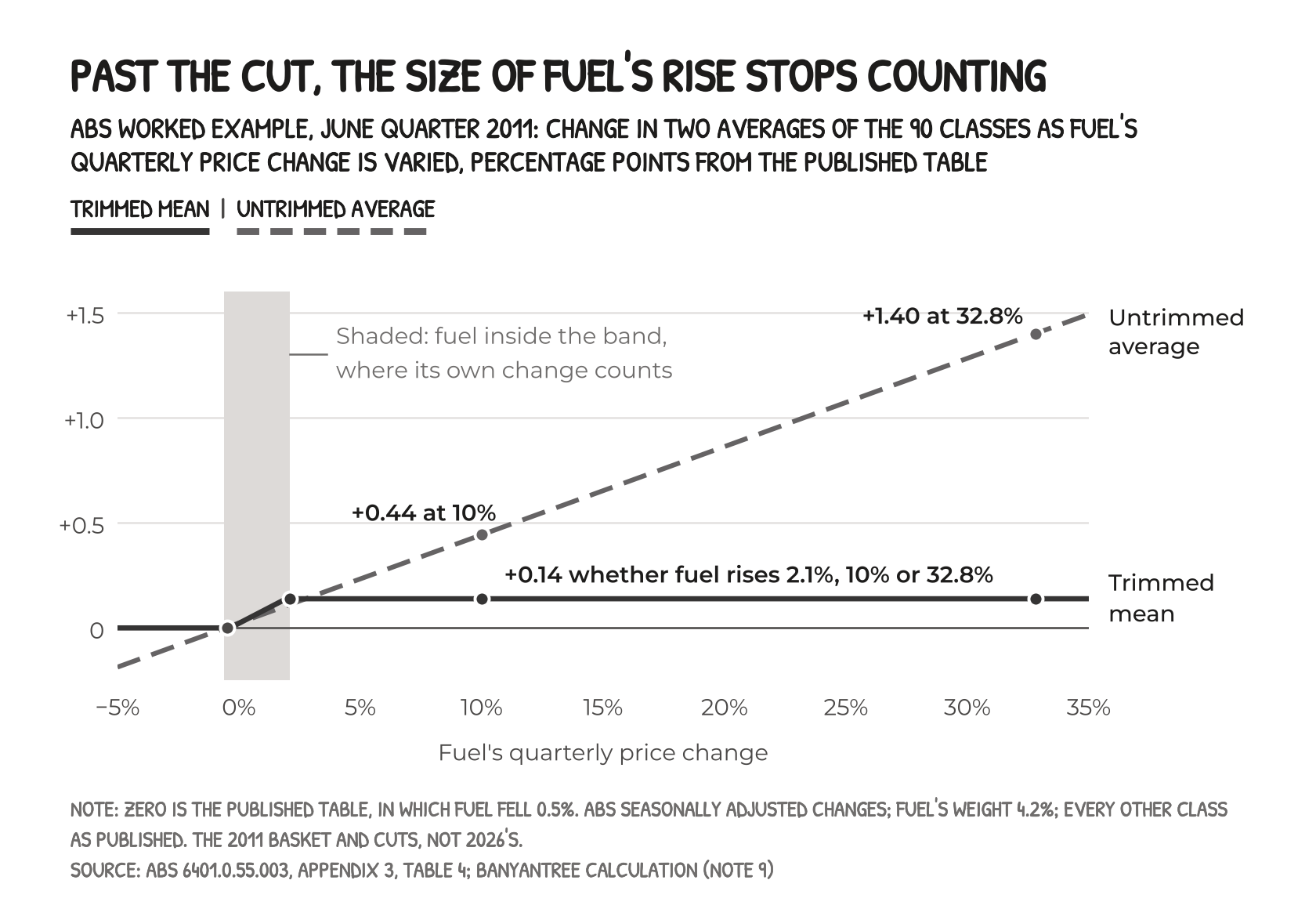
Figure 1. Past the cut, the size of fuel's rise stops counting. The ABS's worked example for the June quarter of 2011, with fuel's price change varied and every other class as published. With fuel up 32.8%, as in March 2026, an untrimmed average of the 90 classes would rise 1.40 points; the trimmed mean rises 0.14 point, as it does at 2.1%. It moves only while fuel is inside the narrow shaded band. The 2011 basket and cuts, not 2026's.⁹
The trim forgives the size of a shock and charges for its weight and its position. Position, in that table, was itself the work of a convention. The ABS had reported fuel up 4.0% in the quarter, and only the seasonal adjustment it applied to fuel at the time put it on the bottom cut; left unadjusted, fuel would have sat in the upper tail and lifted the trimmed mean by the same 0.14 point.⁹ ¹¹ The ABS has classed fuel as non-seasonal since at least 2016, so in 2026 its quarterly changes should reach the ranking unadjusted.¹¹ Where a heavy item lands is decided by its price and by the rules that turn prices into quarterly changes.
A calendar for the tails
In 2026 the rule that mattered was an averaging convention. For classes priced every month, fuel among them, the quarterly series takes "the average of the relevant three monthly indexes".³ Fuel fell 3.2% in January and 3.4% in February, then rose 32.8% in March. Averaged over the three months, the March-quarter index was 5.3% above the December quarter's: one month of the spike, diluted by two months of its prelude.¹² That was still enough for the upper tail, as the Bank's footnote recorded, and there any rise beyond the cut counts the same. The 32.8% had been compressed twice, by the averaging into about five, and by the trim into a change of membership.
The averaging also carried prices forward. April's fuel index, though 7% below March's, stood 10% above the March-quarter average. Had prices held there, fuel's June-quarter rise would have been another 10%, enough for the top again.¹²
Then Canberra wrote a calendar for the tails. On 30 March the Prime Minister, Anthony Albanese, announced that the Commonwealth would halve the fuel excise on petrol and diesel for three months, and the Treasurer, Jim Chalmers, told the same press conference that the expected impact was "to reduce headline inflation by about half of a percentage point through the year to the June quarter of 2026".¹³ From 1 April the excise was 32 cents a litre lower, the halving deepened by a further cut agreed with the states and territories. The Bank's Statement described the cut as "scheduled to reverse on 1 July", and its return would put the 32 cents back: about 35 cents a litre at the pump once GST is charged on it.¹⁴
The pump began to follow. On 1 April the average price of petrol in the five largest cities fell 16.7 cents a litre in a day.¹⁴ The ABS's April index showed fuel down 7.0%, and in its new monthly measure, the ABS noted, fuel had been "excluded from the Trimmed mean in both March and April 2026": thrown out at the top in March and, falling 7% in a month when the measure rose 0.3%, at the bottom in April.¹⁵
By late May most of the June quarter could be seen. Through the first three weeks of May, pump prices, weighted as the index weights petrol and diesel, ran about 12% below April's average, and if June merely matched May, fuel's June-quarter rise would come to about 1%.¹⁶ Whether that counts depends on where June's cuts fall, which could not be known until the quarter's figures appeared, and the Bank does not say where March's fell. The 2011 table stands in for the shape of the distribution, and the rule suggests it is a fair stand-in: its gap, applied at fuel's 2026 weight, gave a tenth consistent with the Bank's. The top cut sat near 2% in 2011; with underlying inflation a little higher in 2026, a top cut of 2% to 3% is a reasonable assumption. On it, fuel would sit inside the band in June, its own small rise counted. June's own prices would settle the matter: a June a few per cent dearer than May would put fuel back above the cut, and a June cheaper than May would push it towards the bottom. Measured as the Bank measured March's tenth, against fuel in the bottom tail, a rise of about 1% would add roughly half a tenth to the June reading.¹⁷
The September quarter is less open. If the excise returned on 1 July and pre-tax prices stayed at their late-May level, petrol would go from about 185 cents a litre to about 220, and the September quarter's fuel index would stand about 13% above the June quarter's, whose average still holds April's dearer prices: far above the cut. Rerun on the Bank's own assumptions, in which oil eases through the second half of 2026 and refining margins return to normal by early 2027, the calculation still puts the rise at 5% to 7%, above the cut.¹⁸
Governments had written such calendars before. Through 2025, as electricity rebates rolled off, the Bank reported that the resulting rise had "largely been excluded from the quarterly trimmed mean". When the last temporary fuel excise cut ended, in late September 2022, the Bank reported that its end "was largely offset by lower global oil prices": fuel rose 2% in the December quarter, when the trimmed mean rose 1.7%, which probably left fuel inside the band.¹⁹ Oil can offset an excise's return. In 2026 it would have had to fall a long way within a single quarter.¹⁸ The date itself could also move. On 27 May the Treasurer said the government was "not anticipating extending" the cut, but kept it "under review, really from week to week".²⁰ Were it extended, the jump would wait for whichever quarter the excise came back in.
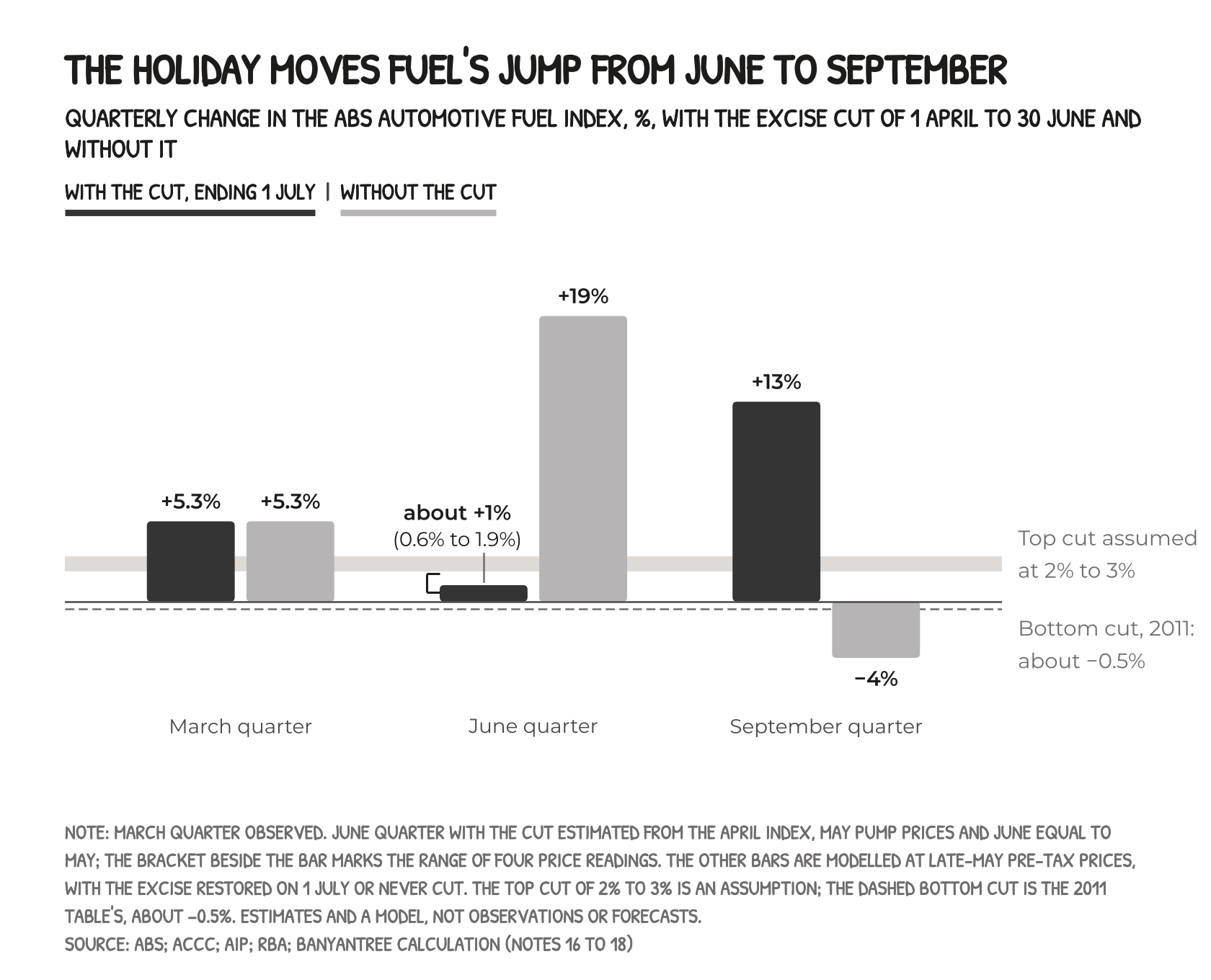
Figure 2. The holiday moves fuel's jump from June to September. Quarterly change in the fuel index the trimmed mean ranks, with the excise cut of 1 April to 30 June and without it, against a top cut assumed at 2% to 3% and the 2011 table's bottom cut, a fall of about 0.5%. With the cut, the June quarter's rise is about 1%, inside the band on every price reading but close to the top cut at the high end (0.6% to 1.9%), and the September quarter's about 13%; without it, about 19% and a fall of about 4%. June with the cut rests on April's index, May estimated from pump prices and June assumed equal to May. The other June and September bars are modelled at late-May pre-tax prices, with the excise restored on 1 July or never cut. Estimates and a model, not observations or forecasts.¹⁸
Set the two paths side by side and the holiday's effect on the Bank's measure comes into view. Without it, the same pre-tax prices would have given fuel a June-quarter rise of about 19%, deep in the top tail, and then a September-quarter fall of about 4% as April's dearer prices dropped out of the average: the top in June, the bottom in September.¹⁸ With it, fuel probably sits inside the band in June and at the top in September. By September the fuel index would be at the same level on both paths, so the holiday, which Treasury estimated would take about half a point off headline inflation in the year to June, would leave the price level where it would otherwise have been. The trimmed mean, which averages each quarter's ranked changes rather than levels, need not be. On these prices and the 2011 shape, it would end the two quarters no lower than without the holiday, and perhaps up to a tenth higher, depending on where fuel landed in June.²¹ The holiday changes the quarter in which the shock is counted, and can add a little to the count.
Where it stops
The tenth matters because of what it sits beside. The Bank's staff expected the costs of dearer fuel, passed on through other prices, to add around 0.4 point to underlying inflation over the year to the March quarter of 2027, with the effect strongest around the middle of 2026: about a tenth a quarter on average. Fuel's change of place in the ranking can move a single quarter's reading by about as much, and the Statement does not say whether that figure, or the Bank's forecasts, allow for it.²² Until it is allowed for, one print cannot show whether the pass-through is arriving or stopping, let alone whether anything lies beyond it. On the calendar above, fuel's placement would most likely add roughly half a tenth to the June reading, against a full tenth in March, just as the first passed-on costs arrived, and a full tenth again to the September reading, which the year-ended rate would then carry for four quarters.²² A June reading below March's would not, on its own, show that the shock had stopped. One no lower than March's would mean more than it appeared to.
The passed-on costs reach the measure through the same ranking. The Bank expects them to lift headline and underlying inflation by about the same amount.²³ That holds if they arrive as small rises across many prices, which stay inside the band. Not all of them do. Postal services rose 3.6% in March and 6.0% in April as parcel delivery fees caught up with fuel, in months when the monthly trimmed mean rose 0.3%.⁴ ¹⁵ A rise that concentrated can be trimmed like fuel.
Nor did the holiday reach the two kinds of fuel evenly. In cents it was much the same for petrol and diesel, but by 20 May it had offset about 70% of petrol's rise since February and about 40% of diesel's. For heavy vehicles the government also cut the road user charge, 32.4 cents a litre, to zero. A trucking business could already claim back the GST and a fuel tax credit equal to the excise less that charge; with the charge at zero, the credit covered all of the reduced excise, so the business saved the 32.4 cents and nothing more: about 40% of the rise in what it paid for a litre.²⁴ The relief did most for the price the trimmed mean is most likely to discard. The costs the measure keeps were still running on diesel.
Inside a single quarter's trimmed mean, the passed-on costs and the second round the central banks were watching for look alike: modest rises across the middle of the distribution. Only time separates them. Passed-on costs lift prices to a new level and stop, which is what the Governor meant by "Now, that could be it", and on the Bank's evidence full pass-through typically takes one to two years.²³ A second round, working through wages and "that mindset", keeps going, and even persistence is a clue rather than a proof, because other shocks arrive in the meantime. The Governor had said that the terms get used interchangeably. Within a quarter, so does the measure.
The Board's own division turned partly on how much home-grown pressure the shock had to work with. Its members agreed in May that monetary policy "could not prevent a near-term increase in the price level" but could "limit the risk that this cost shock resulted in a broader and sustained lift in inflationary pressure", and most were not confident that a cash rate of 4.1% would be enough. The dissenting member judged that "capacity pressures prevailing before the conflict" had been "somewhat less than the staff had assessed", and saw "not yet sufficient evidence" that longer-term inflation expectations were coming loose.²⁵ Read one way, that was Rodrigues's question answered twice: the majority saw enough home-grown pressure for an imported shock to build on, and the dissenter saw less and wanted the evidence first.
The early evidence was thin. Short-run inflation expectations had risen while long-run measures stayed consistent with the target, and some firms in the Bank's liaison were "actively considering whether to raise prices".²⁵ Market services inflation, excluding telecommunications and domestic travel, rose 1.0% in the March quarter, more than the Bank had expected. Fuel's place in the ranking cannot move that series, because fuel is not in it and nothing in it is trimmed.⁵
If the holiday ended on 1 July, the price at the pump would rise by about 35 cents a litre. The September-quarter trimmed mean would throw that rise away and let in, in fuel's place, a slice of whatever prices were sitting just beyond the top cut: about a tenth of a point more than if fuel had fallen into the bottom tail, where without the holiday it would have been, and none of it fuel. The Board would read that number in late October, days before it met in November, and would have to set the tenth aside before it could begin to ask whether the effect had stopped there.
General information only. Not personal advice. Past performance is not indicative of future performance. Examples are illustrative. Banyantree may hold securities or funds discussed in this essay in client portfolios. This material is intended for wholesale and professional investors.
Notes
1. Reserve Bank of Australia (RBA), Minutes of the Monetary Policy Board Meeting, 4 and 5 May 2026, published 19 May 2026, The decision: "The Board resolved by majority to raise the cash rate target to 4.35 per cent"; "Eight members voted in favour; one member voted to leave the cash rate target unchanged at 4.10 per cent." RBA, "Statement by the Monetary Policy Board: Monetary Policy Decision", 3 February 2026 (cash rate target raised to 3.85%) and 17 March 2026 (raised to 4.10%). RBA, Media Release 2025-02, "2026 Monetary Policy Board Meeting Dates", 10 February 2025: the outcome of each meeting is announced at 2.30 pm on its second day, followed by the Governor's media conference at 3.30 pm; the Statement on Monetary Policy is released with the decision in February, May, August and November.
2. RBA, Michele Bullock, Governor, Media Conference, Monetary Policy Decision, Sydney, 5 May 2026, official transcript. Sophia Rodrigues (Central Bank Intel) began "If I have watched and listened to other central banks properly, I think they're all looking for signs of second-round effects of higher oil prices" and asked "Now, is the second-round effect because of home grown inflation or is it because of the Middle East conflict?" The Governor's answer, quoted in order: "So we might get into semantics about what's first-round and what's second-round and so on."; "There's clearly an impact on the Consumer Price Index on inflation from fuel prices. That's number one."; fuel, fertilisers and other inputs feed into "the cost bases of businesses and they pass the costs on"; "Now, that could be it."; "In which case we've just reached a new high level of prices", and if inflation expectations stay low and stable, inflation goes back to the 2 to 3% range the Bank aims for; "I think what central banks are watching for is not necessarily that the cost", then "yes, you would expect to see the costs being passed through and that's second-round", then "but I think more what they're talking about, what they're watching for is: are there other implications once that's occurred, is that mindset getting set further into inflation expectations?"; "So when we say we look through it, we can look through the initial impact. The indirect impact, if you like, on the costs of other businesses. And then we're looking for it to stop there." Rodrigues's follow-up began "Just to clarify, so when you say second-round effect, do you actually mean indirect effect or"; the answer began "Look, the terms get used interchangeably." The transcript does not mention the trimmed mean.
3. Australian Bureau of Statistics (ABS), "Quarterly Trimmed mean (pre-October 2025 compilation basis) explanatory note", information paper, 21 January 2026: "The seasonally adjusted movements for each of the 87 CPI Expenditure Classes (ECs) are ranked from lowest to highest"; the classes that make up the top and bottom 15 per cent of the distribution are trimmed, and "The Trimmed mean is calculated as the weighted average of the movements for the remaining 70 per cent of ECs by weight"; for classes collected monthly, "the average of the relevant three monthly indexes will be used to produce the quarterly index", and the appendix lists automotive fuel as using all months; the series will be published "through to at least the June quarter 2027". RBA, Statement on Monetary Policy, May 2026, chapter 2, endnote 2: "The RBA will continue to focus on measures of underlying inflation from the quarterly CPI (based on the pre-October 2025 collection frequency) for a period." The two documents do not name each other; the March-quarter result each publishes is 0.8% (note 5; ABS, media release, "CPI rose 4.6% in the year to March 2026", 29 April 2026).
4. RBA, Statement on Monetary Policy, May 2026, chapter 4, "In Depth: The Impact of Higher Global Energy Prices on the Australian Economy", section 4.2: "This reflects the fact that fuel directly makes up 3.3 per cent of the CPI basket." The ABS's weight for automotive fuel was 3.35% (ABS, "Seasonal adjustment for the new complete Monthly Consumer Price Index (CPI)", 23 July 2025, Appendix D). ABS, Consumer Price Index, Australia, March 2026, released 29 April 2026: automotive fuel prices rose "32.8 per cent in the month of March 2026, which is the strongest monthly increase since the series began in 2017"; diesel "contributes 10% of the automotive fuel expenditure class"; "prices for Postal services rose 3.6% in March reflecting the impact of higher fuel costs on parcel delivery fees"; the monthly trimmed mean rose 0.3% in March.
5. RBA, Statement on Monetary Policy, May 2026, released 5 May 2026 (forecasts finalised 29 April), chapter 2, Economic Conditions, section 2.2: "Trimmed mean inflation remained elevated at 0.8 per cent in the March quarter and increased to 3.5 per cent in year-ended terms." The direct effects of the increase in fuel prices faced by households "caused quarterly trimmed mean inflation to be around 0.1 percentage points higher than otherwise, as fuel's position within the quarterly distribution of price changes shifted relative to expectations in the February Statement"; setting them aside, "underlying inflation was slightly lower than expected in the February Statement". Footnote 3: "In the February Statement, which was prior to the onset of the Middle East conflict, fuel was expected to be in the 'lower tail' of the distribution of price changes (i.e. the bottom 15 per cent of the distribution) in the March quarter. Owing to the conflict, fuel was in the 'upper tail' of the distribution of price changes (i.e. the top 15 per cent of the distribution) in the March quarter. When an item's inflation rate moves from the lower tail to the upper tail, it causes higher item-level inflation rates to be included in the trimmed distribution over which the mean is calculated, such that trimmed mean inflation will be higher than otherwise." "Market services inflation (excluding telecommunications and domestic travel) increased to 1.0 per cent in the March quarter, above expectations in the February Statement." The Statement does not show how the 0.1 was calculated. Banyantree calculation: 0.1 ÷ 0.8 = 0.125, an eighth.
6. RBA, Media Release 2025-02 (note 1): the 2026 meetings include 15 and 16 June, 10 and 11 August, 28 and 29 September, and 2 and 3 November. ABS, Consumer Price Index, Australia, April 2026 (note 15): the CPI is released on the final Wednesday of each month until February 2027, when it moves to the fourth Wednesday; quarterly indexes are added in the March, June, September and December releases. The final Wednesdays of July and October 2026 are 29 July and 28 October; the release dates in the body are inferred from that rule.
7. ABS, 6401.0.55.003, Seasonal Adjustment of Consumer Price Indexes, 2011, released 14 September 2011, Appendix 3, "Calculation of underlying trend inflation measures using published CPI data", text and Tables 4 and 5. Table 4 ranks the 90 expenditure classes by "June quarter 2011, percentage change from previous quarter (seasonally adjusted)"; its weight column is headed "March quarter 2010, cumulative weights % (seasonally adjusted)", apparently a slip for the March quarter 2011 that the text and Table 5 give. Vegetables −10.3% (rank 1, cumulative weight 1.50); Automotive fuel −0.5% (rank 20, cumulative weight 16.71, after 12.51), footnote (c): "Partially trimmed out. Included weight = 16.71% - 15% = 1.71%."; Fruit +33.8% (rank 90). "Expenditure classes which cross the 15% and 85% threshold have the component of their weight inside the 70% trim included." "In this example, the June quarter 2011 Trimmed mean is 0.7%." The weighted median is Fish and other seafood, 0.6%.
8. RBA, Statement on Monetary Policy, May 2011, Box B, "An Update on the Impact of the Natural Disasters in Queensland": Cyclone Yasi in early February; "The supply of bananas from areas in North Queensland has fallen sharply as a result of Cyclone Yasi", to "around 15 per cent of normal levels". RBA, Statement on Monetary Policy, August 2011, chapter 5, Price and Wage Developments: "Fruit prices rose by 27 per cent in the quarter owing to the ongoing effect of Cyclone Yasi on banana prices (which the ABS estimates were almost five times higher than before the cyclone)"; "vegetable prices declined by 10 per cent as the supply of crops affected by the floods recovered"; "automotive fuel prices rose by 4 per cent in the June quarter". These movements are before seasonal adjustment; the ABS ranking (note 7) uses seasonally adjusted ones.
9. Banyantree calculation from Table 4 (note 7). Weights are the differences between successive published cumulative weights; classes are ranked by their published changes, ties in table order, and cut at 15% and 85% of cumulative weight with partial inclusion. (a) Rebuild: 0.672%, consistent with the published 0.7%, which covers 0.65% to 0.75%; weighted median Fish and other seafood, 0.6%, as published. (b) Fruit (weight 1.28) at the weighted median's 0.6%: 0.650%, so fruit's place added 0.022 point; in an untrimmed weighted average its rise would have added 1.28 × (33.8 − 0.6) ÷ 100 = 0.425 point, of which 94.9% was removed. The 0.6% counterfactual is an assumption. (c) Fuel (weight 4.20) at any change from 2.1% to 32.8%: 0.808%, 0.136 above the rebuild; at 2.0%, where it straddles the top cut, 0.808 to three places. The trimmed mean is flat for fuel changes up to a fall of 0.6% and from a rise of 2.1%. (d) Leaving the band: fuel 1.71, eggs 0.09, motor vehicle parts and accessories 0.71 and motor vehicles 1.69 (4.20 in all; weighted average change −0.32%, or −0.20% for the three classes other than fuel). Entering: domestic holiday travel and accommodation 1.94, urban transport fares 0.74, bacon and ham 0.22, pets, pet food and supplies 0.47, lamb and mutton 0.30, and deposit and loan facilities 0.53 (4.20; changes 1.9% to 2.1%; average 1.95%). Rule: 4.20 ÷ 70 × (1.95 + 0.32) = 0.136, equal to the exact lift. (e) From deep in the bottom tail (−15%) to the top: 0.139, or 0.033 point per point of weight, an implied gap of 2.3 points. At the RBA's 3.3% weight (note 4): 3.3 × 0.033 = 0.11. The RBA's 0.1 at 3.3% implies 0.030 per point of weight and a gap of 2.1 points; a rounded 0.1 could lie anywhere from 0.05 to 0.15, implying gaps of 1.1 to 3.2 points. (f) Of the tail-to-tail lift, 55% lies between the middle of the band (fuel at the rebuilt trimmed mean of 0.672%) and the top, and 45% between the bottom and the middle. (g) Fuel at its unadjusted 4.0% (note 11), every other class seasonally adjusted as published: 0.808%, 0.136 above the rebuild, or 0.0325 point per point of weight against the 0.0303 the RBA's 0.1 implies; a hybrid, used only to show the effect of placement. (h) Inside the band the trimmed mean rises by about 0.060 point per point of fuel's change (4.20 ÷ 70), against 0.042 for the untrimmed weighted average of the 90 changes (4.20 ÷ 100); at a fuel change of 1.4% the two stand 0.103 and 0.080 above the published table. At 10% and 32.8% the untrimmed average is 0.44 and 1.40 above it, the trimmed mean 0.14. Figure 1 plots both for fuel changes from −5% to 35%; its data, source sheet and code accompany the figure files.
10. ABS, "Underlying Inflation Measures: Explaining the Trimmed Mean and Weighted Median", research article, 17 April 2019: after the rise in banana prices that followed Cyclone Larry in 2006, "A similar event occurred again in 2011, with banana prices rising as a result of Cyclone Yasi, and later falling to normal price levels"; "while the CPI was significantly affected by these events, the Trimmed mean and Weighted median were largely unaffected".
11. ABS, 6401.0, Consumer Price Index, Australia, June 2011, Main Features: automotive fuel "(+4.0%)" among the quarter's most significant price rises. ABS, 6401.0.55.003 (note 7), "Trimmed Mean and Weighted Median Measures of Inflation": differences between the series reflect in part "the inclusion of 'Automotive fuel' and 'Hospital and medical services' as seasonal expenditure classes". ABS, Consumer Price Index, Australia, September 2016, Appendix, "Seasonal adjustment of the CPI", Table 1: automotive fuel non-seasonal before and after the 2016 re-analysis. ABS, "Seasonal adjustment for the new complete Monthly Consumer Price Index (CPI)" (note 4), Appendix D: automotive fuel "Non-seasonal"; the legacy quarterly series are to be compiled so that "their pre-October 2025 seasonal patterns and seasonal adjustment quality will be maintained". The ABS does not state fuel's 2026 quarterly seasonal factor in terms; the reading that it is nil rests on these documents. Banyantree calculation: (1 + 4.0%) ÷ (1 − 0.5%) − 1 = 4.5 points of seasonal adjustment in the 2011 example.
12. Banyantree calculation from the ABS monthly movements in automotive fuel (notes 4 and 15): −0.9% (October 2025), +2.5% (November), −0.5% (December), −3.2% (January 2026), −3.4% (February), +32.8% (March), −7.0% (April). Index, December 2025 = 100: October 98.05, November 100.50, January 96.80, February 93.51, March 124.18, April 115.49 (23.5% above February, as the ABS reports). Quarterly index as the average of the three monthly indexes (note 3): December quarter 99.52, March quarter 104.83, a rise of 5.3% (5.2% to 5.5% allowing for the rounding of the monthly movements). April is 10.2% above the March-quarter average. Fuel being non-seasonal (note 11), these unadjusted changes are the ones ranked.
13. Prime Minister of Australia, press conference, Parliament House, Canberra, Monday 30 March 2026, transcript: "today we're announcing the Commonwealth Government will halve the fuel excise on petrol and diesel for three months"; the Treasurer, Jim Chalmers: "The expected impact of what we're announcing today is to reduce headline inflation by about half of a percentage point through the year to the June quarter of 2026." RBA, Statement on Monetary Policy, May 2026 (note 5), chapter 2: "The reduction in fuel excise duty from 1 April is expected to have reduced year-ended headline inflation in April by around 0.5 percentage points."
14. Department of Infrastructure, Transport, Regional Development, Communications, Sport and the Arts, "Fuel excise and heavy vehicle road user charge relief for Australian drivers", web page (undated): "The fuel excise paid per litre has been reduced from 52.6 cents to 20.6 cents."; "This took effect from 1 April and will run for three months."; the road user charge was reduced "from 32.4 cents per litre to zero for three months"; "Fuel is expected to be 32 cents per litre (plus GST) cheaper at the bowser." The same rates and start date: ABS, Consumer Price Index, Australia, April 2026 (note 15), "reduction of the fuel excise from 52.6 cents per litre to 20.6 cents per litre on 1 April". Australian Competition and Consumer Commission (ACCC), media release, "ACCC monitors fuel excise cut, fuel surcharges and fuel price movements", 2 April 2026: on 1 April, daily average retail petrol prices in the five largest cities were 16.7 cents a litre lower, and diesel prices 15.0 cents lower, than the day before; the halving cut the excise by 26.3 cents a litre, and a further cut of about 5.7 cents a litre was agreed between the states and territories and the federal government; retail prices "should reduce initially by about 26.3 cpl and ultimately by 32 cpl". ACCC, weekly fuel price monitoring report, 22 May 2026: "The temporary 32 cents per litre (cpl) reduction in fuel excise is due to end on 30 June 2026"; the further cut reflected "an agreement with States and Territories to forgo GST revenue on fuel". RBA, Statement on Monetary Policy, May 2026, chapter 3, Outlook, section 3.4: "The increase in fuel prices in the June quarter is projected to be reduced by the temporary reduction in fuel excise, which is scheduled to reverse on 1 July." The ACCC's 32 cpl, like its 26.3, is the cut in excise and leaves out the GST charged on it; the Department's "32 cents per litre (plus GST)" includes it. Banyantree calculation: 52.6 − 20.6 = 32.0 cents of excise; with GST at 10% charged on the excise-inclusive price, 35.2 cents at the pump.
15. ABS, Consumer Price Index, Australia, April 2026, released 27 May 2026, and media release, "CPI rose 4.2% in the year to April 2026", same date, quoting Sue-Ellen Luke, ABS head of prices statistics: "Automotive fuel prices fell 7.0 per cent from March to April, after rising by 32.8 per cent in the previous month."; "The fall this month includes the halving of the fuel excise on 1 April."; "Automotive fuel prices are still 23.5 per cent higher compared to February and before the impact of the Middle East conflict". In its own text, the media release notes: "For example, Automotive fuel was excluded from the Trimmed mean in both March and April 2026." The release: postal services rose 6.0% in April after 3.6% in March, reflecting "the continued impact of higher fuel costs on parcel delivery fees"; the monthly trimmed mean rose 0.3% in April; regular unleaded petrol averaged 228 cents a litre in March and 206 in April, and diesel 256 and 292. The exclusions refer to the monthly trimmed mean. That fuel was excluded at the top in March and at the bottom in April is Banyantree's inference: a 32.8% rise cannot sit in the bottom tail of a month in which the measure rose 0.3%, nor a 7.0% fall in the top.
16. Banyantree calculation. Pump prices stand in for the ABS fuel index, whose May figure was not published by the cutoff. Diesel is a tenth of the index at March prices (note 4) and 12.3% at April's. Petrol and diesel, cents a litre: ABS April averages, 206 and 292 (note 15); ACCC five-city daily averages on 6, 13 and 20 May, 181.1, 182.0 and 185.2 (petrol) and 242.7, 231.6 and 226.1 (diesel), and on 8, 15, 22 and 29 April, 225.3, 215.6, 191.8 and 181.4, and 320.3, 312.0, 276.9 and 247.6; Australian Institute of Petroleum (AIP) national weekly averages by calendar month, 210.3 and 293.9 in April and 184.7 and 238.0 in May, one April week interpolated and 25 to 31 May held at the week to 24 May. Four combinations give a May index 11.3% to 13.0% below April's; the central case, the ACCC's May readings against the ABS's own April averages, gives 12.4%. With June equal to May, the June-quarter change is +1.1% in the central case, with a range of +0.6% to +1.9%. For a June-quarter rise of 2%, 2.5% or 3%, June prices would need to be about 2.8%, 4.4% or 5.9% above May's in the central case (0.4% to 7.5% across the four). The ACCC covers the five largest cities and the AIP the nation; the ABS index covers the eight capitals. Sources: ACCC weekly fuel price monitoring reports of 10, 17 and 24 April and 8, 15 and 22 May 2026; AIP, "At a glance: current fuel prices", weeks ended 29 March to 24 May 2026.
17. Banyantree calculation and assumption. The Bank does not state where the 2026 cuts fell, and June's depended on prices not due for publication until late July (note 6). The ABS said it would publish seasonally adjusted series for all 87 classes alongside the quarterly trimmed mean (explanatory note, note 3), and its March 2026 release (29 April 2026) carries an Appendix 1a, "CPI: Quarterly Analytical Series and Seasonal Adjustment Factors on pre-October 2025 basis"; the March-quarter cuts could be computed from those series. The essay uses instead the shape of the 2011 table, checked against the Bank's 0.1. In the 2011 table the top cut was about 2% and the bottom cut about −0.5%, where fuel straddled it (note 9); quarterly underlying inflation was a little higher in 2026 (0.8% against 0.7%), and the gap implied by the Bank's 0.1 at a 3.3% weight is about 2.1 points, against 2011's 2.3 (note 9(e)). The essay therefore assumes a top cut of about 2% to 3%. Figure 2 draws that assumed top cut and, for reference, the 2011 bottom cut; were the whole band up to a point higher in 2026, as the top-cut assumption allows, the bottom cut would sit at up to +0.5%, still below the June range of +0.6% to +1.9% (note 16). Placement effects are measured, as the Bank measured March's, against fuel in the bottom tail, and scaled to the Bank's 0.1. On the 2011 shape, a June-quarter fuel rise of 1.1% keeps about 60% of the tail-to-tail lift, or about half if the whole band sits 0.3 point higher than in 2011: about 0.05 to 0.06 point, against March's 0.1. The range of +0.6% to +1.9% keeps between about 30% and 95%; a fall below the bottom cut would keep none.
18. Banyantree calculation from notes 12, 14 and 16. The excise is restored on 1 July and passed through in full; pre-tax prices are held at their late-May level (central May case); petrol and diesel are weighted at their May shares of the index. Restoring 35.2 cents takes petrol from 185.2 to 220.4 cents a litre (+19.0%) and diesel from 226.1 to 261.3 (+15.6%) on the ACCC's 20 May prices, and the index up 18.6%. The September-quarter index is then 13.3% above the June quarter's (13.0% to 13.8% across the four May cases). With only part of the excise passed through, the rise stays above 2% unless less than about 36% of the 35.2 cents reaches the pump (34% to 38% across the four cases; at half, +4.4%); on 1 April, petrol fell 16.7 cents in a day, against the initial fall of about 26.3 cents the ACCC expected (note 14). To keep the rise below 2%, 2.5% or 3%, pump prices would have to average 10.0%, 9.5% or 9.1% below their restored level; for petrol, with margins unchanged, a 10% fall is a fall of 13.6% in pre-tax prices and of 16.6% in the Mogas 95 benchmark (121 Australian cents a litre in the week to 20 May; ACCC report of 22 May). Bank's assumptions: RBA, Statement on Monetary Policy, May 2026, chapter 3, Table 3.2, Brent US$101.7 a barrel in June 2026 and US$82.3 in December 2026; Table 3.1: "The spread between refined fuel prices and Brent oil is assumed to return to historical average levels by Q1 2027." Inputs, in Australian cents a litre from the ACCC report of 22 May: Brent 100, Mogas 95 121 and Gasoil 143 in the week to 20 May, and 65, 68 and 79 in the week to 20 February, so refining spreads over Brent of 21 and 43 cents against 3 and 14. Brent's 20 May price is taken as its June level and moved with the Bank's path, interpolated in a straight line (US$92.0 in the September quarter, 9.5% below June). Refining spreads fall in a straight line from their 20 May level to March 2027, either to their February level or to 10 and 20 cents, a quarter of the way by the September quarter. Retail and other margins are held at their 20 May level and the exchange rate is unchanged. On those inputs, across both spread paths and the four May cases, the September-quarter rise is 5.1% to 6.8%: a Banyantree calculation on the Bank's assumptions, not a Bank forecast. Without the cut, with the same pre-tax prices and 35.2 cents more in April, May and June: June quarter +19.0% on the March quarter; September quarter −3.8% on the June quarter. From the March quarter to the September quarter the index rises 14.5% on both paths. Figure 2 plots the central cases, with the June range from note 16, and the assumed top cut and the 2011 bottom cut from note 17; its data, source sheet and code accompany the figure files.
19. RBA, Statement on Monetary Policy, February 2026, chapter 2, Economic Conditions: the rise in electricity prices through the year reflected mainly a temporary impulse from the roll-off of rebates, "which has largely been excluded from the quarterly trimmed mean over this period". ACCC, "Petrol prices fell in the September quarter for the first time in almost two years", 13 December 2022: the temporary excise cut applied "from 30 March to 28 September 2022". RBA, Statement on Monetary Policy, February 2023, chapter 4, Inflation, p. 56: "Fuel prices increased by 2 per cent in the December quarter and by 13 per cent over the year"; "The end of the temporary reduction in the fuel excise was largely offset by lower global oil prices." P. 55: "Trimmed mean inflation was 1.7 per cent in the quarter and 6.9 per cent over the year". Banyantree calculation from the ABS monthly movements in automotive fuel for 2022 (ABS, Consumer Price Index, Australia, April 2026, table of monthly movements): September quarter −4.4%, December quarter +2.2%, matching the Bank's figures of a fall of 4% and a rise of 2%. That fuel sat inside the band in the December quarter of 2022 is an inference from its rise relative to the trimmed mean, not from that quarter's ranking.
20. Treasurer, Jim Chalmers, press conference, Blue Room, Parliament House, Canberra, 27 May 2026, official transcript. Asked when the government would decide whether to extend the excise cut: "Well, we keep that under review."; "we're not anticipating extending that or expecting to extend it,"; "but we keep it under review, really from week to week."; "so that fuel excise relief will come off at the end of June, as we announced at the time." He also said: "Treasury analysis shows that our cut to the fuel excise reduced headline inflation by around half of a percentage point."
21. Banyantree calculation: a sensitivity on the prices in notes 16 and 18, not a forecast. Placement effects are measured against fuel in the bottom tail, as in note 17, and scaled to the Bank's tail-to-tail estimate of 0.1 point (note 5): bottom tail 0; middle of the band (fuel at the trimmed mean) +0.045, from the 2011 split (note 9(f)); top tail +0.10. Without the cut, fuel sits at the top in the June quarter and at the bottom in September: +0.10 over the two quarters. With it, September is at the top (+0.10) and June between the tails: +0.10 over the two quarters if June lands at the bottom, +0.145 in the middle and +0.20 at the top. The holiday's effect is therefore 0 to +0.10 over the two quarters; about +0.06 at the central June estimate (note 17), or +0.05 with the band shifted; 0 to +0.15 if the Bank's rounded 0.1 is anywhere from 0.05 to 0.15. In the September quarter alone it is +0.10. The calculation assumes the 2011 shape, the gap implied by the Bank's 0.1 and a fuel weight near 3.3% in both quarters; fuel's higher relative price on the no-cut path would give it slightly more weight in September, adding less than 0.01 to the result. Headline: the fuel index reaches the same September-quarter level on both paths (note 18), so the holiday's direct effect on the price level is nil by then; the half point is the Treasury's estimate for the year to the June quarter (note 13).
22. RBA, Statement on Monetary Policy, May 2026, chapter 3, Outlook, section 3.4: "The effects of higher fuel-related costs on consumer prices are expected to be strongest around the middle of 2026 and contribute around 0.4 percentage points to underlying inflation in the year to the March quarter 2027."; "We expect that the pass-through from fuel-related cost pressures to consumer prices will be relatively fast." The Statement does not say whether the 0.4, or the Bank's forecasts of underlying inflation, allow for fuel's place in the ranking after the March quarter. Banyantree calculation: 0.4 ÷ 4 = 0.1 a quarter on average. Year-ended rates: the RBA's trimmed mean measures "are calculated at the quarterly or monthly level and then cumulated to get annual rates" (Andrea Brischetto and Anthony Richards, "The Performance of Trimmed Mean Measures of Underlying Inflation", RBA Research Discussion Paper 2006-10, section 3.2.2, footnote 12), so a quarter's reading remains in the year-ended rate for four quarters.
23. RBA, Statement on Monetary Policy, May 2026, chapter 4 (note 4), section 4.2: fuel accounts for around 2 to 2½% of the domestic costs of producing and distributing the other goods and services in the CPI, and a 10% rise in domestic fuel prices, if sustained, would leave the price level around 0.2% to 0.25% higher over one to two years through those costs, other things equal; "This indirect cost channel would generally be expected to have equal-sized effects on headline and underlying inflation." The Statement gives no reason in terms; that small, widespread rises stay inside the band is Banyantree's reading. Empirical work suggests that full pass-through typically takes around one to two years; second-round effects work through inflation expectations and wages growth.
24. Road user charge: Department of Infrastructure (note 14), reduced from 32.4 cents a litre to zero for three months. Banyantree calculation from the ACCC's five-city daily average prices (report of 22 May 2026, note 14), with full pass-through of the cut: petrol 170.9 cents a litre on 20 February and 185.2 on 20 May (+8.4%), 220.4 without the cut (+29.0%), so the cut offset 71% of the rise; diesel 176.6 and 226.1 (+28.0%), 261.3 without the cut (+48.0%), 42%. A GST-registered heavy-vehicle operator recovers the GST and claims a fuel tax credit equal to the excise less the road user charge: net cost 176.6 ÷ 1.1 − (52.6 − 32.4) = 140.3 cents on 20 February; 226.1 ÷ 1.1 − (20.6 − 0) = 184.9 cents on 20 May (+31.8%); 217.3 without the relief (+54.9%). The relief is 32.4 cents, the road user charge, and offset 42% of the rise; during the cut the credit was 20.6 cents, the whole excise. Retail five-city diesel prices stand in for the price operators pay.
25. RBA, Minutes of the Monetary Policy Board Meeting, 4 and 5 May 2026 (note 1). Considerations for monetary policy: members agreed that monetary policy "could not prevent a near-term increase in the price level" but could "limit the risk that this cost shock resulted in a broader and sustained lift in inflationary pressure"; most members were "not confident that, at 4.1 per cent, the cash rate would be sufficient" to mitigate the risks. The dissenting member judged "capacity pressures prevailing before the conflict" to have been "somewhat less than the staff had assessed", put the risk of a prolonged conflict weighing on demand higher, and saw "not yet sufficient evidence to be concerned about longer term inflation expectations becoming less anchored". Economic conditions: "The rise in fuel prices had already had an impact on inflation and short-run inflation expectations in Australia."; measures of long-run inflation expectations "remained consistent with the inflation target". Considerations for monetary policy: members acknowledged information from liaison that "some firms were actively considering whether to raise prices". Asked about the split, the Governor said the dissenter had been "less convinced that we had excess demand, as much excess demand as we thought" (note 2). The reading of the vote in terms of home-grown pressure is Banyantree's; the minutes do not use the term second round.
