
Australia's Treasurer said an investor who earned the share market's average return would have done about as well or possibly better under indexation over the past ten or twenty years. A real decade of the fifty largest ASX companies shows the answer turning on something his sentence left out: whether the same shares are owned as one asset or as fifty.
By the team at Banyantree Investment Group
Provenance: Developed from questions first raised in Banyantree's Monthly Investment Letter of 20 May 2026.
On Tuesday 16 June 2026 a Senate committee sat at the Sydney Masonic Centre for its second and final day of evidence on the Government's capital gains bill. It was a public hearing, and it drew no crowd.
The crowd was next door. About a hundred people had packed the neighbouring room, some with placards calling for the tax to be axed, and at one stage were asked to move along so that the inquiry would not be disturbed. The man who had called them together at short notice was a fund manager, Geoff Wilson.¹
Wilson was a high-profile critic of the Bill, which would stop taxing individuals on half of each capital gain and tax instead the whole of the part that beat inflation, from July 2027.² Wilson Asset Management, which he founded and chairs, runs nine listed investment companies and about A$6bn for more than 130,000 people.³ It would be natural to assume that the tax was going to cost him.
Wilson told the room it would pay him. If the legislation went through, he said, "the business which I'm the owner of will be a major beneficiary". His own fortune had been made under the old rules, he said, and was protected.¹ The opening statement his firm published for the hearing put the same thing to the senators: money driven out of shares would move elsewhere, often into funds like his, and "Wilson Asset Management will benefit from that movement of capital".⁴ He opposed it all the same.
Most of his objections concerned investment in general. One was narrower. The Bill's technical design, his statement said, created inequities for Australians who invest directly in companies.⁴ His firm's submission had said how. Without some way of netting results across a portfolio, it said, an investor who owned ASX companies directly would be taxed more heavily than one who held the same exposure through a fund or a listed investment company, and the gap "compounds with portfolio size and volatility".³
On its face the complaint is strange. A fund that holds Westpac and CSL owns the same two companies, at the same prices and with the same result, as an investor who holds them directly. A tax meant to exempt inflation and charge only real gains has no obvious reason to treat the two owners differently, still less to charge more to the one who owns the companies outright.
The Government's own reassurance had passed over the question. Introducing the Bill on 28 May, the Treasurer, Jim Chalmers, said investors would "only pay tax on their above-inflation profit", and offered an example: "Someone who invested in the Australian share market and received the average return would have done about the same or possibly better under indexation over the past 10 or 20 years."⁵ The example gave the investor a return and a holding period. It did not say how the investor owned the market. Ten of those years can be rebuilt, company by company, at actual prices. Over that decade, what would the Bill's rules have charged an investor who owned the market one company at a time, and what would they have charged for the same companies owned as a single asset?
Where the allowance stops
Under the discount, the shape of a portfolio does not change the tax on its gains. Capital gains tax is worked out asset by asset, each holding with its own cost and its own gain or loss, but the results are then pooled: losses are deducted from gains, and the discount halves what remains.⁶ Because the halving comes last, it makes no difference how gains and losses were spread across holdings before it. Fifty shares that gained A$100,000 between them are taxed exactly as one holding that gained A$100,000.
The Bill would do its work inside each asset. The cost of an asset held for at least a year would be raised in line with consumer prices in working out a gain, but not in working out a loss: a loss would still be measured from what was paid, and would still count in full against other gains.⁷ Every holding therefore ends in one of three places. Sold above its indexed cost, it has a real gain, taxed in full. Sold below what it cost, it has a nominal loss, which still reduces other gains. Sold anywhere between the two, it has neither: no gain, because indexation has absorbed it, and no loss, because the price never fell below cost. The inflation allowance, the amount by which indexation raises a holding's cost, is used only as far as it cancels that holding's own gain, and whatever is left cannot be passed to another holding. A holding that ends between its cost and its indexed cost loses the part of its allowance it could not use. One that ends below cost loses all of it. The asymmetry is not new: under the indexation that applied to assets bought before September 1999, a loss was never indexed either.⁸
The middle place is easy to reach. In October 2025 Dion Hershan, head of Australian equities at Yarra Capital Management, observed that some stocks had been "dead money for over a decade": an investor could have sold Westpac "for $39 in 2015 (now $39)".⁹ A share that ends a decade where it began has no gain to tax under either rule. Under the Bill its cost would also have been raised by about a third, and the whole of that allowance would lapse, however much the rest of its owner's portfolio had made. Inside a fund, the same share's shortfall would be part of one price, set against every other company's gain before any tax was worked out.
Below cost the result is stranger. Take two shares, each bought for A$50 and sold after ten years of 2.5% inflation have raised prices by 28%. One sells for A$100; indexing its cost to A$64 leaves a real gain of A$36. The other sells for A$25, a loss of A$25 to set against it. Their owner is taxed on A$11. Yet the pair has brought back A$125, when it would take A$128 to buy what the original A$100 bought. A tax on real gains has found one in a portfolio that lost ground to inflation. Held as one asset, the pair would have nothing to tax.
The arithmetic the Treasurer's sentence needs had been published on Budget night, 12 May, in a table in the Government's explainer averaging what indexation would have charged over the previous twenty years. For the S&P/ASX 200 held for ten years, the average price gain had been 4.3% a year, and 56% of it had been inflation. Indexation would exempt that part and tax the rest in full, which for a seller on the 47% top rate comes to 20.7% of the gain, against 23.5% under the discount. The two rules cost the same where inflation is exactly half the gain.¹⁰ Every number in the table describes an index: one asset, with one cost and one price. The Bill would see the same market as however many assets its owner happened to hold.
The arithmetic was noticed within weeks. Stockspot, a robo-adviser, and Betashares, an ETF issuer, both in the business of pooled investments, told investors that indexation would favour fund units over shares. Betashares called the gap between a holding's cost and its indexed cost "the triangle of sadness".¹¹ On 5 June Stockspot put the rise in taxable gains at 82%, on the twenty securities most popular with Sharesight's users in April 2020; it also reported that an analysis in the Australian Financial Review, on three bank shares, had found the outcome broadly unchanged.¹² The two analyses used very different portfolios, and with a mechanism that works company by company, the choice of companies goes a long way towards deciding the answer. The comparison that isolates ownership needs a portfolio fixed in advance and held both ways.
Fifty companies, ten years
Take the fifty companies in the S&P/ASX 50 on 30 June 2015 and put A$20,000 into each, A$1m in all. Hold them for ten years, following each company through what happened to it: rights issues, the demergers of Coles from Wesfarmers and Endeavour from Woolworths, two mergers paid in shares, and five takeovers paid at least partly in cash, on which a direct holder would have been taxed as they happened. On 30 June 2025, apply the Bill's rules, as if they had been law throughout, to an investor on the top rate who sells everything. The test counts prices only, because dividends would be taxed as they are now.¹³
Consumer prices rose by 32% over the decade, and the fifty, as a portfolio, rose by 48%. Twenty-eight of the fifty failed to keep pace with prices, and seventeen ended below what they had cost. Telstra, AMP and Lendlease fell; Westpac and National Australia Bank rose by less than inflation; CSL and Macquarie each more than doubled.¹³
Had the Bill's rules applied, the tax on the same A$1m would have turned almost entirely on how it was held. Under the discount, the decade's gains would have cost about A$112,000. Held as one asset, like a unit in a fund that never sold anything, the fifty companies would have cost about A$75,000 under indexation, a third less. Held as fifty companies, at the same prices, they would have cost about A$149,000, a third more. The shares were the same, and the tax nearly doubled.¹⁴
On that decade the Treasurer's sentence held for one kind of owner. Inflation made up about two-thirds of the fifty's price gain, more than in Treasury's table, and indexation is generous when that share is high. No real fund is quite as still as the single asset, since an index fund realises gains when its companies are taken over and distributes them, but on the rise in its unit price alone, an actual unit in an ASX 200 index fund held over the same ten years would have paid about a quarter less under indexation than under the discount.¹⁵ The sentence did not hold for the same companies owned one by one, in equal parcels. In a decade kinder to indexation than Treasury's averages, the direct holder still paid a third more than the discount would have charged.
The difference is the allowance. Indexation would have raised the cost of the A$1m by about A$318,000. Held as one asset, which finished well above its indexed cost, all of it was used. Held as fifty companies, half of it was not. Two-thirds of what went unused belonged to companies that fell below cost, which lose their whole allowance even as their losses count. The companies stranded between cost and indexed cost, the triangle that drew attention in May, accounted for about a fifth. The rest never accrued, because the five takeovers stopped indexation early, a cost that a fund taxed on the same takeovers would be expected to share. Taxed at 47%, the unused allowance is the whole of the A$74,000 between the two bills.¹⁴
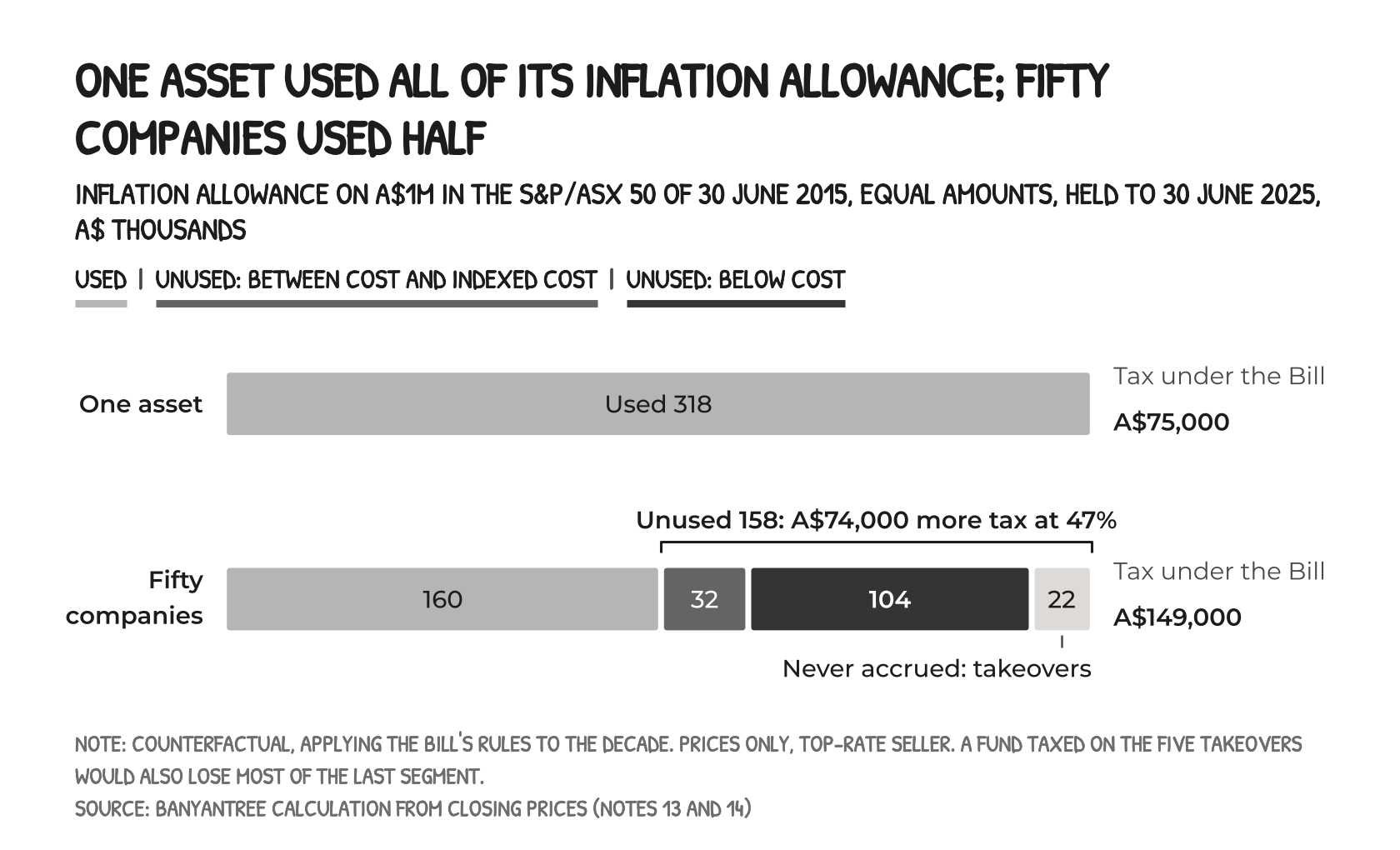
Figure 1. One asset used all of its inflation allowance; fifty companies used half. The amount by which indexation would have raised the cost of A$1m in the S&P/ASX 50 of 30 June 2015, held in equal amounts to 30 June 2025, as one asset or as the companies themselves. The single asset is a benchmark, not a fund's full tax bill. A counterfactual on prices only, for a top-rate seller; a fund taxed on the five takeovers would also have lost most of the last segment.¹⁴
More companies, the same forfeit
Wilson's submission said the asymmetry compounds with portfolio size. Draw five companies at random from the fifty, hold them in equal amounts for the decade, and compare their tax under the Bill with what the same five would have paid as one asset. Do it twenty thousand times, then again for ten, twenty, thirty and forty.
For portfolios of twenty, thirty or forty, owning the companies directly cost about seven cents of extra tax for every dollar invested, much the same as for all fifty. Portfolios of five or ten cost less on a typical draw and were far less predictable. Nearly one five-company portfolio in five paid nothing extra, and almost all of those escaped in the least enviable way: they had nothing to tax however they were held.¹⁶
Spreading the money made the penalty more certain and left it no smaller. Diversification usually thins out whatever is peculiar to each company. Here what is peculiar to each company is the point. Every holding carries its own allowance, and every holding that lags inflation forfeits its own, so more holdings bring more allowances, forfeited at about the same rate. If portfolio size means money, the penalty grew only in proportion to it. If it means the number of companies, on this decade the penalty levelled off past twenty or so at about seven cents a dollar.
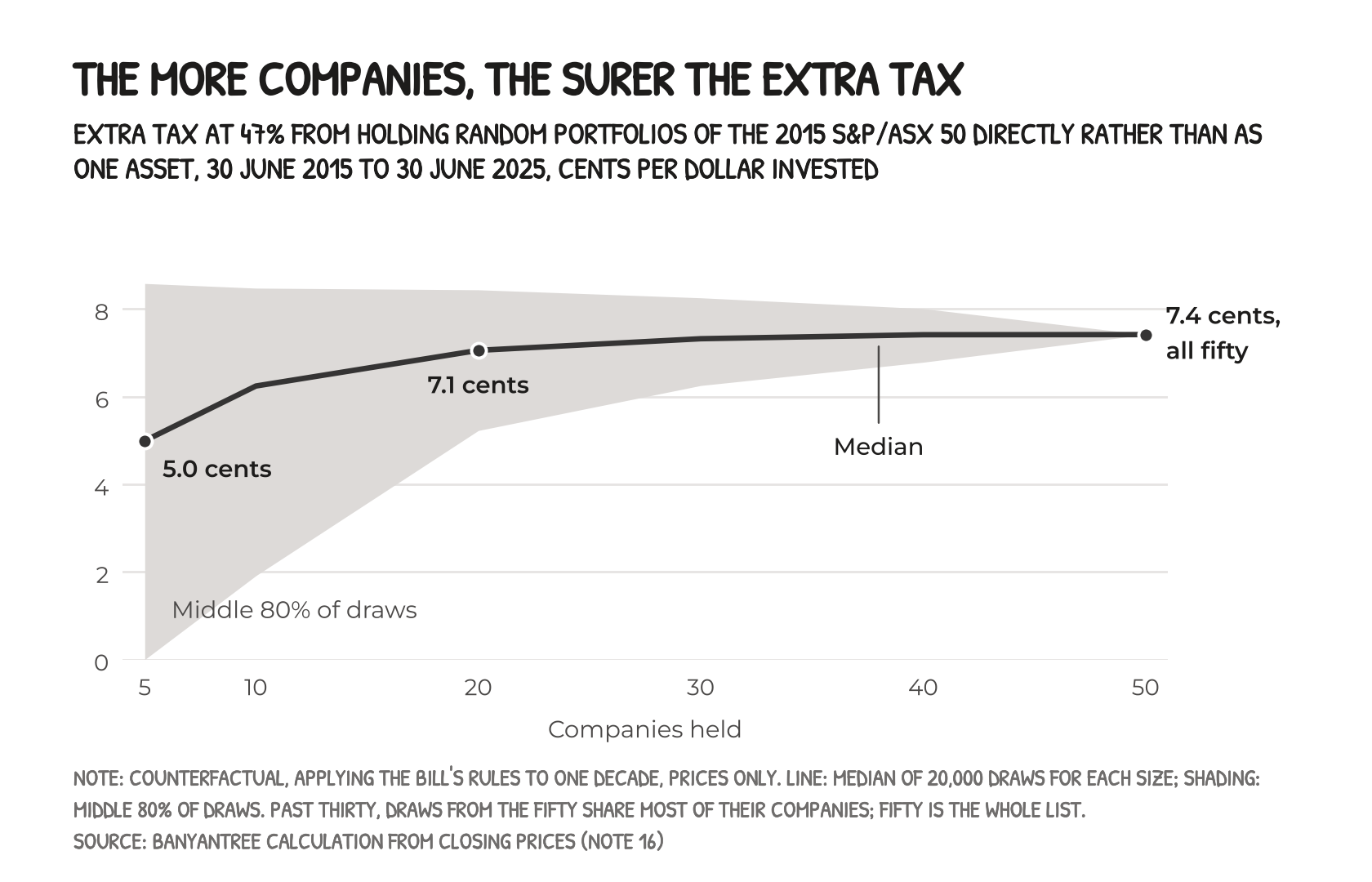
Figure 2. The more companies, the surer the extra tax. Extra tax at 47% from holding random portfolios drawn from the S&P/ASX 50 of 30 June 2015 directly rather than as one asset, over the decade to 30 June 2025: the median and the middle 80% of 20,000 draws for each portfolio size. From twenty companies up the median settles at about seven cents a dollar; past thirty the spread also narrows because draws from a list of fifty share most of their companies. A counterfactual on prices only, over one decade.¹⁶
Owning shares directly did not guarantee a bigger bill than today's: about one twenty-company portfolio in nine would still have paid less than under the discount. But with the same prices, each holding adds at least as much to a direct portfolio's taxable gain as it does inside a single asset, so whenever the portfolio held whole makes a real gain, the same companies held directly can never be taxed less under the Bill. Nor did a portfolio need a real gain to be taxed. About one twenty-company portfolio in six finished the decade worth less, after inflation, than it had cost. As a single asset none of those would have owed anything; held directly, 97 in every 100 of them would still have paid capital gains tax.¹⁷
Volatility, the other half of Wilson's phrase, sets the rate. How many holdings lag inflation depends on how far individual companies stray from the market, and over the decade the fifty strayed by about 18% a year. A standard model that knows nothing about banks, miners or takeovers, given only that scatter and the decade's growth and inflation, expects just over half of a portfolio's holdings to finish behind inflation and about a third below cost, which is what the decade delivered.¹⁸
Indexation's margin is thin. On Treasury's averages inflation was 56% of the gain and the discount exempts half, so indexation wins by six points of the gain, and an investor who forfeits a little over a tenth of the allowance has lost the advantage. On the decade, where inflation was two-thirds of the gain, the margin was a quarter of the allowance, and the direct holder forfeited half.
Run on Treasury's averages and the decade's scatter, the model has one asset paying about 12% less than under the discount over ten years, and separate holdings about 35% more. At that scatter and across the rates tested, the direct holder comes out ahead of the discount only where inflation outruns growth, when there is little real gain to tax however the shares are held. Nor, in the model, does holding longer help: the excess is much the same after one year as after ten, and larger after thirty.¹⁸
The first of July 2027
Many of the direct portfolios the Bill would tax already exist, and for them it begins with a fiction. If the Bill passed as introduced, at the end of 30 June 2027 every share held directly by an Australian resident individual would be sold, in law, and bought back on 1 July, at its market value or, if its owner chose, at a value produced by a method the Minister was to prescribe and had not yet published. The gain up to that day would wait until the asset was sold and then be taxed under the old rules, with the discount where it applied; only the gain after it would be indexed.¹⁹ Every holding would start again with its own cost and its own allowance, and for the part of a gain that indexation would govern, a portfolio assembled in 2010 and one assembled in 2028 would face the same arithmetic. An investor who held the same companies through a fund would have one holding to sell and buy back, and one allowance for each parcel of units.
The transition adds a second cost that falls on direct owners. The Bill would prescribe the order in which losses are used: first against gains deferred from before July 2027, which carry the discount, so that a dollar of loss would save fifty cents of taxable gain where, set against an indexed gain, it would save a dollar.²⁰ It bites only on an investor with both losses and old gains to realise, which describes a portfolio of many companies far more often than a single unit that has risen. Over the decade the fifty companies' losses came to about A$89,000 on the A$1m; spent against older gains, had there been any, they would have added at most about A$21,000 to the bill.²⁰
One choice in the transition favours the direct owner, who appears to have it for every holding. The value used for 1 July 2027 need not be chosen until the sale price is known. For a holding that goes on to lag inflation, a value below the market moves part of the gain to where the holding's own allowance can absorb it, until the indexed value meets the sale price; below that, each dollar lower adds tax back. Any such value would have to come from the Minister's unpublished method.²¹
One asset or fifty
Under the discount, owning shares directly or through a fund was a matter of cost, control and convenience; a given gain was taxed the same either way. Under the Bill it would also be a capital gains decision, and it would cut against a structure the advice industry has built. Managed accounts, in which a manager runs a portfolio of shares that each client owns beneficially, held A$292.9bn at the end of 2025, though how much of that is Australian shares held outside super is not published.²² "An investor can elect to hold or sell parcels of stock depending on their overall tax position," one manager of such accounts wrote in 2020; in a pooled fund, by contrast, "Investors have inherited a capital gain liability."²³ Under the Bill every parcel would also be its own asset, with its own allowance to lose. The Australian Shareholders' Association, in the part of its submission on complexity and compliance costs, told the committee that some investors might move away from direct share ownership towards ETFs, managed funds or other pooled structures.²⁴
The fund's advantage has conditions. The single asset's A$75,000 assumes the gain stays in the unit until its holder sells. A fund that trades realises gains on individual companies while the investor still holds the unit, and how indexation would interact with the rules for attribution managed investment trusts was left for later legislation.²⁵ A broad index fund that seldom trades comes closest to the decade's single asset. A listed investment company such as Wilson's is a company, outside the change. It pays company tax on the gains it realises, with neither discount nor indexation, and to its shareholders its shares are a single asset.²⁶ Fees, the loss of control over when each holding is sold, and the tax on selling shares to make the switch all count against the fund. On the decade, the difference between the two tax bills was worth about half a percentage point a year of after-tax return.¹⁴
At 17 June the Senate had yet to vote, and the Government had not said that netting across a portfolio would be added.²⁷ The House had already declined one remedy. On 4 June the independent Allegra Spender moved an amendment that would have let regulations index the cost from which a loss is measured. Chalmers objected to the trades it would invite: investors selling a holding and buying it back to offset gains elsewhere, which he said would "disrupt markets and reduce the integrity of the system". The Bill passed the House that day without it.²⁸On the decade, measuring losses from indexed cost would have cut the fifty companies' bill from about A$149,000 to about A$85,000, and only the takeovers would have separated it from the single asset's.
Asked in the Shareholders' Association's survey what it should put to the Government, one respondent had written: "Why can't real losses be deducted from indexed nominal gains?"²⁴ Under the Bill as introduced the nominal loss could be, and nothing more. What inflation took from a losing company could count in one place alone: inside a single asset, where winners and losers share one price and one indexed cost. A unit in a fund is one such asset, with fifty companies inside it.
General information only. Not personal advice. Past performance is not indicative of future performance. Examples are illustrative. Banyantree may hold securities or funds discussed in this essay in client portfolios. This material is intended for wholesale and professional investors.
Notes
1. Julie-Anne Sprague, Matthew Cranston and Thomas Henry, "'Insane, banana republic stuff': top investors protest CGT reforms", as republished by Wilson Asset Management, 17 June 2026 (the page does not name the original publication): a last-minute protest organised by Wilson, described as a high-profile fund manager and a critic of the Government, drew about 100 people, who packed a room at the Sydney Masonic Centre next door to the second day of the Senate inquiry; some carried placards calling for the tax to be axed; the crowd was at one stage asked to move along so as not to disturb the inquiry; the hearing, though public, did not draw a crowd; Wilson's remark about his business, and his account of his own wealth as accumulated under the old system and grandfathered, were made at the protest; he had received a late invitation to appear before the inquiry. William Farrington, "CGT reforms carry serious SMSF lending risk: Budget inquiry day two", Mortgage Professional Australia, 16 June 2026: "The second and final day of the Senate Economics Legislation Committee's inquiry". ABC News, "The battle over tax changes continues", 16 June 2026 (Jacob Greber reporting): Wilson among the witnesses on the second and final day of the hearings.
2. Australian Government, Budget tax explainer, Negative Gearing and Capital Gains Tax Reform, Budget night, 12 May 2026: the 50% discount replaced by cost base indexation and a 30% minimum tax on real capital gains accruing from 1 July 2027, for individuals, trusts and partnerships. Corrs Chambers Westgarth, "Capital gains tax and negative gearing amendments: key changes and implications", 3 June 2026: the Bill was introduced on 28 May 2026 and referred to the Senate Economics Legislation Committee.
3. Wilson Asset Management, submission to the Senate Economics Legislation Committee inquiry into the Treasury Laws Amendment (Tax Reform No. 1) Bill 2026, 9 June 2026, signed by Geoff Wilson AO, Chairman, p. 1: "the investment manager of nine listed investment companies (LICs)"; p. 6: "direct retail shareholders in individual ASX securities face a systematic tax disadvantage relative to investors holding equivalent exposure through an exchange traded fund (ETF), listed investment company (LIC) or managed fund"; "This asymmetry compounds with portfolio size and volatility."; "The Government has not indicated whether a portfolio netting mechanism will be introduced." The submission's principal recommendation (p. 7) is that the CGT discount be retained for productive Australian assets; it does not propose a netting mechanism. Wilson Asset Management manages listed investment companies and so has a commercial interest in the comparison, which Wilson stated (notes 1 and 4). Funds managed and number of investors: note 4.
4. Wilson Asset Management, "Opening Statement", Geoff Wilson AO, Chairman and Chief Investment Officer, published by the firm as "Geoff-Wilson-Opening-Statement-16-June-2026": it describes Wilson as the firm's founder and chairman; "We manage approximately $6 billion on behalf of more than 130,000 Australians"; when direct investment in shares becomes more costly, capital moves elsewhere, often into vehicles such as the firm's; the firm could stay silent and benefit, and opposes the changes as against the national interest; the technical design of the reforms also creates inequities for Australians who invest directly in Australian companies. The quotation from the statement in the body is from this document.
5. Jim Chalmers, Treasurer, second reading speech, Treasury Laws Amendment (Tax Reform No. 1) Bill 2026, House of Representatives, Hansard, 28 May 2026 (OpenAustralia rendering of the official record, speech beginning 9.34 a.m.): investors would "index the cost base of their assets in line with inflation so they only pay tax on their above-inflation profit"; "Not everyone will pay more tax under these changes; some will pay less tax. It will depend on a range of factors, like rates of return, inflation and the holding period. Someone who invested in the Australian share market and received the average return would have done about the same or possibly better under indexation over the past 10 or 20 years."
6. Australian Taxation Office, Capital gains tax guide 2021, Part B, "Step 6 Applying current year capital losses", including Example 111: current year capital losses are applied "against (that is, deducted from) any capital gains", in the order the taxpayer chooses, before the discount is applied to the discount-method gains that remain. This is the law before the Bill.
7. Corrs (note 2), describing the Bill introduced on 28 May 2026: "There will be no cost base indexation to determine capital losses"; "This means nominal capital losses will continue to be offset against CPI-adjusted capital gains"; indexation applies "provided the asset has been held for at least 12 months", to every element of the cost base except the costs of owning the asset. Cowell Clarke, "Tax Reform – Draft Legislation Released", 3 June 2026, on the Bill introduced on 28 May: "Indexation under the new measures will take place on an expense-by-expense basis", citing proposed s 110-36(1A) of the Income Tax Assessment Act 1997 for indexation of resident individuals' and trusts' gains from CGT events on or after 1 July 2027 and proposed s 960-275(1B) for a separate indexation factor for each item of expenditure. MLC TechConnect, "Legislation introduced: proposed changes to tax", 29 May 2026: "indexation does not apply when calculating a capital loss." The account of the Bill's mechanics here and in notes 19 to 21 rests on these law-firm and adviser descriptions of the Bill as introduced, which agree with one another, and on the section and paragraph numbers they cite; the text of the Bill and its explanatory memorandum is not quoted.
8. Australian Taxation Office, Capital gains tax guide 2020, Part A, "How to calculate a capital loss": "You cannot index a reduced cost base"; and "What is the reduced cost base?": "These elements are not indexed." The indexation method described there is the one that applied to assets acquired before 21 September 1999.
9. Dion Hershan, head of Australian equities, Yarra Capital Management, "The ASX is full of broken blue chips", Firstlinks, 29 October 2025. The prices are the author's, for dates in 2015 and 2025 he does not specify, and are not adjusted for dividends. Consumer prices rose 33.0% from the September quarter 2015 to the September quarter 2025 (Australian Bureau of Statistics, Consumer Price Index, All groups, weighted average of eight capital cities, index numbers 108.0 and 143.6, as reproduced by the Australian Taxation Office).
10. Budget tax explainer (note 2), pp. 2 and 3, Table 1, "Comparison of tax rates under indexation on average over past 20 years": S&P/ASX 200, ten-year holds, average capital growth 4.3%, discount for CPI 56%, effective tax rate at a 47c marginal rate 20.7% (five-year holds: 4.4%, 53%, 22.1%). Growth is measured "not including rental or dividend income or additional investor costs". Banyantree calculation: the effective rate is 47% × (1 − inflation share), against 47% × 50% = 23.5% under the discount, so the two are equal at an inflation share of 50% for any seller taxed at 30% or more.
11. Chris Brycki, "Why the proposed CGT changes could favour ETFs over direct shares", Stockspot, 22 May 2026: "Treasury's modelling may be broadly accurate for broad market index investing"; the article credits the Australian Financial Review article "Investors face 50pc more tax than Treasury says" (21 May 2026), which is cited here as Stockspot reports it, and quotes Geoff Francis, a former Treasury official: "You will typically pay more tax than the Treasury numbers suggest". Cameron Gleeson, "CGT changes: How to avoid the triangle of sadness", Betashares, 27 May 2026: the middle zone is "the gap between the two cost bases, and it widens every year the asset is held"; "Indexation does not apply to losses"; in its three-stock example a fund holding the same stocks has a taxable gain "matching the portfolio level real economic gain". Stockspot invests clients' money in ETFs and Betashares issues ETFs; both have a commercial interest in the comparison.
12. Chris Brycki, "How share investors could face 82% more tax under the new CGT", Stockspot, 5 June 2026: "The portfolio consists of the 20 most popular ASX securities traded by Sharesight investors in April 2020", with A$10,000 in each, measured to June 2026; taxable gain A$154,685 under the discount and A$280,870 under indexation, "82% higher than under the current system". The same article describes a subsequent Australian Financial Review analysis (27 May 2026) "using a simple portfolio of three Australian bank shares" that found "the tax outcome would be broadly unchanged", and says it "suffers from a form of survivorship and selection bias". The Financial Review articles are cited as Stockspot describes them.
13. Banyantree calculation. Universe: KPMG, ASX50 financial reporting insights: January to June 2015, December 2015, Appendix 1, the constituents of the ASX 50 at 30 June 2015. Prices at 30 June 2015, for most holdings: the closing-price valuations of two listed investment companies in their audited accounts, Argo Investments, Annual Report 2015, Note 29, and Australian Foundation Investment Company, Annual Report 2015, "Holdings of Securities" (value ÷ number held). Prices at 30 June 2025, and at 30 June 2015 for names neither company held: month-end closing prices published by a third-party market-data website (digrin), not by an exchange or a licensed data vendor. Of the 45 closes for 30 June 2025 taken from that website, 26 can be checked against Australian Foundation Investment Company, Annual Report 2025, "Holdings of Securities" (audited market values at 30 June 2025): 25 agree within the rounding of the published figures, and James Hardie's differs by 0.5%. Corporate actions: rights issues through capital-adjusted prices; Coles (2018) and Endeavour (2021) as separate assets from their demergers, with cost apportioned by value; Oil Search into Santos (2021) and Newcrest into Newmont (2023) as scrip-for-scrip roll-overs; BHP's 2022 distribution of Woodside shares as a dividend; Asciano (2016; Australian Taxation Office, CR 2016/81), Westfield (2018; ATO guidance on the Unibail-Rodamco takeover), Coca-Cola Amatil (2021), Crown Resorts (2022) and Sydney Airport (2022) as disposals at the scheme consideration, indexed to the quarter of the event. The cash terms used for Coca-Cola Amatil and Sydney Airport, and the 30 June 2025 price used for Vicinity Centres, are not drawn from primary documents; excluding all three holdings moves the comparisons with the discount below by up to two percentage points. Consumer prices: ABS CPI as in note 9, June quarter 2015 107.5 and June quarter 2025 141.7, a rise of 31.8%. Equal-weighted portfolio: A$1m to A$1,477,309, up 47.7% (3.98% a year), prices only. Counted by original holding, 28 of the 50 ended below their indexed cost, 11 of them above cost and 17 below; counted as 52 assets after the two demergers, 24 ended above indexed cost, 10 between cost and indexed cost and 18 below cost. Dividends, franking, fees, capital returns and trusts' tax-deferred distributions are excluded; all holdings are sold on 30 June 2025 (takeovers at their dates); losses are assumed usable in full; the minimum tax does not bind at the top rate.
14. Banyantree calculation, at 47%, from note 13. Discount: 47% × 50% × net nominal gain of A$477,309 = A$112,167. One asset: 47% × (A$1,477,309 − 1.31814 × A$1m) = A$74,809, the factor being 141.7 ÷ 107.5, 33.3% less. Held directly: real gains of A$406,017, less nominal losses of A$89,032, at 47% = A$148,983, 32.8% more; 1.99 times the one-asset figure; difference A$74,174. The inflation allowance on A$1m is A$318,140 (1.31814 − 1). Held as one asset, all of it is used. Held directly: used A$160,323; unused by the 10 assets between cost and indexed cost A$32,193 (indexed cost less sale value); unused by the 18 assets below cost A$103,800 (their whole allowance); not accrued because indexation stopped at the five takeovers A$21,823. The three unused amounts total A$157,816, 49.6% of the allowance, and 47% of that is the A$74,174 difference. Figure 1 plots these amounts, rounded to the nearest A$1,000. Across the variants tested (excluding the three holdings in note 13 whose terms or prices are not drawn from primary documents; alternative 2025 values for Vicinity; BHP's distribution treated as capital; demerged pairs combined; Wesfarmers' 2021 capital return added; the five cash takeovers excluded), the one-asset result ranges from 28% to 34% below the discount and the direct result from 31% to 33% above it. All ratios are the same at any marginal rate of 30% or more. After tax, A$1m became A$1,365,142 under the discount (3.16% a year), A$1,402,500 held as one asset (3.44%) and A$1,328,326 held directly (2.88%): the direct holder's after-tax price return was 0.56 percentage points a year below the single asset's.
15. Banyantree calculation: inflation was 66.7% of the equal-weighted portfolio's price gain (31.8% ÷ 47.7%). SPDR S&P/ASX 200 Fund (ASX: STW), unit price only, 30 June 2015 to 30 June 2025: up 50.6%, inflation 63% of the gain; indexation 25.6% below the discount for a top-rate seller. The comparison covers the rise in the unit price alone, which is after the fund's fees; the capital gains the fund distributed over the decade, on which unitholders would have been taxed as they were paid, are not included.
16. Banyantree calculation: 20,000 random equal-weighted portfolios of each size drawn without replacement from the 50 holdings of note 13 (seed 20260617); for each, the tax held directly less the tax held as one asset, per dollar invested. Median, with 10th and 90th percentiles, in cents: 5 companies 5.0 (0.0, 8.6); 10 companies 6.2 (1.9, 8.5); 20 companies 7.1 (5.2, 8.4); 30 companies 7.3 (6.3, 8.3); 40 companies 7.4 (6.8, 8.0); all 50, 7.4. Draws with no extra tax: 18.0% of five-company portfolios, 6.2% of ten, 0.5% of twenty, one draw in 20,000 of thirty and none of forty; of the five-company draws with no extra tax, 97% had no real gain to tax under the Bill however they were held (for ten and twenty companies, all but four). Draws paying less than under the discount when held directly: 27.5%, 23.1%, 11.0%, 3.6% and 0.4% of all draws for 5 to 40 companies (29.9%, 23.5%, 11.0%, 3.6% and 0.4% of the draws that made a nominal gain). Figure 2 plots the medians and the 10th to 90th percentiles.
17. Banyantree calculation. For a holding with cost c, indexation factor f and sale value S, its contribution to the taxable amount held directly is max(S − fc, 0) − max(c − S, 0), which is never less than S − fc. Summed over holdings, the direct taxable amount is therefore never less than the portfolio's sale value less its indexed cost, which is the single asset's taxable gain whenever the portfolio held whole ends above its indexed cost. When it does not, the single asset has no taxable gain and may have a smaller loss than the direct portfolio: two holdings costing 100 each, with a factor of 1.3, sold for 150 and 40, give a net loss of 40 held directly and of 10 held whole, so the direct holder is taxed less if that loss can be used against other gains. A direct holder taxed earlier on a takeover has a smaller indexation factor on that holding, which only widens the gap. On the draws of note 16, 11.0% of twenty-company portfolios paid less than under the discount held directly, and none paid less tax on its own gains than held as one asset; had a net loss been usable against other gains, 100 of the 20,000 (0.5%), all of them portfolios that made no real gain held whole, would have come out ahead held directly. Of the 20,000 twenty-company draws, 3,308 (16.5%) ended below their indexed cost held whole and so had no taxable gain as one asset; 3,208 of those (97.0%) had a taxable gain held directly, the median bill being 5.9 cents per dollar invested. For ten companies the figures are 29.9% and 79.5%; for thirty, 7.6% and 100%.
18. Banyantree calculation. Scatter: the standard deviation of the 50 holdings' ten-year log price relatives is 0.579, or 0.183 a year (0.152 on a robust estimate). Model: each holding's price relative to the market is lognormal with that scatter and a mean that preserves the market's path; each holding's expected forfeited allowance is valued in closed form as the difference between two put options struck at indexed cost and at cost, at a zero interest rate, and the direct portfolio's expected taxable amount is the market's gain over indexed cost plus that forfeit, floored at zero. At the decade's growth (3.98% a year) and inflation (2.80%), the model expects 54% of holdings to end behind inflation and 35% below cost; the decade's 52 assets gave 54% and 35%. At Treasury's 4.3% growth and inflation of 2.5%, the middle of the Reserve Bank's target, over ten years: one asset 7.0% below the discount, the direct portfolio 37.4% above; after one year 38.6% above, after thirty 45.3% above. Treasury's Table 1 (note 10), whose inflation share of 56% implies inflation of about 2.6% a year, has one asset 12% below the discount; the model at that rate gives 12.0% below, and the direct portfolio 34.9% above (36.2% above after one year, 42.8% after thirty). On Table 1's shares, indexation exempts 56% of the gain and the discount 50%, a difference equal to 10.7% of the allowance (6 ÷ 56); on the decade's inflation share of 66.7% (note 15) the difference is 25.0% of the allowance, against the 49.6% left unused (note 14). Over ten years at the decade's scatter, for growth of 3.0%, 3.5%, 4.3%, 5.0% and 6.0% and inflation of 2.0%, 2.5%, 3.0% and 3.5%, the direct holder pays more than under the discount in every case but one, from 0.7% more (3.5% growth, 3.5% inflation) to 61.0% more (6.0%, 2.0%); at 3.0% growth with 3.5% inflation it pays 10.7% less, and the scatter needed to reach the discount there is 0.230. At the robust estimate of 0.152, the direct holder also pays less at 3.0% growth with 3.0% inflation (4.1% less) and at 3.5% with 3.5% (7.6% less). A model on stated assumptions, not a forecast.
19. Corrs (note 2): "a deemed sale will occur just before 1 July 2027 with a deemed reacquisition on that date"; "This apportionment method has not been released yet."; the deferred gain "will be taxed under old CGT law rules (i.e. with the 50% CGT discount if applicable)". PwC Australia, "2026-27 Federal Budget – CGT and housing tax reform", Tax Alert, 1 June 2026: assets held at that date are "deemed to have been sold just before 1 July 2027 and reacquired on 1 July 2027 at market value" or at an amount worked out under an apportioning method. Cowell Clarke (note 7): the method is "a method prescribed by the Minister by legislative instrument which remains unpublished"; it places the deemed disposal and reacquisition in proposed s 112-155(2) and the Minister's apportioning method in proposed s 112-185. Pitcher Partners, letter to the Senate Standing Committees on Economics, 9 June 2026, refers to "proposed Subdivision 112-E (deemed disposal and acquisition rule)".
20. PwC (note 19): the order "effectively requires capital losses to be used against discount capital gains first"; "This removes the flexibility that is available under the current law." Cowell Clarke (note 7): current year capital losses are applied against deferred non-residential gains, then deferred residential gains, then other non-residential and residential gains. Corrs (note 2): losses "must be applied in a prescribed order across these separate categories". Financial Advice Association Australia, submission to the Senate Economics Legislation Committee (submission 84) from its chief executive, Sarah Abood, 9 June 2026, p. 4: the "mandated order of attribution of capital losses" is "set out in paragraph 1.94 of the Explanatory Memorandum", and the memorandum's Example 1.9 applies it. Banyantree calculation: nominal losses in the direct portfolio of note 14 were A$89,032; if every dollar reduced a deferred discount gain instead of an indexed gain, the extra tax would be 47% × 50% × A$89,032 = A$20,923. The decade's counterfactual has no gains from before July 2027, so the figure is a ceiling on a hypothetical. SMSF Adviser, "Accounting bodies raise concerns over complexity, cost of CGT rules", 17 June 2026: Chartered Accountants Australia and New Zealand recommended "changing the ordering in which capital losses are to be used".
21. PwC (note 19), on assets held by resident individuals and trusts on 30 June 2027: the choice between market value and the apportioning method "does not need to be made until the taxpayer lodges their tax return for the income year in which the actual realisation event occurs". Budget tax explainer (note 2), p. 4: the formula "estimates the asset's value on 1 July 2027, based on its growth rate" over the holding period. PwC ties the choice to the year in which the asset is actually sold, which implies a choice made for each asset; none of these descriptions states that in terms. Banyantree calculation: with cost c, value chosen for 1 July 2027 V, sale value S and indexation factor f after that date, the taxable amount is 0.5 × (V − c) + max(S − fV, 0), lowest at V = S ÷ f. For a holding bought for A$100 and sold for A$200 ten years after July 2027 at 2.5% inflation (f = 1.2801): A$50.00 at a value of A$200; A$35.00 at A$170; A$28.12 at A$156.24; A$40.79 at A$140. Below S ÷ f a lower value raises the taxable amount again, and any value below the market would have to come from the Minister's method, which was unpublished.
22. Mike Taylor, "Managed accounts FUM approaches $300b", Financial Newswire, 31 March 2026, reporting the managed accounts FUM census of the Institute of Managed Account Professionals and Milliman to 31 December 2025: FUM "increased to $292.9 billion", 64.4% of it in separately managed accounts. The census does not report the share held in Australian shares outside superannuation.
23. Andrew Stanley, Ralton Asset Management, "Top three ways an SMA helps optimise tax", Firstlinks, 4 March 2020, which also states: "This is the advantage of having beneficial ownership of shares." The second quotation in the body refers to investors in pooled funds.
24. Australian Shareholders' Association, submission to the Senate Economics Legislation Committee, 9 June 2026, signed by Rachel Waterhouse, chief executive: "Some retail investors may move away from direct share ownership and towards ETFs, managed funds, or other pooled investment structures", in a section on complexity and compliance costs. Survey: "a total of 1,112 participants", distributed "to ASA members and the broader retail investor community" rather than to a general population sample. Appendix B, question 11, "What question would you like ASA to put to Treasury, Government or policymakers?", response 85, which continues from "This is clearly not the case." The respondent is anonymous; nothing in the submission records how the respondent holds shares.
25. PwC (note 19): further work is needed on, "importantly, the interaction with the attribution managed investment trusts (AMIT) rules". Treasurer's speech (note 5): "Further consideration will also be given to a range of specific details such as interactions with attribution managed investment trusts (AMITs)"; "Where appropriate, these details will be finalised in subsequent legislation following consultation." Corrs (note 2): indexation applies to trusts. How a fund's own sales would be taxed under indexation is a Banyantree reading of these descriptions, not a settled treatment.
26. Corrs (note 2): "The changes do not apply to companies, superannuation funds, life insurance companies, or foreign and temporary residents"; complying superannuation funds "instead receive a 33% discount". PwC (note 19): "existing CGT settings continue to apply for companies, superannuation funds and life insurance companies"; under those settings a company's capital gains carry no discount. Income Tax Assessment Act 1997, Subdivision 115-D (s 115-280), as in force before the Bill: an individual shareholder in a listed investment company may deduct 50% of the part of a dividend attributable to the company's capital gains on assets held for at least twelve months. What the Bill would do to that deduction is not established here. The comparison in the body therefore concerns resident individuals and trusts.
27. The Adviser, "CGT and negative gearing changes pass lower house", 5 June 2026: the Bill passed the House of Representatives on 4 June by 94 votes to 48, and the Senate committee was to report by 22 June. Corrs (note 2): a report expected by the end of June. Wilson Asset Management, submission (note 3): netting not indicated. At 17 June 2026 the committee had not reported and the Senate had not voted on the Bill.
28. House of Representatives, Hansard, 4 June 2026, Treasury Laws Amendment (Tax Reform No. 1) Bill 2026, consideration in detail (OpenAustralia rendering of the official record): amendment (2) moved by Allegra Spender, to insert a proposed s 110-11, "Indexation of capital losses", under which regulations could provide for indexing the reduced cost base of a CGT asset; the Treasurer's reply, that indexing losses would lead more people to sell and repurchase the same assets to offset other gains, from which the quotation is taken. Passage of the Bill that day: note 27. Banyantree calculation, from notes 13 and 14: if each of the 52 assets contributed its sale value less its indexed cost, whether a gain or a loss, the tax held directly would be A$85,066 against A$148,983, leaving A$10,257 above the single asset's A$74,809, which is 47% of the A$21,823 of allowance that never accrued because of the takeovers. The amendment would have permitted regulations and did not prescribe a method; the calculation assumes losses measured from the same indexed cost as gains.
