
In the first quarter of 2026 S&P 500 companies beat their earnings forecasts by more than twice the usual margin. Nearly half of that beat, in dollars, came from three items at three companies that the forecasts appear to have left out. Amazon had described most of its item in its annual report before the quarter was half over.
By the team at Banyantree Investment Group
Provenance: Developed from questions first raised in Banyantree's Monthly Investment Letter of 20 May 2026.
On the afternoon of Wednesday 29 April 2026, Brian Nowak had questions to ask on three calls. Nowak is an analyst at Morgan Stanley, and Alphabet, Amazon and Meta had all reported their first quarters after the New York market closed. Alphabet's call was set for half past four. Amazon's and Meta's were both set for half past five. Nowak asked the first question on Alphabet's and the first on Meta's, and by a published transcript the second on Amazon's. Two other analysts, Eric Sheridan of Goldman Sachs and Justin Post of Bank of America, put questions on all three as well.¹
They asked about the businesses. Nowak asked Alphabet how it would share out its computing capacity and price the chips it sells, and Amazon how broad its backlog of cloud orders was. Across the three calls analysts were called on twenty-four times. Nobody asked about what sat a few lines below each company's operating profit: US$36.9bn of gains on shares Alphabet holds in other companies, US$16.8bn of gains on Amazon's investment in Anthropic, the artificial-intelligence developer, and a tax benefit of US$8.03bn at Meta. Alphabet's chief financial officer gave her company's item one sentence. Meta's said what the company would have earned without its benefit. Amazon's executives, by the transcript, gave theirs none.¹
The first verdicts on those lines were written elsewhere, and not by a person. The Associated Press carried a short item on each company that day, generated, a closing line said, by Automated Insights using data from Zacks Investment Research. Amazon had earned US$2.78 a share. "Earnings, adjusted for investment gains, were $1.56 per share," its item said. The 13 analysts Zacks had surveyed had expected US$1.60, and "The results fell short of Wall Street expectations." For Meta the software took the tax benefit out, calling it "pretax gains", and reported a beat. For Alphabet it left the gains in and reported a beat, nearly all of which was the gains. The software took two of the three items out before passing judgement and left the third in.¹
Two days later FactSet published its weekly scorecard of the S&P 500, written by John Butters, a senior earnings analyst there. It left all three items in. Against a consensus of US$1.63, Amazon had reported "a positive EPS surprise above 70%".² The two forecasts, US$1.60 and US$1.63, were three cents apart. The two results were the gains apart.³ Butters flagged each company's item and explained why it counted. FactSet scores a company on the basis that most of its analysts forecast, and for these three that basis was GAAP, the US accounting standard. Alphabet, Amazon and Meta, he wrote, "historically have only reported EPS numbers on a GAAP basis".²
The gains had not arrived unannounced. On 5 February, presenting its fourth-quarter results, Amazon said it expected to invest about US$200bn in capital expenditure in 2026, and guided first-quarter operating income below what analysts had expected. Its shares fell 11.5% in after-hours trading.⁴ The next morning it filed its annual report. In the first note to the accounts, under the heading "Non-Marketable Investments", Amazon brought its shareholders up to date on Anthropic. More of its convertible notes in the company had turned into preferred stock since the year-end, and the conversion would bring a gain of about US$3bn into the first quarter. The next sentence went further: "In our Q1 2026 financial statements, we will also record an upward adjustment of approximately $12 billion to our nonvoting preferred stock as of December 31, 2025 in 'Other income (expense), net' to reflect observable changes in price."⁵
Fortune later reported Amazon as saying that the markup had been triggered by Anthropic's Series G funding round, which was led by GIC and Coatue and valued the company at US$380bn, and by the conversion of some of its notes into preferred stock.⁶ The mean forecast did not rise to take the gains in. By 27 March FactSet's mean estimate of Amazon's first-quarter earnings had fallen to US$1.62 a share, from US$1.73 at the end of December, and Amazon led the fall in expected earnings for its sector.⁷ The cut fits the cautious guidance. The gains are harder to place. After tax, the roughly US$15bn the annual report described was worth about two-thirds of what analysts now expected Amazon to earn in the whole quarter.⁸ On Amazon's results call of 29 April, by the published transcript, none of them raised the gains.⁹
On 29 April the gains arrived, a little larger than foretold: US$4.5bn from the conversion and US$12.3bn from marking the preferred stock to the new price. Amazon's quarterly report, filed the next day, put the tax arising mainly from them at US$4.1bn. On that figure they were worth US$1.17 a share after tax, and without them Amazon earned US$1.61, between the two forecasts.¹⁰ Its operating income had cleared the top of February's guidance. The wire's miss turned on how much tax came off the gains. FactSet's 70% was, in effect, the gain alone, and most of the gain had been described in a public filing 82 days before the result.
FactSet also adds the same company results into its figure for the season as a whole. By 29 May, with 97% of the S&P 500's companies reported, their earnings stood 16.7% above estimates, more than twice the five-year average of 7.3%.¹¹ Part of that surprise had been on the record since 6 February. If a surprise can be announced in advance, what was the 16.7% measuring?
A forecast called GAAP
FactSet's rule for which earnings count is sound on its face. A surprise means something only if the result is measured the way the forecast was made, so the scorer follows the basis that most of a company's analysts use, as LSEG's I/B/E/S, another large compiler of analysts' estimates, also does.¹² NVIDIA, which reported on 20 May, shows the rule pointing the other way. Its GAAP earnings for the quarter, US$2.39 a share, included US$15.9bn of net gains on equity securities. NVIDIA also publishes an adjusted figure that leaves such gains out; most of its analysts forecast that one, and FactSet scored the adjusted US$1.87 against an estimate of US$1.75. The gains stayed out of both sides of the subtraction.¹³
The rule rests on an assumption: that a forecast described as GAAP is a forecast of GAAP earnings. The three consensus figures can be tested against it. Alphabet said its gains on equity securities added US$2.35 to its earnings per share.¹⁴ Had its consensus of US$2.68 contained them, analysts would have expected the rest of Alphabet to earn 33 cents a share, in a quarter when it earned US$2.76. Meta said its tax benefit added US$3.13.¹⁵ Had its consensus contained that, analysts would have expected the rest of Meta to earn less than half of what it did; on the same test Amazon's consensus would have expected the rest of Amazon to earn less than a third. All three were businesses whose operating profit had risen by about 30% in a year.
An allowance for an ordinary quarter's gains fits no better. Read as a forecast without gains, Alphabet's US$2.68 had the rest of the company growing by 21% to 23%, beside revenue expected to grow by almost a fifth. Suppose instead analysts had left room for an ordinary quarter's gains, the average of 2025: the rest would then have been growing by 3% to 5%.¹⁶ The public record shows the consensus; what each analyst put into it is not public. The tests cannot rule out a small allowance. They do show that none of the three forecasts can have held the whole of its item, and that Alphabet's held little or none of its own; the scorecard set all three against results with all of it.
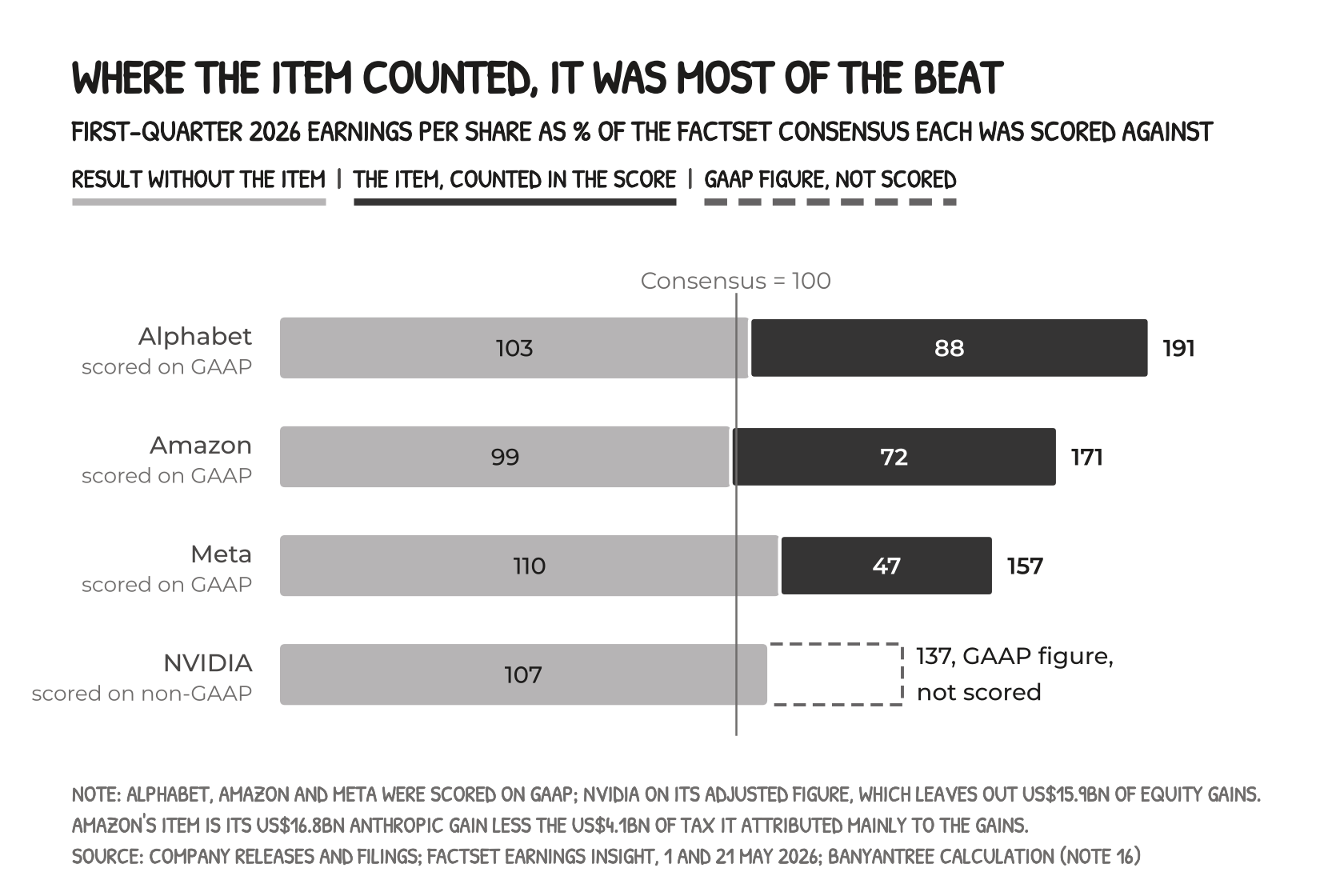
Figure 1. Where the item counted, it was most of the beat. First-quarter 2026 earnings per share as a percentage of the FactSet consensus each company was scored against, split into the result without its item and the item itself. Without their items, all four results sat within about 10% of their forecasts; with them, the three companies scored on GAAP beat by 57% to 91%. NVIDIA, scored on its adjusted figure, kept its gains out of both sides. Amazon's item is net of the tax it attributed mainly to its gains.¹⁶
The questions asked on 29 April fit that reading, and the way the forecasts are built suggests why. Amazon's guidance covers net sales and operating income and stops there; below that line the forecast is the analysts' own.⁴What they put there, on this evidence, is the business they can model. A mark set by another company's fundraising, or a tax benefit created by a Treasury notice, is a real change in what shareholders own, but it is not something customers bought in the quarter, and so far as the tests can show it is not in the forecasts. For a company that publishes only GAAP figures, the label on its consensus records how the company reports, and is a poor guide to what the forecasts contain.
A convention, not an oversight
What analysts could have known about the three items varied widely, and it made no visible difference to the forecasts. Alphabet's gains came through an option US accounting calls the measurement alternative. A company may carry shares that have no market price at what it paid for them. Whenever an observable transaction sets a price for identical or similar shares of the same company, the holder moves the carrying value to that price. The move runs through earnings, and nothing has to be sold. Alphabet holds such shares in private companies it does not name, and in the first quarter the value at which it carried them rose from US$64.1bn to US$101.3bn.¹⁷ Its marks arrive with transactions in those unnamed companies' shares, so analysts had little basis for sizing them. Meta's benefit was the result of guidance that the US Treasury issued on 18 February on how the corporate alternative minimum tax treats research costs that companies had capitalised. It could have been sized at most 70 days before Meta reported.¹⁵
Amazon's was the most visible of the three. Its US$12.3bn came through the same door as Alphabet's, since Amazon carries its Anthropic preferred stock at cost, "with adjustments for observable changes in prices or impairments".⁵ The other US$4.5bn had been on show for longer. Amazon also held Anthropic convertible notes, classified as available for sale, so their rise in value had collected in shareholders' equity rather than in earnings, US$39.5bn of it by the end of 2025, ready to move into earnings as notes converted.¹⁰ On the tests above the three items were treated alike, whatever could be known about them in advance.
The difficulty is as old as the accounting. Since 2018 US accounting has sent changes in the value of most of a company's shareholdings through its net income, and the measurement alternative arrived with the same standard. That February Warren Buffett, whose Berkshire Hathaway held about US$170bn of listed shares, told his shareholders what to expect: "truly wild and capricious swings in our GAAP bottom-line". For analysis, he wrote, the bottom line would be useless, and he promised to set out the adjustments needed every quarter.¹⁷Alphabet now carries US$101bn of shares in private companies and Amazon US$74bn of Anthropic's preferred stock and notes, and neither publishes an adjusted figure. Their analysts, on the evidence above, make the adjustment for themselves. The size of the S&P 500's surprise therefore depends in part on which of its largest companies publish an adjusted figure of their own. Reporting nothing but GAAP looks like the stricter habit. This quarter it made the scorecard noisier.
Nearly half
The season's two headline numbers measure different things. By 29 May, 85% of the companies that had reported had beaten their estimates, against a five-year average of 78%. That is a count, in which every company has one vote and no single result can move the total far. The 16.7% is a sum of actual earnings dollars set against estimated dollars, and a company that earns tens of billions a quarter can move it with one line below its operating profit.¹¹
Butters had pointed at the three companies himself. In the week they reported, he wrote, they accounted for 71% of the net increase in the index's first-quarter earnings total.² FactSet does not publish its dollar figures company by company, but its own totals allow a sizing. On them the season's surprise came to roughly US$100bn. On the reading that the forecasts left the items out, the three items, after tax, were about 45% of it, or nearly half, and removing them leaves a surprise of about 9%.¹⁸ That is still above the five-year average of 7.3%, although the average was itself made of past headlines that carried items of their own. Of the 9.4 points by which the headline beat that average, most came from the three items. The reading can bend without breaking: had the forecasts carried a tenth of the items, the part not forecast would be about 41% of the surprise, and the surprise with the items taken out of both results and forecasts about 10%.
Revenue, which none of the items touches, beat estimates by 1.9%, a little below its own five-year average of 2.0%. Whatever was exceptional about the season sat below the top line.¹¹ The useful first question about any season's surprise is therefore which of the largest companies were scored on GAAP, and what sat below their operating lines that quarter.
Most of what sat there this quarter was of one kind. Alphabet's gains on its private holdings and Amazon's US$12.3bn adjustment were both marks to prices set in transactions in private companies' shares. After tax, and on the same reading of the forecasts, they came to roughly a third of the season's dollar surprise. Alphabet and Amazon had booked marks of this kind in 2025; what changed in the first quarter was their size, nearly three times that of the largest quarter of 2025.¹⁹ To that extent the S&P 500's earnings surprise was reporting prices at which private companies' shares had changed hands, carried into a public statistic through the accounts of two of the index's largest companies.
When the items cancel
Meta's benefit partly offset a charge that the same convention had scored the other way. When the One Big Beautiful Bill Act became law in the third quarter of 2025, Meta took a non-cash tax charge of US$15.93bn, and FactSet scored its GAAP earnings, charge and all, against the consensus. Over the two quarters Meta's tax position came to a net charge of US$7.9bn; its scorecards record a miss of 84% and then a beat of 57%.²⁰
In that third quarter Meta's charge did not stand alone. Amazon booked US$9.5bn of pre-tax gains on Anthropic. Alphabet booked a gain on equity securities of US$10.7bn, which added more to its earnings per share than the whole margin by which it beat, and in each of the next two quarters its gains made up most of its beat. After tax the three items roughly cancelled, and the season's surprise, 6.6%, came in below its five-year average, then 8.4%. In the first quarter of 2026 all three pointed the same way. Across those two seasons, half a year apart, the headline rose from 6.6% to 16.7%. Allowing for the three items, the margin by which companies beat their forecasts rose from about 6.5% to about 9%.²¹ A headline can be made by alignment.
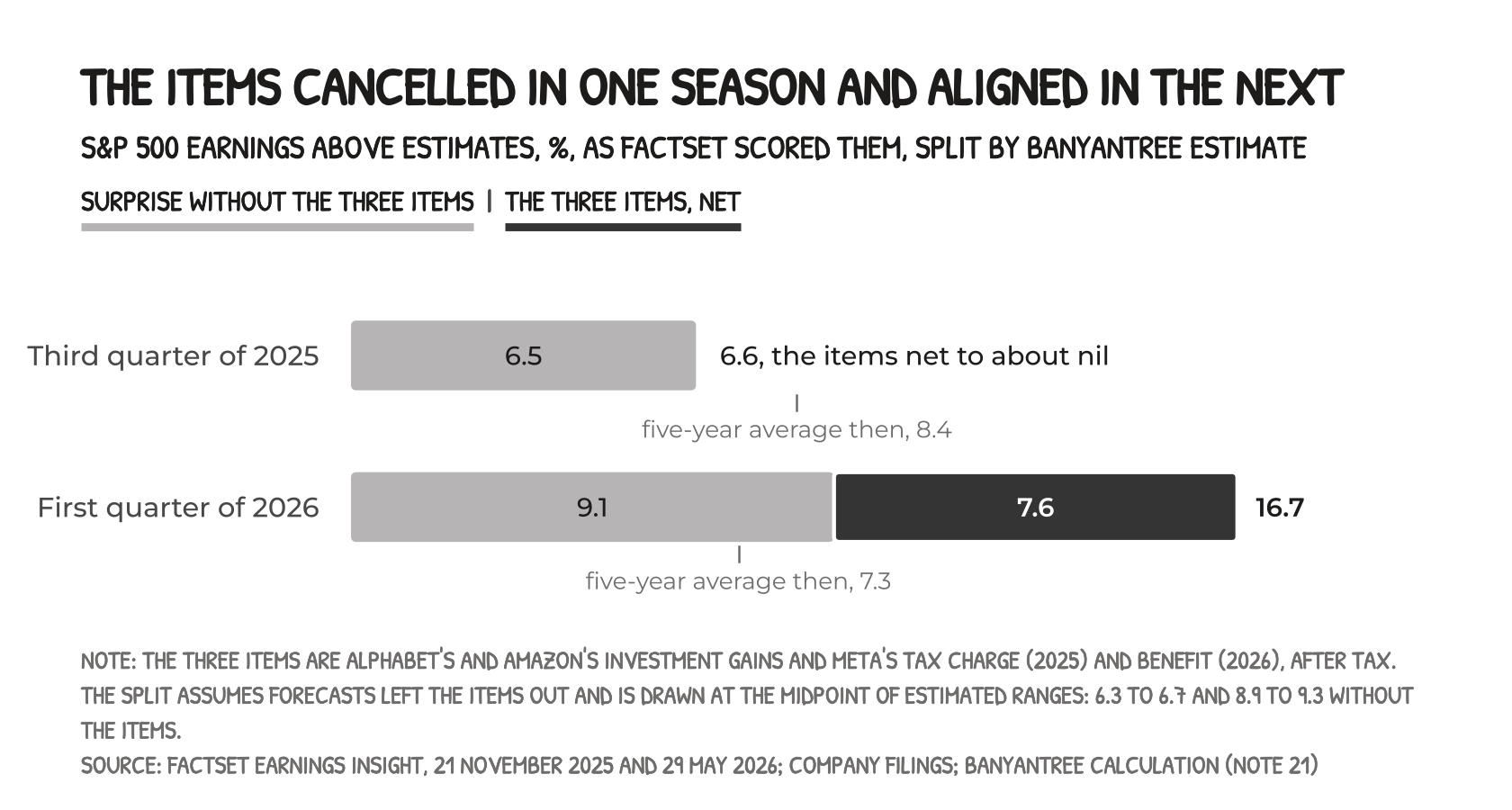
Figure 2. The items cancelled in one season and aligned in the next. FactSet's earnings surprise for the S&P 500 in two seasons, split by Banyantree's estimate into the surprise without the three companies' items and the items' net effect. In the third quarter of 2025 Meta's charge offset Alphabet's and Amazon's gains and the items all but vanished; in the first quarter of 2026 they added roughly 7.6 points. The split assumes that the forecasts left the items out, and is drawn at the midpoint of estimated ranges.²¹
What the scores carry forward
The items lifted the season's growth figure as well as its surprise: taken out of the first quarter's earnings in both years, they leave growth of between 22% and 23%, against the 28.6% reported. The scores also outlast the season. Unless analysts change the basis on which they forecast, the first quarter of 2027 will be measured against these results as scored, and Alphabet, Amazon and Meta would need the rest of their earnings to grow by 43% to 85% just to report the same earnings per share again without items like these. Across the index the three items were just over 6% of the first quarter's earnings, so if nothing like them recurs, a 10% rise in underlying earnings would register a year from now as growth of about 3%.²²
Something like them may recur. For Amazon a transaction that could bring a second gain is already public. On 28 May Anthropic announced a funding round of US$65bn that valued it at US$965bn, against the US$380bn of the round that, by Fortune's account, Amazon tied to its first-quarter mark. The new round included US$5bn that Amazon had already committed.⁶ Amazon's quarterly report records US$5.0bn put into Anthropic's preferred stock after the quarter ended.¹⁰ At the end of March Amazon carried its preferred stock at US$32.0bn, at prices observed before that round. What the round does to that figure depends on the terms of the shares Amazon holds, and it is for Amazon's next accounts to say. Anyone forecasting Amazon's second quarter has a public valuation in front of them, and must decide whether anything goes below the operating line for it.
It may also recur in the other direction. Alphabet's holdings will be marked again whenever a transaction sets a new price for them, and the rule runs both ways: cumulative downward adjustments and impairments on the same holdings stood at US$8.9bn at the end of March.¹⁷ A round struck at a lower price would reach Alphabet's net income as a loss, and if the consensus treated it as it treated this quarter's gains, the scorecard would record a miss.
The software that called Amazon's quarter a miss and the scorecard that called it a 70% beat were each applying a rule about which earnings count, and the business sat between them, about where its analysts had put it. What the 70% measured, and on this reading nearly half of the season's 16.7% with it, was the distance between the earnings a company must publish and the earnings its analysts choose to forecast. For Amazon most of that distance had been set out in February, in the future tense. Its quarterly report of 30 April prints something else that could open it again: US$36.3bn of gain on the Anthropic notes it had not yet converted, held in shareholders' equity for as long as they remain notes.¹⁰
General information only. Not personal advice. Past performance is not indicative of future performance. Examples are illustrative. Banyantree may hold securities or funds discussed in this essay in client portfolios. This material is intended for wholesale and professional investors.
Notes
1. Earnings calls of 29 April 2026. Meta's results release set its call for 5.30pm Eastern time (note 15); The Motley Fool's transcripts give 4.30pm for Alphabet's call and 5.30pm for Amazon's (note 9). Brian Nowak of Morgan Stanley asked the first question on Alphabet's call and on Meta's, by the companies' own transcripts (notes 14 and 15), and the second on Amazon's, by the third-party transcript (note 9); Eric Sheridan of Goldman Sachs and Justin Post of Bank of America also asked on all three. Nine analysts asked questions on Alphabet's call, nine on Meta's and six on Amazon's, 24 in all, and none of the questions concerned the items. Nowak's questions are paraphrased: to Alphabet, on its priorities for computing capacity and the pricing of its sales of TPU chips; to Amazon, on the breadth of the AWS backlog. The items: Alphabet's gain on equity securities of US$36.9bn (note 14), Amazon's gains of US$16.8bn (note 3) and Meta's tax benefit of US$8.03bn (note 15). Associated Press, "Amazon: Q1 Earnings Snapshot", "Meta Platforms: Q1 Earnings Snapshot" and "Alphabet: Q1 Earnings Snapshot", 29 April 2026 (WTOP editions), each closing: "This story was generated by Automated Insights ... using data from Zacks Investment Research." Amazon (Seattle dateline): earnings of US$30.26bn, or US$2.78 a share; "Earnings, adjusted for investment gains, were $1.56 per share."; the average estimate of 13 analysts surveyed by Zacks was US$1.60; "The results fell short of Wall Street expectations." Meta: "Earnings, adjusted for pretax gains, came to $7.31 per share."; the average estimate of 15 analysts was US$6.71; "The results exceeded Wall Street expectations." Alphabet: US$5.11 a share, with no adjusted figure, against an average estimate of US$2.64; "The results topped Wall Street expectations." Banyantree calculations: Meta's US$7.31 is its reported US$10.44 less the US$3.13 it attributed to its tax benefit (note 15); Amazon's US$1.56 is its reported US$2.78 less its US$16.807bn of gains (note 10) taxed at 21%, over 10,874m diluted shares; Alphabet's US$2.35 (note 14) is 95% of the US$2.47 by which it beat the Zacks average, and US$36.3bn of its US$36.9bn gain on equity securities was unrealised gain on non-marketable securities (note 17).
2. FactSet, John Butters, VP, Senior Earnings Analyst, Earnings Insight, 1 May 2026, p. 1 (byline) and p. 3: "Amazon.com reported a positive EPS surprise above 70% for Q1 ($2.78 vs. $1.63)", with Alphabet above 90% (US$5.11 against US$2.68) and Meta above 56% (US$10.44 against US$6.67); GAAP EPS was used for the three companies in both the surprise and the growth calculations because the majority of analysts contributing estimates for them provide GAAP estimates, and "Alphabet, Amazon.com, and Meta Platforms historically have only reported EPS numbers on a GAAP basis."; the GAAP actuals were flagged as including Alphabet's "net gain of $37.7 billion" (Alphabet's total other income; its gain on equity securities was US$36.9bn, note 14), Amazon's "pre-tax gains of $16.8 billion" and Meta's "$8.03 billion income tax benefit". The same issue reports that in the week to 1 May blended first-quarter growth rose from 15.0% to 27.1%, and that the three companies "accounted for 71% of the net dollar-level increase in earnings for the S&P 500" over the week. P. 13: Alphabet's revenue of US$109.90bn against an estimate of US$107.00bn. The flags recur in later issues, including that of 29 May (pp. 8 to 10; note 11). Banyantree calculations: 2.78 ÷ 1.63 − 1 = 70.6%; 5.11 ÷ 2.68 − 1 = 90.7%; 10.44 ÷ 6.67 − 1 = 56.5%.
3. Amazon.com, Inc., "Amazon.com Announces First Quarter Results", 29 April 2026 (Form 8-K, Exhibit 99.1): diluted earnings per share US$2.78 (US$1.59 in the first quarter of 2025); operating income US$23.9bn (US$18.4bn); net income includes "pre-tax gains of $16.8 billion included in non-operating income from our investments in Anthropic"; 10,874m diluted weighted-average shares. Banyantree calculation: operating income growth 29.6% (US$23,852m against US$18,405m).
4. Amazon.com, Inc., "Amazon.com Announces Fourth Quarter Results", 5 February 2026 (Form 8-K, Exhibit 99.1). First Quarter 2026 Guidance: net sales "expected to be between $173.5 billion and $178.5 billion" and operating income "expected to be between $16.5 billion and $21.5 billion, compared with $18.4 billion in first quarter 2025"; no guidance is given for any measure below operating income. Andy Jassy, in the same release: "we expect to invest about $200 billion in capital expenditures across Amazon in 2026". Reuters, Greg Bensinger and Deborah Mary Sophia, "Amazon sees 50% boost to capital spending this year, shares tumble", 5 February 2026 (The Star edition, 6 February): analysts had estimated first-quarter operating income of US$22.04bn, according to LSEG; the shares fell 11.5% in after-hours trading.
5. Amazon.com, Inc., Form 10-K for the year ended 31 December 2025, filed 6 February 2026 (accession 0001018724-26-000004; MarketScreener's notice of the filing is timed 06:06 EST that day), Item 8, Note 1, "Non-Marketable Investments": "Subsequent to December 31, 2025, an additional portion of our notes was converted to nonvoting preferred stock. As a result of this conversion, in our Q1 2026 financial statements, we will reclassify a portion of the unrealized gain associated with the notes as of December 31, 2025 and record a gain of approximately $3 billion in 'Other income (expense), net.' In our Q1 2026 financial statements, we will also record an upward adjustment of approximately $12 billion to our nonvoting preferred stock as of December 31, 2025 in 'Other income (expense), net' to reflect observable changes in price." Quotation marks inside the passage are rendered as single marks. The same note: equity investments in private companies not accounted for under the equity method, "which primarily relate to nonvoting preferred stock in Anthropic, are accounted for at cost, with adjustments for observable changes in prices or impairments"; in the third quarter of 2025, a conversion gain of approximately US$2.3bn and "an upward adjustment of $7.2 billion to our nonvoting preferred stock".
6. Anthropic, "Anthropic raises $30 billion in Series G funding at $380 billion post-money valuation", 12 February 2026: "We have raised $30 billion in Series G funding led by GIC and Coatue, valuing Anthropic at $380 billion post-money."; the announcement names 37 lead, co-lead and significant investors, and the round includes a portion of previously announced investments from Microsoft and NVIDIA; Amazon is not named. Fortune, Eva Roytburg, "Google and Amazon's biggest profit driver last quarter was their Anthropic stakes, which they haven't sold", 30 April 2026 (the headline's dash is rendered as a comma): "Amazon, in response to questions from Fortune, said the markup was triggered by Anthropic's Series G funding round and the conversion of some of Amazon's convertible notes into preferred stock." That sentence is the magazine's account; it does not quote Amazon's own words. The headline's attribution of Google's profit to Anthropic is likewise the magazine's: Alphabet does not name the companies behind its gains (note 17). Anthropic's announcement came six days after Amazon filed its annual report (note 5), which records a conversion of notes made after 31 December 2025; neither that report nor the quarterly report (note 10) names the transaction behind the observable changes in price. Anthropic, "Anthropic raises $65B in Series H funding at $965B post-money valuation", 28 May 2026: a round of US$65bn led by Altimeter Capital, Dragoneer, Greenoaks and Sequoia Capital, "valuing the company at $965 billion post-money"; it includes US$15bn of previously committed investments from hyperscalers, US$5bn of it from Amazon. The valuations of US$380bn and US$965bn are of the whole company after each round; they are not prices of the particular shares Amazon holds, and the announcement does not say what Amazon's shares are worth. Amazon's preferred stock was carried at approximately US$32.0bn at 31 March 2026 (note 10). Neither the announcement nor Amazon's quarterly report says whether the US$5bn in the round is the US$5.0bn that Amazon invested after 31 March.
7. FactSet, Earnings Insight, 27 March 2026, p. 8, "Consumer Discretionary: Amazon.com Leads Earnings Decrease Since December 31": "Amazon.com (to $1.62 from $1.73) and Ford Motor have been the largest contributors to the decrease in expected (dollar-level) earnings for this sector since December 31." FactSet publishes the mean, not contributing analysts' individual estimates, so the timing and content of individual revisions are not visible. On 1 May FactSet scored Amazon against US$1.63 (note 2).
8. Banyantree calculation: about US$3bn plus about US$12bn, or about US$15bn before tax (note 5), taxed at 21% to 24% is US$11.4bn to US$11.85bn, or US$1.05 to US$1.09 a share on 10,874m diluted shares (note 3): 65% to 67% of the US$1.62 mean estimate (note 7). A forecast that included the two items would have been about US$2.67 to US$2.71. The gains booked, US$16.8bn, were US$1.8bn larger than the approximate amounts in the annual report (note 10).
9. The Motley Fool, transcripts of Amazon.com's fourth-quarter 2025 earnings call, 5 February 2026, and first-quarter 2026 earnings call, 29 April 2026. In the February transcript Anthropic appears only in a question and answer about Project Rainier; in the April transcript, in remarks by Andy Jassy on agreements and computing commitments. Neither records a question or an executive's remark on the gains on Anthropic, the conversion of notes, other income or non-operating income. The April transcript records questions from six analysts, of Goldman Sachs, Morgan Stanley, Bank of America, Loop Capital Markets, Wolfe Research and Baird, in that order. These are third-party transcripts, not official company records, and the statements in the text about Amazon's call rest on them.
10. Amazon.com, Inc., Form 10-Q for the quarter ended 31 March 2026, filed 30 April 2026 (accession 0001018724-26-000014). Note 1, other income (expense), net, for the quarter: reclassification adjustments for gains on available-for-sale debt securities US$4,479m; upward adjustments relating to equity investments in private companies US$12,328m, which "reflect observable changes in prices, primarily from our nonvoting preferred stock in Anthropic"; marketable equity securities valuation losses US$889m; equity warrant valuation losses US$398m; foreign currency, a gain of US$160m; other, a loss of US$33m; total US$15,647m. Note 2: a further portion of the Anthropic notes converted to nonvoting preferred stock in the quarter, with a gain of approximately US$4.5bn, and "an upward adjustment of approximately $12.3 billion to our nonvoting preferred stock"; preferred stock carried at approximately US$14.8bn at 31 December 2025 and US$32.0bn at 31 March 2026; the remaining notes, classified as available for sale, at an estimated fair value of approximately US$45.8bn and US$42.2bn, with associated unrealised gains in accumulated other comprehensive income of US$39.5bn and US$36.3bn; "Subsequent to March 31, 2026, we invested $5.0 billion in Anthropic nonvoting preferred stock." Note 7 and Management's Discussion and Analysis, Income Taxes: "Our income tax provision for the three months ended March 31, 2026 was $9.6 billion, which included $4.1 billion of net discrete tax expense primarily attributable to the net gains from our investments in Anthropic." Banyantree calculations: 4,479 + 12,328 = US$16,807m; less US$4.1bn, US$12.7bn after tax, or US$1.17 a share on 10,874m diluted shares; 2.78 − 1.17 = US$1.61, against the Zacks average of US$1.60 (note 1) and FactSet's consensus of US$1.63 (note 2). Treating the whole US$4.1bn as the tax on the gains is an approximation. Taxed instead at 21%, the rate the Associated Press figure implies (note 1), the gains leave US$1.56, below the Zacks average. The US$1.61 includes the rest of Amazon's other income (expense), net, a loss of US$1.16bn. Operating income of US$23.9bn (note 3) was US$2.4bn above the top of the February guidance (note 4).
11. FactSet, John Butters, Earnings Insight, 29 May 2026. P. 7: 97% of the companies in the S&P 500 had reported actual results for the first quarter, and 85% of them had reported EPS above estimates, against a five-year average of 78%. P. 8: "In aggregate, companies are reporting earnings that are 16.7% above expectations", against one-, five- and ten-year averages of 7.2%, 7.3% and 7.1%; if the figure stands it will be the highest surprise percentage since the first quarter of 2021 (22.2%). P. 10: revenues 1.9% above expectations, below the five-year average of 2.0%. P. 12: blended first-quarter earnings growth of 28.6%. The issue of 21 May, with 94% of companies reported, gave 16.6%, 84% and 28.4%. FactSet's issues of 5 and 12 June show the first-quarter scorecard and surprises only in charts (12 June, "Q126 Earnings & Revenue Scorecard" and "Q126 Earnings & Revenue Surprises"). Banyantree calculation: 16.7 ÷ 7.3 = 2.3.
12. LSEG, "IBES Actuals", data catalogue (an undated description of standing methodology): I/B/E/S actuals "align reported company results with the operating or comparable basis used by the majority of contributing analysts", adjusting actuals to the consensus basis "where reported figures contain unusual, one-time or non-comparable items". LSEG, "I/B/E/S Real-Time", product sheet, 2024, "Industry standard": "Consensus estimates are calculated using only recent estimates created on the same accounting basis". Reuters, Medha Singh, "S&P 500 profit eyes sharpest quarterly growth in four years after Big Tech results", 1 May 2026 (The Star edition): first-quarter earnings growth expected at 27.8% on LSEG I/B/E/S data, against 16.1% a week earlier. LSEG, Tajinder Dhillon, "This Week in Earnings 26Q1", 1 May and 29 May 2026: first-quarter growth expected at 27.8% and then 29.3%, against FactSet's 27.1% and 28.6% (notes 2 and 11). Banyantree calculation and inference: a rise of 11.7 points, against 12.1 points in FactSet's blended growth over the same week (note 2); on FactSet's base the three items alone are worth about 8.3 points of growth, so a rise of that size is unlikely to have come without them, which suggests that for these companies the items stayed in the earnings LSEG used to measure growth. The reports do not give LSEG's figures company by company, and the two providers' definitions are not identical.
13. NVIDIA Corporation, "NVIDIA Announces Financial Results for First Quarter Fiscal 2027", 20 May 2026, quarter ended 26 April 2026: diluted EPS US$2.39 on GAAP and US$1.87 on a non-GAAP basis; the reconciliation removes "(Gains) losses from equity securities, net" of US$15,936m. FactSet, Earnings Insight, 21 May 2026, p. 3: non-GAAP EPS was used for NVIDIA and Micron Technology "as the majority of analysts contributing EPS estimates to FactSet for these two companies are providing EPS estimates on a non-GAAP basis"; p. 10: "NVIDIA ($1.87 vs. $1.75)". FactSet's first-quarter season includes NVIDIA's quarter to 26 April. Banyantree calculations: 1.87 ÷ 1.75 − 1 = 6.9%; on GAAP, 2.39 ÷ 1.75 − 1 = 36.6%.
14. Alphabet Inc., "Alphabet Announces First Quarter 2026 Results", 29 April 2026 (Form 8-K, Exhibit 99.1): revenues US$109,896m (US$90,234m in the first quarter of 2025); diluted EPS US$5.11 (US$2.81); diluted shares 12,238m (12,291m); operating income US$39,696m (US$30,606m); "Other income reflected a net gain of $37.7 billion, primarily the result of net unrealized gains on our non-marketable equity securities."; "For Q1 2026, the net effect of the gain on equity securities of $36.9 billion increased the provision for income tax, net income, and diluted net income per share by $8.2 billion, $28.7 billion, and $2.35, respectively." Banyantree calculations: 5.11 − 2.68 = US$2.43; 2.35 ÷ 2.43 = 97%; operating income growth 29.7%. Alphabet Inc., first-quarter 2026 earnings call, 29 April 2026, the company's transcript: in prepared remarks Anat Ashkenazi, chief financial officer, attributed other income and expenses of US$37.7bn primarily to unrealised gains in the non-marketable equity securities portfolio, in one sentence; nine analysts asked questions (Morgan Stanley, JPMorgan, Goldman Sachs, Barclays, MoffettNathanson, AllianceBernstein, Citi, Wells Fargo and Bank of America), on the allocation of computing capacity, capital expenditure, cloud margins, advertising and search; none concerned other income or the gains.
15. Meta Platforms, Inc., "Meta Reports First Quarter 2026 Results", 29 April 2026: diluted EPS US$10.44 (US$6.43 in the first quarter of 2025); income from operations US$22,872m (US$17,555m); footnote: "Includes an $8.03 billion income tax benefit recognized in the first quarter of 2026, which partially offsets the $15.93 billion non-cash tax charge recorded in the third quarter of 2025 upon enactment of the One Big Beautiful Bill Act. This benefit is the result of U.S. Treasury Notice 2026-7, which addressed the Corporate Alternative Minimum Tax treatment of previously capitalized U.S. research and development costs. Excluding this tax benefit, our effective tax rate would have been 37 percentage points higher and our diluted earnings per share (EPS) would have been $3.13 lower." Meta Platforms, Inc., Form 10-Q for the quarter ended 31 March 2026, filed 30 April 2026 (accession 0001628280-26-028526), Note 10, Income Taxes: "On February 18, 2026, the U.S. Treasury issued Notice 2026-7". Banyantree calculations: 10.44 − 6.67 = US$3.77; 3.13 ÷ 3.77 = 83%; operating income growth 30.3%; 18 February to 29 April 2026 is 70 days. Meta Platforms, Inc., first-quarter 2026 results conference call, 29 April 2026, the company's transcript: in prepared remarks Susan Li, chief financial officer, said that absent the tax benefit net income and EPS would have been US$18.7bn and US$7.31; nine analysts asked questions, none on the tax benefit or the tax rate.
16. Banyantree calculations from notes 2, 3, 10, 13, 14, 15, 17, 19 and 21. Consensus less the item, against the result without it: Alphabet 2.68 − 2.35 = US$0.33, against 5.11 − 2.35 = US$2.76 (12%); Meta 6.67 − 3.13 = US$3.54, against 10.44 − 3.13 = US$7.31 (48%); Amazon 1.63 − 1.17 = US$0.46, against US$1.61 (29%). Operating income growth: Alphabet 29.7%, Amazon 29.6%, Meta 30.3%. Each item as a share of its company's beat: Alphabet 97%, Amazon 102%, Meta 83%. Figure 1 sets each figure, before rounding, against FactSet's consensus at 100: Alphabet 103.0 without the item and 87.7 for it, 190.7 in all; Amazon 98.9 and 71.7, 170.6 (95.6 without the item if the gains are taxed at 21%, as in the Associated Press figure); Meta 109.6 and 46.9, 156.5; NVIDIA 106.9 as scored and 136.6 on GAAP, not scored. Alphabet with an allowance for ordinary gains: its first-quarter 2025 EPS without gains on equity securities was 2.81 − 9.758 × (1 − 0.21) ÷ 12.291 = US$2.18, or 2.81 − 9.316 × (1 − 0.222) ÷ 12.291 = US$2.22 counting only the unrealised gain on non-marketable securities (notes 14 and 17), so the consensus of US$2.68 was 21% to 23% above it; FactSet's revenue estimate of US$107.00bn (note 2) was 18.6% above revenue of US$90,234m a year earlier (note 14). Gains on equity securities averaged US$6.0bn a quarter in 2025 (US$9.8bn, US$1.3bn, US$10.7bn and US$2.3bn; notes 17, 19 and 21), or US$0.38 to US$0.39 a share after tax at 21% to 22.2% on 12,238m diluted shares; a consensus containing that much would have implied growth of 3% to 5%. A smaller allowance cannot be excluded on this test: US$0.10 a share, 4% of the item, would imply growth of 16% to 18%. The tax rates are assumptions; 22.2% is the tax Alphabet stated on its first-quarter 2026 equity gains (8.2 ÷ 36.9, note 14).
17. Alphabet Inc., Form 10-Q for the quarter ended 31 March 2026 (accession 0001652044-26-000048), Note 3: non-marketable equity securities accounted for under the measurement alternative, whose carrying value "is adjusted upward or downward to fair value upon observable transactions for identical or similar investments of the same issuer", or upon impairment; carrying value US$64,094m at 31 December 2025 and US$101,346m at 31 March 2026, against an initial cost of US$29,489m at 31 March 2026; cumulative upward adjustments of US$44,485m and US$80,792m; cumulative downward adjustments, including impairments, of US$8,820m and US$8,935m; for the first quarter of 2026, an unrealised net gain on non-marketable equity securities of US$36,314m within a total gain on equity securities of US$36,915m (US$9,316m within US$9,758m in the first quarter of 2025). The filing does not name the investees. The measurement alternative dates from Financial Accounting Standards Board, Accounting Standards Update 2016-01, issued in January 2016 and effective for public companies in fiscal years beginning after 15 December 2017, which also requires changes in the fair value of equity securities to be recognised in net income. Berkshire Hathaway Inc., Warren Buffett's letter to shareholders for 2017, 24 February 2018: the new rule "will produce some truly wild and capricious swings in our GAAP bottom-line"; Berkshire then owned US$170bn of marketable stocks; for analytical purposes its bottom line would be useless; and the company would explain each quarter the adjustments needed to make sense of its numbers. Scale of private holdings: Alphabet's US$101.3bn (this note) and Amazon's Anthropic preferred stock and notes of US$32.0bn and US$42.2bn (note 10).
18. Banyantree calculation; an estimate from FactSet's published totals and stated assumptions, not a FactSet figure. FactSet, John Butters, "S&P 500 Earnings Season Preview: Q1 2026", 2 April 2026: "total estimated earnings for the first quarter have increased by 0.4% (to $629.3 billion from $627.0 billion)" since 31 December, with expected growth of 13.2%, implying first-quarter 2025 earnings of 629.3 ÷ 1.132 = US$555.9bn. At the blended growth of 28.6% on 29 May (note 11), and assuming that base unchanged, first-quarter 2026 earnings come to about US$714.9bn. Assuming the companies that had reported, 97% of the index by number, held 96% to 99% of them, the dollar surprise is reported earnings × 0.167 ÷ 1.167, or US$98.2bn to US$101.3bn. The three items after tax come to US$49.4bn on the companies' diluted share counts: US$28.7bn (note 14), US$12.7bn (note 10) and US$8.03bn (note 15). FactSet does not state the share counts behind its dollar totals. Its attribution of 71% of the week's rise in index earnings to the three companies (note 2), 0.71 × 12.1 points × US$555.9bn = US$47.8bn, against beats of US$51.9bn on diluted shares (Alphabet 2.43 × 12,238m, Amazon 1.15 × 10,874m, Meta 3.77 × 2,564m, the diluted weighted-average shares in its Form 10-Q, note 15), implies a factor of about 0.92 (0.91 to 0.93 allowing for rounding), close to the 0.93 that counting only the companies' listed share classes gives. On that factor the items are US$45.0bn to US$46.0bn, 44% to 47% of the dollar surprise (about 45%; nearly half), and removing them from the actual results leaves a surprise of 8.9% to 9.3%; on full diluted counts the share would be 49% to 50%. The headline's margin over the five-year average, 16.7% − 7.3% = 9.4 points, falls to 1.6 to 2.0 points: the items account for 79% to 83% of it. The sizing assumes that the consensus left the items out (note 16). If it carried a tenth of them, the part not forecast is 40% to 42% of the dollar surprise, and taking the items out of both the results and the forecasts leaves a surprise of 9.7% to 10.1%; at a fifth, 36% to 37% and 10.6% to 10.9%. Other items FactSet flagged are left in: GE Vernova's GAAP result included US$4.5bn of pre-tax gains related to mergers and acquisitions, and Ford's adjusted result a one-time tariff benefit of US$1.3bn (FactSet, Earnings Insight, 15 May 2026, p. 11); counting them too, at an assumed 21% tax and on the same factor, would give a share of 49% to 51% and a surprise without the items of 8.2% to 8.6%. The five-year average is of headline figures as scored in past quarters, which carried items of their own.
19. Banyantree calculation, from notes 10, 14, 17 and 18. Alphabet's unrealised gain on non-marketable securities after tax, allocating its stated tax on equity gains in proportion: US$36.314bn × (1 − 8.2 ÷ 36.9) = US$28.2bn. Amazon's upward adjustment after tax, allocating its US$4.1bn in proportion: US$12.328bn × (1 − 4.1 ÷ 16.807) = US$9.3bn. Together US$37.6bn, 76% of the three items, and in the units of note 18 34% to 36% of the season's dollar surprise. Neither company states the tax on these marks separately. Alphabet's adjustments follow "observable transactions for identical or similar investments of the same issuer" (note 17), which need not be funding rounds; Amazon's are "primarily" on its Anthropic preferred stock (note 10). Pre-tax marks in the first quarter of 2026, US$36.3bn + US$12.3bn = US$48.6bn, against at most US$17.9bn in the third quarter of 2025 (Alphabet's total gain on equity securities of US$10.7bn, note 21, and Amazon's upward adjustment of US$7.2bn, note 5): 2.7 times. The third quarter was the largest of 2025. Alphabet's total gains on equity securities were US$9.8bn, US$1.3bn and US$2.3bn in the first, second and fourth quarters (note 17; Alphabet Inc., "Alphabet Announces Second Quarter 2025 Results", 23 July 2025; note 21). Amazon's upward adjustments relating to equity investments in private companies were US$7,709m for 2025 as a whole (Form 10-K, note 5, Item 8, Note 1, other income (expense), net), leaving about US$0.5bn for its other three quarters together. No other quarter of 2025 exceeded US$10.3bn.
20. Meta Platforms, Inc., "Meta Reports Third Quarter 2025 Results", 29 October 2025: diluted EPS US$1.05, after a one-time, non-cash income tax charge of US$15.93bn related to the implementation of the One Big Beautiful Bill Act; "Diluted EPS would have increased by $6.20 to $7.25, compared to the reported diluted EPS of $1.05." FactSet, Earnings Insight, 21 November 2025, p. 6: "the negative EPS surprise reported by Meta Platforms ($1.05 vs. $6.72)", whose GAAP actual included the charge. Banyantree calculations: 1.05 ÷ 6.72 − 1 = −84%; 7.25 ÷ 6.72 − 1 = +7.9%; 10.44 ÷ 6.67 − 1 = +57% (note 2); 15.93 − 8.03 = US$7.90bn.
21. Alphabet Inc., "Alphabet Announces Third Quarter 2025 Results", 29 October 2025: "For Q3 2025, the net effect of the gain on equity securities of $10.7 billion and the performance fees related to certain investments of $174 million increased the provision for income tax, net income, and diluted net income per share by $2.2 billion, $8.3 billion, and $0.68, respectively." Alphabet Inc., "Alphabet Announces Fourth Quarter and Fiscal Year 2025 Results", 4 February 2026: a gain on equity securities of US$2.3bn added US$0.15 to diluted EPS. FactSet scored Alphabet at US$2.87 against US$2.27 for the third quarter (Earnings Insight, 21 November 2025, p. 12) and US$2.82 against US$2.63 for the fourth (Earnings Insight, 13 February 2026, p. 9). Amazon.com, Inc., "Amazon.com Announces Third Quarter Results", 30 October 2025: net income included "pre-tax gains of $9.5 billion" from investments in Anthropic, in non-operating income; operating income was reduced by US$2.5bn for a legal settlement with the Federal Trade Commission and US$1.8bn of estimated severance costs. FactSet, Earnings Insight, 21 November 2025, p. 9: with 95% of companies reported, earnings 6.6% above estimates, "below the 5-year average of 8.4%". Banyantree calculations: Alphabet's gain as a share of its beat, 0.68 ÷ 0.60 = 113%, 0.15 ÷ 0.19 = 79% and 2.35 ÷ 2.43 = 97%. Third-quarter items after tax: Alphabet +US$8.3bn; Amazon's US$9.5bn at an assumed 21% to 24%, +US$7.2bn to +US$7.5bn; Meta −US$15.93bn; net −US$0.4bn to −US$0.1bn on diluted shares, or +US$1.1bn to +US$1.4bn counting listed share classes only, which are 92% of Alphabet's diluted count, 99% of Amazon's and 86% of Meta's (note 18). On any earnings base from US$556bn to US$715bn that is under 0.3 points of the season's 6.6%, leaving 6.3% to 6.7% without the items, against 8.9% to 9.3% in the first quarter of 2026 (note 18). Whether analysts' estimates for Amazon's third quarter included its special operating charges is not known, so the offset is approximate. Figure 2 plots the two headlines and, at the midpoints of these ranges, the split: 6.5 for the third quarter of 2025, where the items' 0.1 is too small to draw, and 9.1 and 7.6 for the first quarter of 2026; its data, source sheet and code accompany the figure files.
22. Banyantree calculations from notes 10, 14, 15, 17 and 18; arithmetic on stated assumptions, not a forecast. Growth in earnings without the items needed to match first-quarter 2026 reported EPS: Alphabet 5.11 ÷ 2.76 − 1 = 85%; Amazon 2.78 ÷ 1.61 − 1 = 73%; Meta 10.44 ÷ 7.31 − 1 = 43%. Index: the items, US$45.0bn to US$46.0bn in the units of note 18, are 6.3% to 6.4% of first-quarter 2026 earnings of US$714.9bn; if nothing similar recurs, measured growth = (1 − share) × (1 + underlying growth) − 1, so 10% underlying growth registers as 2.9% to 3.1%. Growth without the items in either year: the first quarter of 2025 carried Alphabet's US$9.758bn gain on equity securities (note 17) and Amazon's US$3.263bn reclassification gain on its Anthropic notes (Amazon.com, Inc., Form 10-Q for the quarter ended 31 March 2026, other income table, prior-year column), taken after tax at assumed rates of 21% to 22.2% and 21% to 24%; removing both years' items gives growth of 22.4% to 22.6% in the units of note 18 (21.9% to 22.0% on full diluted counts), against the 28.6% reported.
