
History indicates what might happen to markets in a US-China conflict. In past wars, US share prices have often been steadier than in peacetime. Yet inflation has reached nearly 6% in wartime, eating into real returns even when the sharemarket held up.
By Max Riaz, an investment manager and director at Banyantree Investment Group, with responsibilities across equity and multi-asset strategies.
First published in Money Magazine, February 2024, issue 274, pp. 76–77.

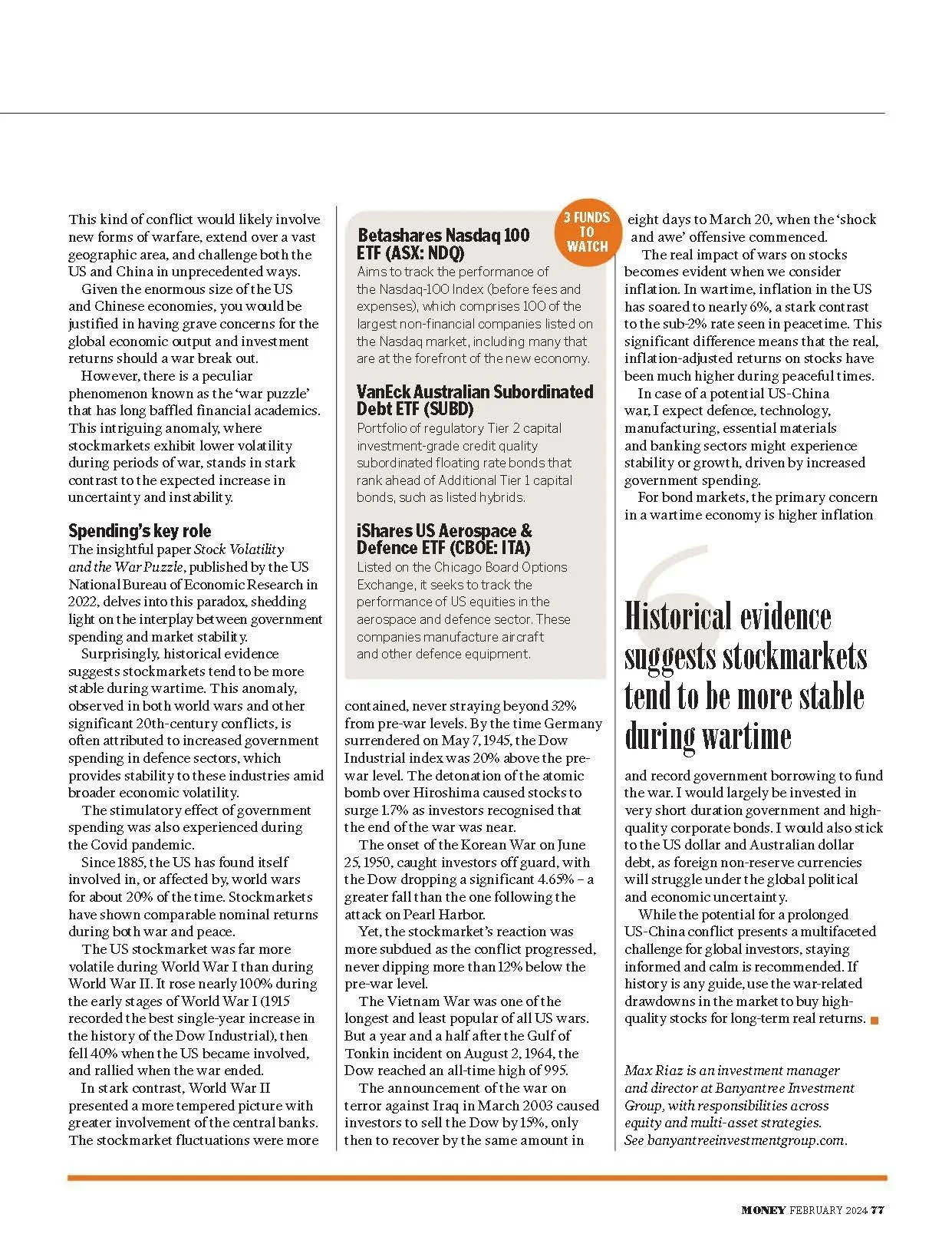
History indicates what might happen to markets in a US-China conflict
As global markets grapple with the rising tensions between the US and China over Taiwan, investors are wondering how to navigate the landscape.
A recent essay in Foreign Affairs magazine titled ‘Preparing for a Long War With China’ offers a crucial perspective on the potential for conflict and its implications for global investment returns (particularly in the US and Australia).
This article aims to provide investors with the possibilities for returns in the context of potential war between China and the US, looking at how markets responded in past wars to help us understand what might happen.
The essay points to the increasing probability of a conflict, particularly given China’s recent military actions in the Indo-Pacific region. Taiwan is underscored as a potential flashpoint, given its strategic and economic significance.
It discusses several possible scenarios, ranging from a swift Chinese conquest of Taiwan to a more extended, conventional war involving a US-led coalition. It also addresses the spectre of nuclear escalation, a concern given both nations’ arsenals, but suggests that historical precedents indicate a restraint in using nuclear weapons.
The analysis points to the likelihood of a protracted conventional war, one that could be less devastating than a nuclear conflict but still exact enormous costs (economic, social and humanitarian).
This kind of conflict would likely involve new forms of warfare, extend over a vast geographic area, and challenge both the US and China in unprecedented ways.
Given the enormous size of the US and Chinese economies, you would be justified in having grave concerns for the global economic output and investment returns should a war break out.
However, there is a peculiar phenomenon known as the ‘war puzzle’ that has long baffled financial academics. This intriguing anomaly, where stockmarkets exhibit lower volatility during periods of war, stands in stark contrast to the expected increase in uncertainty and instability.
Spending’s key role
The insightful paper Stock Volatility and the War Puzzle, published by the US National Bureau of Economic Research in 2022, delves into this paradox, shedding light on the interplay between government spending and market stability.
Surprisingly, historical evidence suggests stockmarkets tend to be more stable during wartime. This anomaly, observed in both world wars and other significant 20th-century conflicts, is often attributed to increased government spending in defence sectors, which provides stability to these industries amid broader economic volatility.
The stimulatory effect of government spending was also experienced during the Covid pandemic.
Since 1885, the US has found itself involved in, or affected by, world wars for about 20% of the time. Stockmarkets have shown comparable nominal returns during both war and peace.
The US stockmarket was far more volatile during World War I than during World War II. It rose nearly 100% during the early stages of World War I (1915 recorded the best single-year increase in the history of the Dow Industrial), then fell 40% when the US became involved, and rallied when the war ended.
In stark contrast, World War II presented a more tempered picture with greater involvement of the central banks. The stockmarket fluctuations were more contained, never straying beyond 32% from pre-war levels. By the time Germany surrendered on May 7, 1945, the Dow Industrial index was 20% above the pre-war level. The detonation of the atomic bomb over Hiroshima caused stocks to surge 1.7% as investors recognised that the end of the war was near.
The onset of the Korean War on June 25, 1950, caught investors off guard, with the Dow dropping a significant 4.65% – a greater fall than the one following the attack on Pearl Harbor.
Yet, the stockmarket’s reaction was more subdued as the conflict progressed, never dipping more than 12% below the pre-war level.
The Vietnam War was one of the longest and least popular of all US wars. But a year and a half after the Gulf of Tonkin incident on August 2, 1964, the Dow reached an all-time high of 995.
The announcement of the war on terror against Iraq in March 2003 caused investors to sell the Dow by 15%, only then to recover by the same amount in eight days to March 20, when the ‘shock and awe’ offensive commenced.
The real impact of wars on stocks becomes evident when we consider inflation. In wartime, inflation in the US has soared to nearly 6%, a stark contrast to the sub-2% rate seen in peacetime. This significant difference means that the real, inflation-adjusted returns on stocks have been much higher during peaceful times.
In case of a potential US-China war, I expect defence, technology, manufacturing, essential materials and banking sectors might experience stability or growth, driven by increased government spending.
For bond markets, the primary concern in a wartime economy is higher inflation and record government borrowing to fund the war. I would largely be invested in very short duration government and high-quality corporate bonds. I would also stick to the US dollar and Australian dollar debt, as foreign non-reserve currencies will struggle under the global political and economic uncertainty.
While the potential for a prolonged US-China conflict presents a multifaceted challenge for global investors, staying informed and calm is recommended. If history is any guide, use the war-related drawdowns in the market to buy high-quality stocks for long-term real returns.
3 funds to watch
Betashares Nasdaq 100 ETF (ASX: NDQ)
Aims to track the performance of the Nasdaq-100 Index (before fees and expenses), which comprises 100 of the largest non-financial companies listed on the Nasdaq market, including many that are at the forefront of the new economy.
VanEck Australian Subordinated Debt ETF (SUBD)
Portfolio of regulatory Tier 2 capital investment-grade credit quality subordinated floating rate bonds that rank ahead of Additional Tier 1 capital bonds, such as listed hybrids.
iShares US Aerospace & Defence ETF (CBOE: ITA)
Listed on the Chicago Board Options Exchange, it seeks to track the performance of US equities in the aerospace and defence sector. These companies manufacture aircraft and other defence equipment.
