
Shocks Don’t Create Fragility. They Reveal It.
Three vulnerabilities preceded the February event: leveraged capital intensity, softening Chinese demand, and an energy complex priced for a stability it no longer had. The shock did not create any of them. It simply changed the lighting.
8 min read | By the team at Banyantree Investment Group
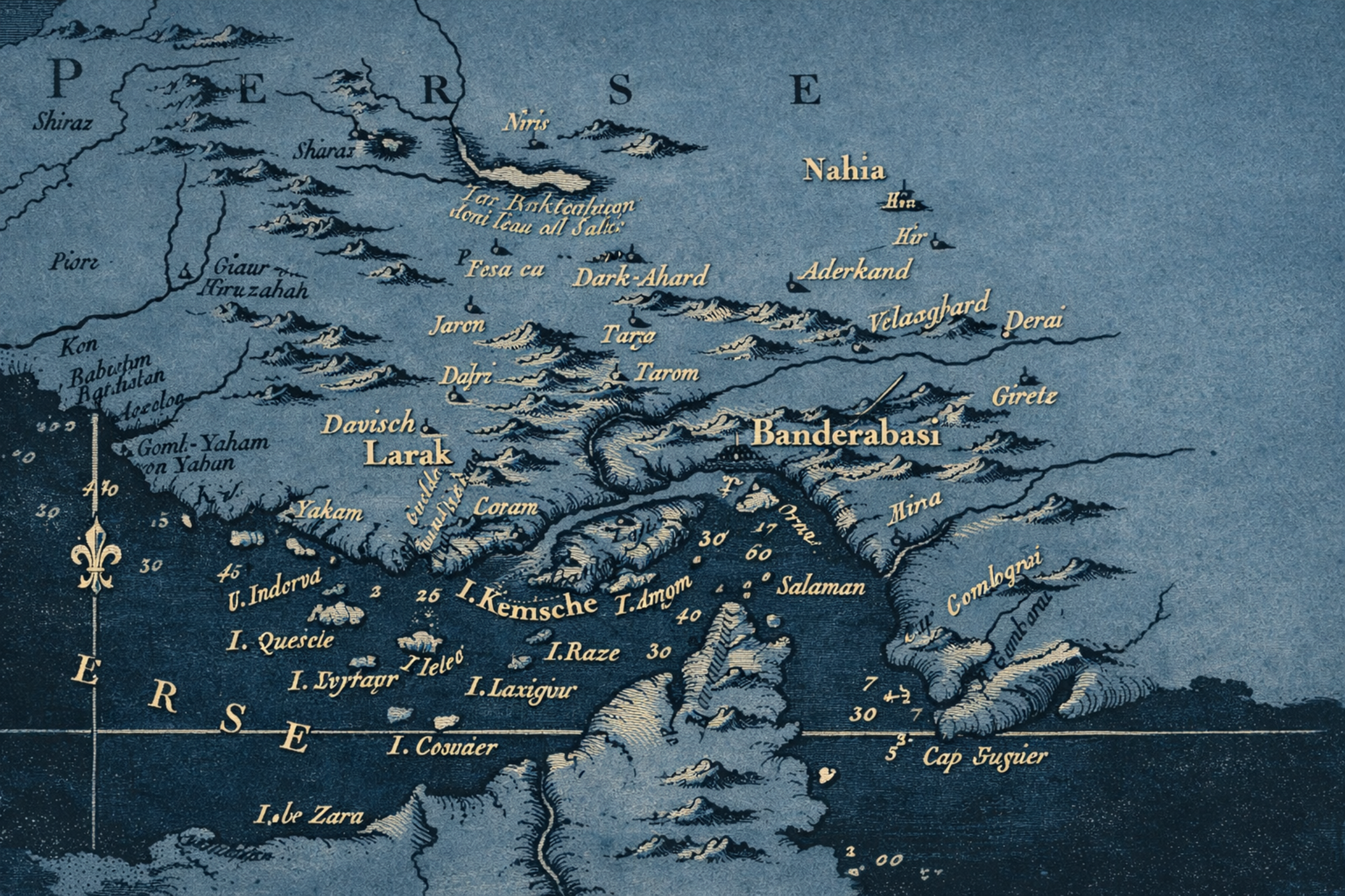
Lines on paper, borders in ink, and a narrow strait through which history keeps passing. Map of the Persian Gulf and Strait of Hormuz. Library of Congress. Cropped, redrawn, and colour-treated.
───
On the morning of 3 February, a Sunday, the news broke across trading desks before anyone had reached the office. The US-Israel strike on Iran had killed Supreme Leader Ali Khamenei. By Monday’s open, the questions were already familiar: one-day story or multi-week disruption? Buy the volatility or wait? What does this do to oil?
These are reasonable questions. They are not the most useful ones.
The most useful question is different: what fragility was already present that this shock is now revealing?
That is the question we want to work through here. Because the answer tells you something far more enduring than any prediction about what happens next in Tehran.
───
Why Geopolitics Rarely Moves Markets for Long: Until It Does
The instinct, when a geopolitical event occurs, is to find a comparable situation in history, observe what markets did, and extrapolate. This instinct is understandable and often wrong.
Markets are not indifferent to geopolitics. But they tend to absorb shocks quickly unless the shock is touching something structural: energy supply, liquidity conditions, or confidence in the kind of systemic stability that financial assets are priced to assume.
The Iran situation is unusual because it touches all three, in sequence.
Start with energy. The concern is not simply that oil prices rise. Oil price spikes happen. What investors should be watching is the nature of this particular risk: it is a disruption risk, not a demand risk. Disruption risks are harder to price because they are asymmetric and non-linear. OPEC’s claims of increased spare capacity are reassuring on paper. They are less reassuring if what you are actually worrying about is Iranian strikes on regional oil infrastructure, shipping lane closures, or cascading damage to the logistics that move a significant share of the world’s oil supply through a narrow body of water.
The key insight is not to predict whether such damage occurs. It is to recognise that when the downside scenario involves infrastructure and logistics, the relevant variable is disruption, not intentions. Leaders can intend to de-escalate. That does not mean they can control what the IRGC does in the hours and days after an assassination. These are different things.
The second transmission channel is confidence. Not the visible, measurable confidence tracked by consumer surveys, but the baseline assumption embedded in asset prices: that the world tomorrow will look roughly like the world today. This assumption is usually safe. It is also the assumption that gets punished most severely when it is wrong. In a market priced for continuity, regime change in a major energy-producing nation, with unclear succession dynamics and the IRGC likely to wield greater near-term influence, is precisely the kind of event that tests that embedded assumption.
───
The Machine That Was Already Humming a Little Too Fast
Before this shock arrived, there was already a story worth telling about where we were in the cycle.
A mid-size data centre operator’s CFO is presenting to his board in early January. The slide showing committed capital expenditure for 2025 and 2026 is the largest the company has ever tabled. The hyperscalers are ordering capacity faster than it can be built. Power purchase agreements are locked in at decade-length terms. The debt is manageable at current rates: the model shows it easily serviced, so long as demand holds and rates do not move significantly higher.
These are rational decisions. That is precisely the point.
We have seen this before. In the late 1990s, fibre-optic networks were being laid under oceans and across continents at a pace that was entirely rational if you believed in the demand forecasts. The demand forecasts were real enough: internet traffic was doubling every few months. What the spreadsheets could not model was too many participants making the same rational bet simultaneously, followed by a moment when financing conditions changed. By 2001, enough dark fibre existed to carry global internet traffic many times over. The companies that had borrowed to build it were insolvent.
We are not making a negative call on artificial intelligence or data infrastructure as long-run themes. The analogy is not about the technology. It is about the capital structure around it. Late-cycle capital intensity combined with leverage is a common feature in the final chapters of investment booms. Not because the underlying theme is wrong, but because the cycle tends to end when exogenous events expose the assumptions baked into the expansion.
A repricing of geopolitical risk is exactly the kind of external force that can pull that thread. Demand does not need to collapse. It only needs to disappoint slightly, or the cost of servicing that leverage needs to rise modestly, for the spreadsheet to start looking different.
───
China: The Marginal Influence Nobody Wants to Talk About
China’s economy expanded five per cent in 2025. The direction of travel matters more than the number.
It matters to the global picture through a specific mechanism: China is the single largest source of marginal demand for the commodity inputs that energy exporters, including those in the Middle East, depend on. When Chinese industrial activity softens, commodity demand softens with it, which compresses the fiscal headroom of the Gulf states, which changes the dynamics of regional geopolitics in ways that are slow to surface in headline data. It is a long chain, but it is a real one.
The numbers right now support caution. Chinese manufacturing PMI has been below 50 for several of the last twelve months. Household consumption remains subdued: retail sales growth in late 2024 was running at roughly half the pre-pandemic trend. The property market continues to weigh on household balance sheets in a way that no amount of incremental stimulus has so far resolved.
The disinflationary pressure that a slower China has been quietly exporting to developed markets has been one of the unacknowledged supports of the post-pandemic disinflation story. If that pressure fades, for whatever combination of domestic stimulus and commodity price shocks, it complicates the path for central banks at precisely the moment they are hoping to thread the needle. Mixed signals are what happen when supply-side inflation and demand-side weakness arrive together. They do not neatly cancel out. They create an environment where policy errors become more likely and market pricing becomes more uncertain.
───
What We Are Actually Doing About This
In periods of elevated uncertainty, there is a temptation to do something dramatic: to position aggressively around a scenario, to make a large call, to demonstrate that you have seen what is coming. We are not doing that.
We are not buying volatility indiscriminately. When genuine uncertainty exists about escalation and succession in a geopolitically sensitive region, volatility is not a buying opportunity by default. Position-driven volatility mean-reverts. Event-driven volatility requires the event to resolve. These are different situations, and treating them the same way is expensive.
We are stress-testing the parts of the portfolio most exposed to the dynamics described above, specifically companies with high capital intensity and leverage in sectors that depend on stable financing conditions and steady demand expectations. The question is not whether the thesis is correct in the long run. It is whether the position can tolerate a scenario where the external environment deteriorates for longer than expected.
We are treating oil not merely as a commodity but as a signal. Oil prices contain information about inflation expectations, policy response functions, and global growth confidence simultaneously. When supply is under threat from geopolitical disruption rather than demand weakness, that signal is worth watching carefully.
We are maintaining liquidity. In an environment where conditions can shift quickly, the ability to move, to rotate, to reduce, to take advantage of dislocations, depends on not having committed all the dry powder when things were calm.
───
What would change our view?
Frameworks are only useful if they are falsifiable.
We would become more constructive if we saw genuine de-escalation: not statements of intent to negotiate, but observable evidence of reduced military activity and stabilising succession dynamics in Iran. We would revise our view on the data centre capex cycle if financing conditions remained benign and demand indicators re-accelerated without a material deterioration in balance sheets. On China, we would want to see manufacturing PMI sustaining above 50 and retail sales growth returning to the pre-pandemic trend, not just policy announcements pointing in that direction.
Until then, we are not reaching for conviction the situation does not yet warrant.
───
The February shock will be absorbed eventually. Markets are remarkably good at moving on.
But the fragilities the shock has illuminated will not disappear when the headlines do. Leveraged capital intensity in a late-cycle investment boom. China’s softening momentum. An energy complex more vulnerable to disruption than pricing had implied.
These are the conditions that existed before the shock arrived. The shock simply changed the lighting.
Our job is not to be the most confident voice in the room about what happens next. It is to understand the landscape clearly enough to avoid being surprised twice: first by the shock, and then by what the shock was pointing at.
───
General information only. Not personal advice. Past performance is not indicative of future performance. This material is intended for wholesale and professional investors.